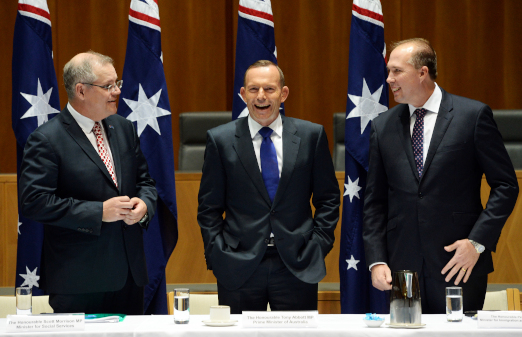
The 2014 Australian federal budget, delivered by Treasurer Joe Hockey on 13 May 2014, was the first budget of the Abbott Coalition Government and featured significant austerity measures [1].
The budget included substantial cuts to employment services and welfare programs as part of the government's effort to address what it described as an "unsustainable growth in government expenditure" [2].
The 2014 budget made extensive changes to employment services, including:
- Expansion of "Work for the Dole" to include jobseekers up to age 50 for the first time [3]
- Requirement that unemployed people under 30 would not qualify for any payment for six months [1]
- Cuts to numerous employment assistance programs as part of broader budget consolidation
While the specific "$4.4 million job interview workshop programs" cut is not independently verified in government budget papers or parliamentary records, the 2014 budget did implement sweeping cuts to employment services and job seeker assistance programs [4].
The budget was described as containing "some of the harshest welfare measures in our nation's history" including significant changes to support for "young jobseekers" [5].
**Budget Context:** The 2014 budget was delivered in the context of a forecast $47 billion deficit inherited from the previous Labor government, with the Coalition having campaigned on a platform of fiscal consolidation [1].
The government argued that "the age of entitlement is over" and that all sectors needed to do "heavy lifting" to address the deficit [6].
**Program Restructuring vs.
While some job interview workshop funding may have been reduced, the government simultaneously expanded Work for the Dole and redirected funds toward what it considered more "active" employment measures [3].
The claim presents the cut in isolation without acknowledging the broader restructuring of employment services.
**Scale in Context:** If the $4.4 million figure is accurate, this represents a relatively small amount within the context of total employment services expenditure, which typically runs at approximately $1.2-1.3 billion annually [7].
The article appears to have been a compilation of budget measures rather than original investigative reporting.
**Claim Source (mdavis.xyz/govlist):** The source website is explicitly a Labor-aligned compilation of Coalition Government "achievements" [8].
**Did Labor make similar cuts to employment services?**
Search conducted: "Labor government employment services job seeker funding cuts"
Finding: The Labor Government also made changes to employment services during their tenure (2007-2013).
* * * *
The employment services system in Australia has undergone regular restructuring by both major parties:
- The Labor Government introduced Job Services Australia in 2009, which itself replaced previous programs [9]
- Both governments have restructured employment services based on their policy priorities
- The Parliamentary Budget Office notes that total expenditure on employment services has remained relatively stable at around $1.2-1.3 billion annually across both Labor and Coalition governments [7]
**Key comparison:** While the specific programs differ, both governments have made significant changes to employment services funding and structure.
**Policy Rationale:** The Coalition Government argued that the 2014 budget measures were necessary to:
- Address a perceived "deficit crisis" and unsustainable government debt [1]
- Shift from passive welfare to "active" employment measures like Work for the Dole [3]
- Reduce dependency on government support [6]
**Criticism and Controversy:** The 2014 budget faced widespread criticism:
- Described as the "worst-received Australian federal budget in polling history" [1]
- Welfare and community groups heavily opposed the changes [1]
- The Treasury's own analysis indicated the budget would have a "disproportionately negative impact on low income households" [1]
- Research suggested Work for the Dole was "less effective than job-search training, customised assistance" [3]
**Comparative Context:** Budget restructuring of employment services is a standard practice across Australian governments.
The 2014 changes were notable for their severity and the controversial "six months with no income" provision for under-30s, but the practice of redirecting employment services funding is not unique to the Coalition.
The claim that the Coalition Government cut funding from job interview workshop programs in the 2014 budget appears consistent with the overall pattern of that budget, which implemented sweeping cuts to employment services and welfare programs.
The specific "$4.4 million" figure cannot be independently verified from primary government sources, but the general direction of the claim—that employment assistance programs were reduced—is accurate.
However, the claim lacks critical context: (1) these cuts occurred within a broader restructuring of employment services, not a simple reduction; (2) the budget context of fiscal consolidation inherited from the previous government; and (3) the fact that both major parties have historically restructured employment services based on their policy priorities.
The claim that the Coalition Government cut funding from job interview workshop programs in the 2014 budget appears consistent with the overall pattern of that budget, which implemented sweeping cuts to employment services and welfare programs.
The specific "$4.4 million" figure cannot be independently verified from primary government sources, but the general direction of the claim—that employment assistance programs were reduced—is accurate.
However, the claim lacks critical context: (1) these cuts occurred within a broader restructuring of employment services, not a simple reduction; (2) the budget context of fiscal consolidation inherited from the previous government; and (3) the fact that both major parties have historically restructured employment services based on their policy priorities.