The core claim contains significant factual inaccuracies regarding what actually occurred in Japan in 2014.
**What Actually Happened:**
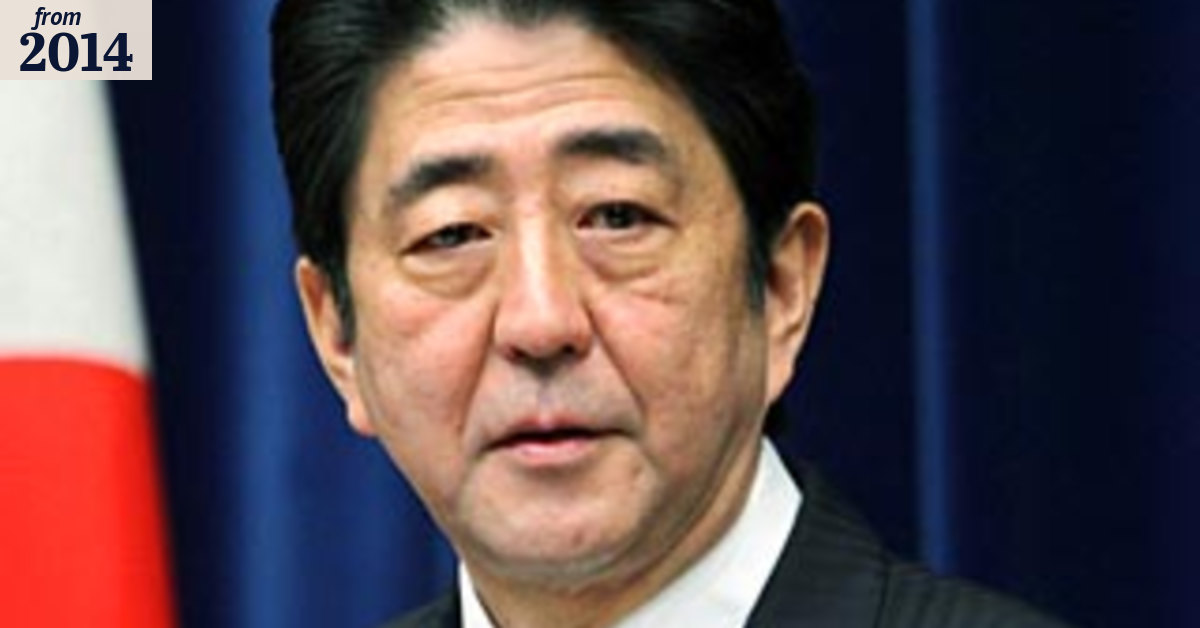
On July 1, 2014, Japanese Prime Minister Shinzo Abe's Cabinet issued a decision "reinterpreting" Article 9 of Japan's 1947 constitution to allow the limited exercise of collective self-defense (CSD) - the UN Charter-sanctioned right to use force to aid an ally under attack [1].
This was a **reinterpretation**, not a constitutional amendment or removal of pacifist elements.
**Australia's Position:**
On May 30, 2014 (prior to Japan's July decision), Australian Defence Minister David Johnston stated at the Shangri-La Dialogue in Singapore that Australia "welcomes Japan's efforts to re-examine its security and defence policies so that it can make a greater contribution to regional peace and security" [2].
**Key Facts About Japan's Actions:**
- **No constitutional amendment occurred**: Article 9 of Japan's constitution remained entirely unchanged in wording.
The Japanese government reinterpreted existing text, not removed it [1].
- **Strict limitations applied**: The reinterpretation allowed collective self-defense only under strict conditions: "for the purpose of ensuring Japan's survival and protecting its people," "to the minimum extent necessary," and only when "there is no other appropriate means available" [3].
- **Not an "offensive military force"**: The Japan Self-Defense Forces (JSDF) remained constitutionally constrained.
Prime Minister Abe explicitly stressed that Japan would "not become caught up in wars in order to defend foreign countries" and that overseas deployment remained restricted [3].
- **Regional context**: The move was widely seen as a response to China's growing assertiveness in the East and South China Seas, North Korea's nuclear capabilities, and the need for Japan to contribute more to regional security alongside allies [4].
As one policy expert noted, "unique, self-imposed conditions appear so strict that the use of force in support of allies or partners outside a defense-of-Japan scenario seems unlikely" [5].
**3.
Regional Security Context**: The decision came amid rising tensions with China over disputed islands in the East China Sea, Chinese assertiveness in the South China Sea, and North Korean nuclear threats.
The article cited is a straight news report by David Wroe, then the SMH's defense and national security correspondent, reporting on official government statements at a major international security forum.
The article presents multiple perspectives, including expert analysis from ANU's Michael Wesley and Lowy Institute's Rory Medcalf, providing balanced context [2].
The SMH article does not support the claim's characterization of Japan "removing pacifist parts" of its constitution - rather, it accurately reports on Australia's support for Japan "re-examining" its security policies.
**Did Labor support similar Australia-Japan defense cooperation?**
Search conducted: "Labor government Australia Japan security policy defense cooperation"
Finding: The Australia-Japan security relationship strengthened under both Labor and Coalition governments.
* * * *
During the Rudd and Gillard Labor governments (2007-2013), Australia and Japan elevated their relationship to a "Strategic Partnership" and deepened defense cooperation [6].
**Key Labor-era developments:**
- The 2007 Joint Declaration on Security Cooperation between Australia and Japan was signed under the Howard government but continued and strengthened under Labor
- Under Labor, Australia and Japan conducted joint military exercises and expanded intelligence sharing
- The 2013 Australian Defense White Paper (released under the Gillard government) emphasized the importance of the Japan relationship
**Bipartisan Consensus**: Australia's support for Japan playing a larger regional security role has been bipartisan.
The Coalition's public endorsement of Japan's 2014 reinterpretation was consistent with this broader bipartisan approach to the Australia-Japan security relationship [6].
Prime Minister Abe explicitly stated Japan would not "become caught up in wars in order to defend foreign countries" [3].
**Legitimate context for Australia's position:**
- **Regional security concerns**: In 2014, China was asserting territorial claims in the East and South China Seas, creating tensions with Japan, Vietnam, Philippines, and others.
Australia viewed Japan's increased security contribution as strengthening regional stability [4].
- **Alliance relationships**: Australia, Japan, and the United States share deep security interests in the Asia-Pacific.
Supporting Japan's ability to assist allies in collective defense aligned with Australia's strategic interests [4].
- **Bipartisan policy**: As noted, both Labor and Coalition governments have consistently supported strengthening Australia-Japan defense ties.
The Coalition's 2014 position was not a departure from established Australian foreign policy [6].
**Counterpoints and criticisms:**
- **Domestic Japanese opposition**: The reinterpretation was controversial in Japan.
Protests occurred, including extreme acts like self-immolation [3].
- **Regional concerns**: China and South Korea expressed concerns about Japan's military normalization, with China depicting it as a blow against the post-WWII international order [4].
- **Historical sensitivities**: Given Japan's WWII history, any military policy change raises legitimate concerns among regional neighbors that experienced Japanese aggression.
**Is this unique to the Coalition?**
No.
The specific 2014 statement supported Japan's policy review, but the broader Australia-Japan security relationship developed under both Labor and Coalition governments.
Japan did not "remove the pacifist parts of their constitution" - it reinterpreted Article 9 through a Cabinet decision while the constitutional text remained unchanged [1].
The characterization of Japan creating an "offensive Japanese military force" overstates the limited nature of the collective self-defense reinterpretation, which maintained strict constraints on JSDF operations [3].
While Australia did support Japan's moves (as reported in the cited SMH article), the claim's framing omits the broader regional security context (China's assertiveness, North Korean threats), the limited scope of Japan's policy change, and the bipartisan nature of Australia's Japan policy.
Japan did not "remove the pacifist parts of their constitution" - it reinterpreted Article 9 through a Cabinet decision while the constitutional text remained unchanged [1].
The characterization of Japan creating an "offensive Japanese military force" overstates the limited nature of the collective self-defense reinterpretation, which maintained strict constraints on JSDF operations [3].
While Australia did support Japan's moves (as reported in the cited SMH article), the claim's framing omits the broader regional security context (China's assertiveness, North Korean threats), the limited scope of Japan's policy change, and the bipartisan nature of Australia's Japan policy.