
The Claim
“Slashed $560,000 from the Refugee Council of Australia.”
Original Sources Provided
✅ FACTUAL VERIFICATION
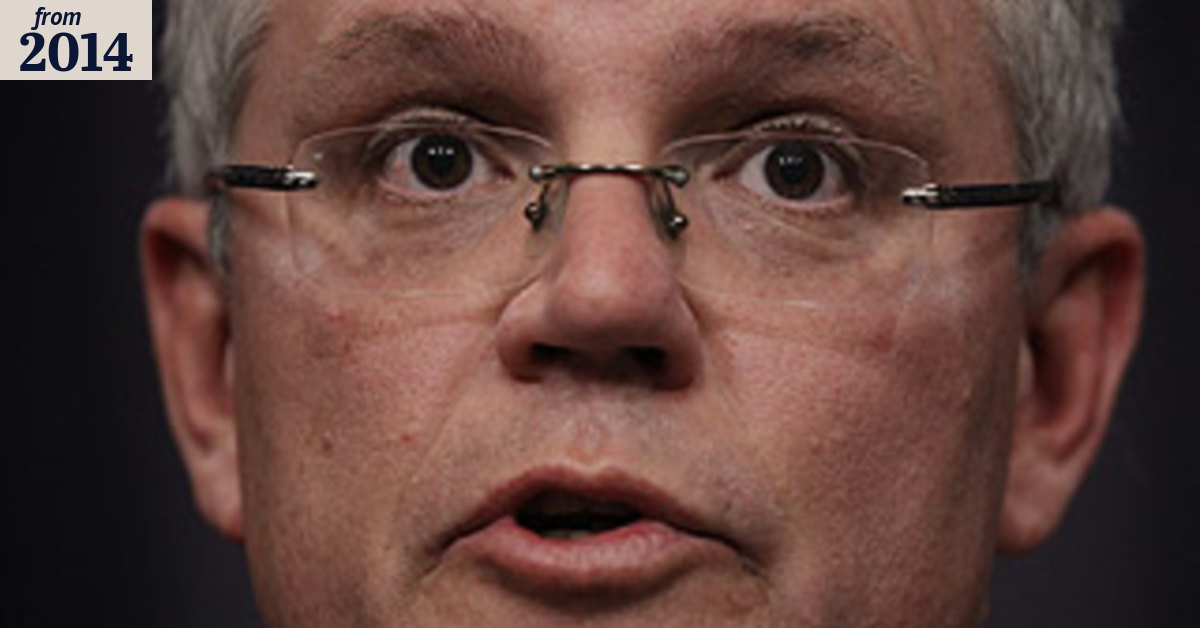
The factual elements of this claim are accurate. In May 2014, Immigration Minister Scott Morrison did personally intervene to cut $560,000 in funding allocated to the Refugee Council of Australia (RCOA) in the federal budget released just weeks earlier on May 13, 2014 [1][2].
The funding consisted of core operational support of $140,000 per year for four years ($560,000 total). This funding had been included in the May 2014 budget but was subsequently removed by Minister Morrison after he became aware of it [1].
Morrison stated publicly: "It's not my view, or the government's view that taxpayer funding should be there for what is effectively an advocacy group... There is freedom of speech but the taxpayer shouldn't have to fund the microphone" [1].
The Refugee Council of Australia, established in 1981, is a peak body representing a network of 185 organizations, 800 individual members, and thousands of supporters [2]. The $140,000 annual grant represented approximately one-quarter of the council's budget [2].
Missing Context
Historical Precedent
The claim omits crucial historical context: this was not the first time the Refugee Council had its core funding cut by a Coalition government. The Howard government withdrew the council's core funding in 2002 following the Tampa affair, and it was only restored when Labor won power in 2007 [1][2]. Morrison explicitly stated he was "returning the funding arrangements to those that were in place under the Howard government" [1].
This establishes a clear partisan pattern regarding funding for refugee advocacy organizations that spans multiple governments.
Budgetary Justification
A spokesperson for Morrison stated the decision was made "in light of the tight fiscal environment and budgetary constraints" [2]. While the $560,000 amount is small in federal budget terms, the government framed this as part of broader fiscal consolidation efforts following their 2013 election victory on a platform of budget repair.
Advocacy vs. Service Delivery Debate
The claim does not acknowledge the substantive policy debate about whether taxpayer funds should support advocacy organizations versus direct service delivery. Morrison's rationale—that government should not fund organizations that primarily advocate against government policy—reflects a longstanding conservative position on NGO funding, not a unique or unprecedented action.
Source Credibility Assessment
Sydney Morning Herald (SMH)
The primary source is the Sydney Morning Herald, a major Australian mainstream newspaper owned by Nine Entertainment Co. SMH is generally regarded as center-left in its editorial stance but maintains professional journalistic standards. The article by Sarah Whyte (former political reporter in the Canberra bureau) presents factual reporting with direct quotes from both Morrison and Refugee Council CEO Paul Power, demonstrating reasonable balance [1].
Credibility: High - Mainstream media outlet with professional standards, though with acknowledged center-left leanings.
Green Left
The second source is Green Left (formerly Green Left Weekly), which describes itself as an "Australian socialist newspaper" and is the de facto newspaper of the Socialist Alliance [3]. According to Media Bias/Fact Check, Green Left "exclusively favor[s] the left" with "moderate use of loaded words" and an explicit mission to serve "anti-capitalist and socialist movements" [3].
Credibility: Low to Medium - Advocacy publication with explicit socialist/anti-capitalist political alignment. Would not be considered a neutral or balanced source.
Labor Comparison
Did Labor do something similar?
Search conducted: "Labor government cuts to advocacy NGO funding" and "Labor government refugee council funding history"
Finding: Labor restored the Refugee Council's funding in 2007 after the Howard government had cut it in 2002 [1][2]. However, Labor governments have also reduced or restructured NGO funding when it aligned with their policy objectives.
More importantly, the Albanese Labor government (2022-present) has been criticized by refugee advocates for maintaining or deepening cuts to asylum seeker support programs. According to the Asylum Seeker Resource Centre, Labor has "continued the Morrison Government's legacy of drastic cuts to social support for people seeking asylum, with a budget decrease of 54% for 2024-2025" [4]. Government funding for the Status Resolution Support Services (SRSS) program shrank from $300 million to $16.4 million over nine years spanning both Coalition and Labor governments [5].
This indicates that while Labor has typically been more supportive of refugee advocacy organizations rhetorically, both major parties have implemented significant cuts to asylum seeker and refugee support funding when in government.
Balanced Perspective
While critics characterized the 2014 funding cut as "petty and vindictive" and an attempt to "silence critics" [2], the government provided a coherent (if contested) rationale based on:
- Precedent: Returning to Howard-era funding arrangements where advocacy NGOs did not receive core government funding
- Principle: The view that taxpayer funds should not support organizations that primarily exist to criticize government policy
- Fiscal consolidation: Contributing to broader budget repair efforts, however symbolically
The Refugee Council's own CEO acknowledged that "the relationship between the refugee sector and government was probably at its lowest point ever" [1], suggesting the funding cut occurred within a broader context of deteriorating relations between the refugee advocacy sector and the Coalition government, rather than being an isolated punitive action.
When compared to the Howard government's complete withdrawal of core funding in 2002, Morrison's action—while significant—was not unprecedented in Coalition refugee policy. Similarly, Labor's more recent continuation of asylum seeker support cuts demonstrates that fiscal constraints and policy priorities often override party rhetoric on refugee issues.
Key context: This was not unique to the Coalition. Both major parties have adjusted refugee advocacy and support funding based on their policy priorities and fiscal constraints. The 2014 cut was consistent with a longer pattern of partisan divergence on refugee advocacy funding.
TRUE
7.0
out of 10
The claim is factually accurate—the Coalition did cut $560,000 from the Refugee Council of Australia in 2014. However, the framing suggests this was a unique or particularly egregious action when in fact:
- It was consistent with Howard government precedent (2002 cut)
- It reflected a principled (if debatable) position about funding advocacy groups
- Labor governments have also made significant cuts to refugee/asylum seeker funding, including continuing Morrison-era cuts
- The amount represented a return to pre-2007 funding arrangements rather than a novel punitive measure
Final Score
7.0
OUT OF 10
TRUE
The claim is factually accurate—the Coalition did cut $560,000 from the Refugee Council of Australia in 2014. However, the framing suggests this was a unique or particularly egregious action when in fact:
- It was consistent with Howard government precedent (2002 cut)
- It reflected a principled (if debatable) position about funding advocacy groups
- Labor governments have also made significant cuts to refugee/asylum seeker funding, including continuing Morrison-era cuts
- The amount represented a return to pre-2007 funding arrangements rather than a novel punitive measure
📚 SOURCES & CITATIONS (6)
-
1
smh.com.au
Immigration Minister Scott Morrison says he didn't know the country's peak refugee body was receiving taxpayer money from his immigration portfolio until after his own government's budget was published, at which point he moved immediately to axe the funding.
The Sydney Morning Herald -
2
thenewdaily.com.au
Thenewdaily Com -
3

mediabiasfactcheck.com
LEFT BIAS These media sources are moderately to strongly biased toward liberal causes through story selection and/or political affiliation. They may
Media Bias/Fact Check -
4
en.wikipedia.org
En Wikipedia
-
5
asrc.org.au
Despite some positives, what was announced in Canberra last night blatantly fails to address the unprecedented demand charities such as ASRC are seeing from people seeking asylum for emergency food support, crisis housing and urgent medical care.
Asylum Seeker Resource Centre -
6

tma.melbourneanglican.org.au
Christian charities say people seeking asylum need better financial support from the federal government.
The Melbourne Anglican
Rating Scale Methodology
1-3: FALSE
Factually incorrect or malicious fabrication.
4-6: PARTIAL
Some truth but context is missing or skewed.
7-9: MOSTLY TRUE
Minor technicalities or phrasing issues.
10: ACCURATE
Perfectly verified and contextually fair.
Methodology: Ratings are determined through cross-referencing official government records, independent fact-checking organizations, and primary source documents.