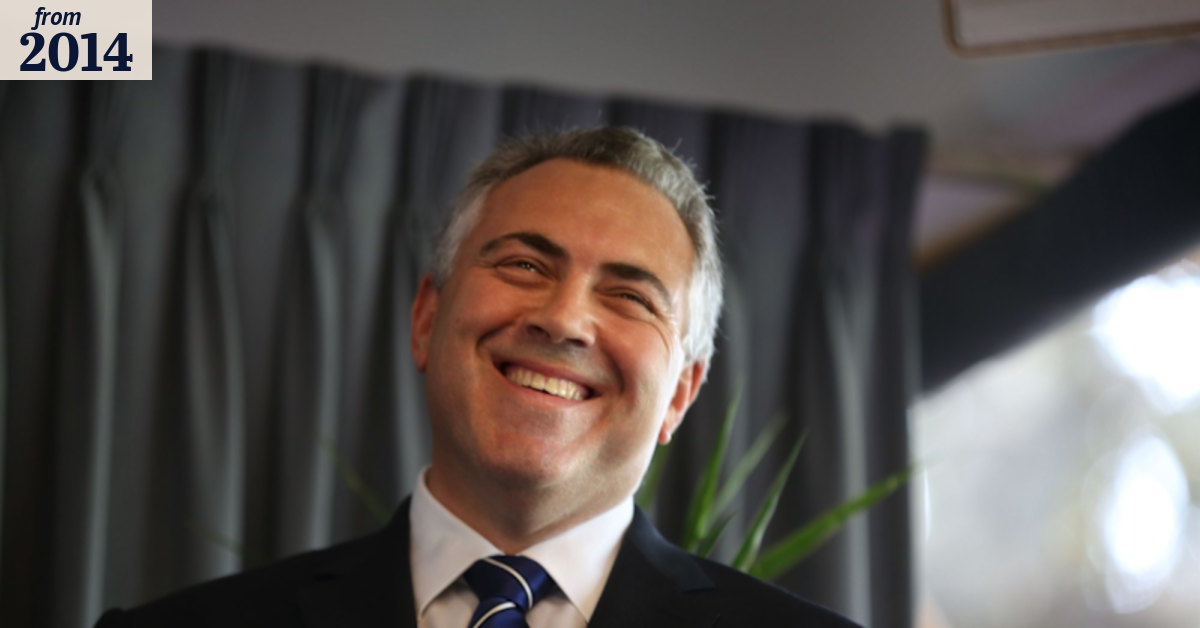
On July 26, 2014, Treasurer Joe Hockey told New Zealand political current affairs program "The Nation" that there was "no crisis at all in the Australian economy" [1].
The fact is you need to move on the budget to fix it now, and you need to undertake structural reform to structure the economy in the years ahead" [1].
The claim omits several important contextual elements:
First, the "no crisis" statement was made in a specific diplomatic context—to reassure New Zealand, Australia's second-largest trading partner, that the Australian economy remained stable despite budget reforms [1].
Second, Hockey explicitly distinguished between immediate economic crisis conditions and longer-term structural budget problems: "There's no crisis at all in the Australian economy... you need to move on the budget to fix it now, and you need to undertake structural reform to structure the economy in the years ahead" [1].
The Reserve Bank of Australia estimated that by 2013, the mining boom had raised real per capita household disposable income by 13% and lowered unemployment by about 1.25 percentage points, but this was ending [3].
**Did Labor make similar "no crisis" statements while campaigning on economic concerns?**
Labor governments under Rudd and Gillard operated through the Global Financial Crisis (2007-2009), a genuine global economic emergency.
* * * *
During this period, the Rudd government moved from a surplus of nearly $20 billion in 2007 to a deficit of about $55 billion by 2010 [4].
In 2012, Treasurer Wayne Swan abandoned the promise of a surplus, declaring that "a temporary pause" in the surplus commitment was necessary due to changed economic circumstances [5].
Labor's largest deficit ($54.5 billion in 2009/10) came immediately after the GFC, representing a response to genuine global economic crisis conditions [7].
By contrast, the Coalition's "budget emergency" messaging came during a period of 23 consecutive years of Australian economic growth [1].
**Comparative analysis:**
- Labor campaigned on fiscal responsibility while delivering deficits (GFC context)
- Coalition campaigned on "budget emergency" while economy grew 23 consecutive years
- Hockey's statement acknowledged no immediate crisis while arguing for preventive structural reform
The claim captures a genuine political messaging inconsistency: the Coalition did campaign heavily on debt and deficit concerns in 2013, using language like "budget emergency," while Hockey later acknowledged the economy itself was not in crisis.
However, there is an important distinction between "economic crisis" (recession, high unemployment, collapse) and "structural budget problems" (long-term deficits, unsustainable spending trajectories).
Hockey's statement attempted to make this distinction—arguing that while the economy was performing well (23 years of growth), structural reforms were needed to maintain that performance [1].
The "budget emergency" framing was therefore arguably hyperbolic from an international comparative perspective, even if the Coalition genuinely believed structural action was needed.
Labor's deficits came during the GFC—a genuine global crisis—while the Coalition's "emergency" language came during relative economic stability, making the contrast more politically pointed.
**Key context:** This is not unique to the Coalition.
Australian governments of both persuasions have campaigned on fiscal discipline messaging and then moderated that language when describing actual economic conditions to trading partners or international audiences.
Joe Hockey did state there was "no crisis at all in the Australian economy" in July 2014 [1], and the Coalition had campaigned heavily on debt, deficit, and "budget emergency" messaging during the 2013 election [2].
Joe Hockey did state there was "no crisis at all in the Australian economy" in July 2014 [1], and the Coalition had campaigned heavily on debt, deficit, and "budget emergency" messaging during the 2013 election [2].