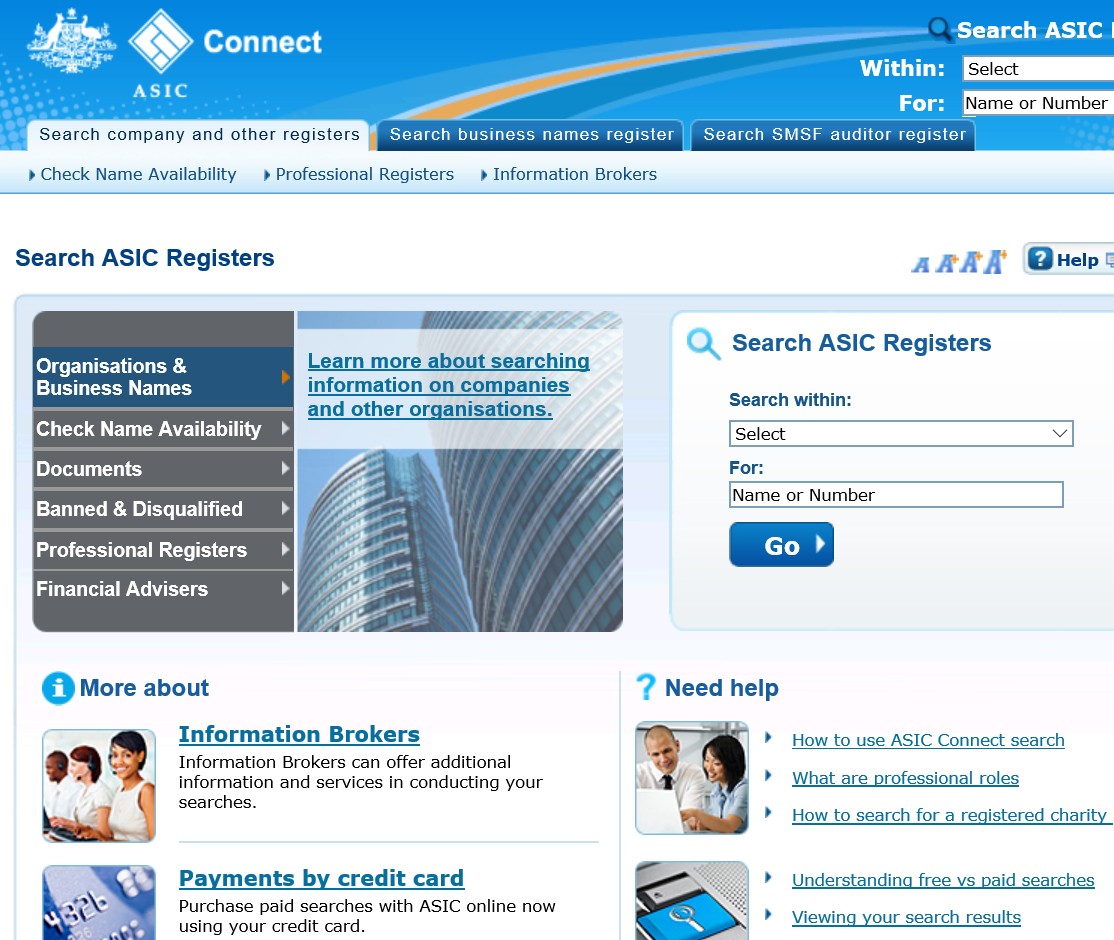
The Abbott government announced plans in its 2015-16 budget to undertake a competitive tender process for ASIC's registry business, with the Turnbull government pushing ahead with those plans [1].
The ASIC corporate registry is indeed a critical database containing information on more than two million companies in Australia, including business names, histories, financial records and backgrounds of directors [1].
By September 2016, 84 journalists signed an open letter opposing the privatization, stating that "The charges levied by your government to access these public records are already some of the highest in the world" [2].
However, the available evidence does not clearly establish what ultimately happened to this tender process after August 2016 or whether the privatization was actually implemented.
Several important pieces of context are absent from this claim:
**The proposal's rationale:** The claim does not mention that the government's rationale for privatization was that it believed the registry "would be better run in private hands" with improved software upgrades [1].
The government stated it would retain ownership of the data, with only the software operations being privatized [1].
**ASIC's own position:** The claim omits that Greg Medcraft, the ASIC chairman at the time, supported the privatization proposal [1].
This suggests institutional support from the regulator itself, not just government imposition.
**Comparative international context:** While the claim suggests privatization would be unique to Australia, it doesn't note that the letter from journalists mentioned "In New Zealand and the United Kingdom, this critical public information is free" [2], indicating that other countries had different access models but not necessarily that privatization was uniquely problematic.
**Actual vs. proposed costs:** The claim states costs "would increase" (future tense) but the actual outcome of the privatization proposal—whether it was implemented, abandoned, or modified—is not clearly established in available sources.
**Law enforcement use:** The claim focuses on journalist access but omits that law enforcement agencies such as the Fair Work Ombudsman and Australian Tax Office relied on ASIC's register for identifying company ownership and location [1].
The original sources provided show mixed credibility:
**Guardian Australia source [1]:** The Guardian is a mainstream, established news organization with a generally reliable reporting record.
However, the article covers an inherently contested political issue and reflects concerns raised by activists and civil society groups rather than providing government justification for the proposal equally.
**ASIC regulatory guide [2]:** This is a technical regulatory document on derivative transaction reporting, which appears to be cited but may not directly address the privatization issue substantively.
**CPA Australia archive [3]:** The archived CPA Australia page on ASIC industry funding is a credible industry source, though accessing archived content from 2019 limits evaluation of how current this information is.
The claim itself relies heavily on advocacy positions from GetUp (a "leftwing activist group" per The Guardian) and activist campaigns, which are politically motivated actors with clear opposition to privatization.
**Did Labor do something similar?**
Search conducted: "Labor government ASIC policy database access transparency"
The available research does not reveal evidence of Labor proposing or implementing ASIC database privatization during their 2007-2013 period in government.
However, the historical record regarding Labor's approach to ASIC database access and fees during their tenure is not clearly documented in the sources available.
Journalists and civil society organizations genuinely documented that Australia's fees for accessing corporate data were among the highest in the world, creating barriers to investigating corporate wrongdoing [1][2].
If a for-profit private operator took control, the commercial incentive would be to maximize revenue through higher fees, potentially further restricting access for journalists, academics, and civil society organizations with limited budgets [2].
The concern about reduced corporate transparency and accountability is legitimate—media investigations into corporate tax avoidance, money laundering, and financial crime genuinely rely on accessible corporate registry data [1].
The Panama Papers scandal (discussed in the context of this debate) demonstrated that shell company registration and concealment is a real problem requiring strong information access [1].
**The government's perspective:** The government's stated rationale was efficiency and better service.
The government indicated it would retain data ownership while privatizing operations, and the ASIC chairman himself supported the approach [1], suggesting institutional confidence that privatization would improve service delivery rather than degrade it.
The goal of competitive tendering is typically to drive efficiency gains.
**The critical unknown:** The most significant gap in this analysis is that the ultimate outcome of the 2016 tender process is not clearly documented.
This is crucial context for assessing whether the stated concern materialized or whether the political pressure successfully prevented implementation.
**Complexity:** This represents a genuine policy tension between:
- Government efficiency goals (competitive tendering, private sector efficiency)
- Public access and transparency values (free or low-cost access to corporate data)
- Regulator expertise (ASIC chairman's support vs. civil society opposition)
This is not a straightforward case of government misconduct, but rather a legitimate policy disagreement between those prioritizing operational efficiency and those prioritizing public access to information.
However, the claim is incomplete in several critical ways:
1. **Outcome unestablished:** The claim states costs "would increase" but doesn't clarify whether this privatization was actually implemented or abandoned.
This is essential to assessing whether the feared outcome actually materialized.
2. **Context missing:** The claim omits that the ASIC chairman himself supported the proposal [1], that the government intended to retain data ownership [1], and that the government's rationale was operational efficiency rather than purely ideological privatization.
3. **Attribution incomplete:** While presented as a unilateral Coalition attack on transparency, the proposal originated in the Abbott government's budget and was continued by Turnbull's government, representing continuity of a specific policy approach rather than a sudden departure from established practice.
The core factual claim about the privatization attempt is accurate, and the concerns about increased journalist costs in a privatized regime are plausible.
However, the claim omits critical context about government reasoning, ASIC's own position, and most importantly, whether the privatization actually occurred.
However, the claim is incomplete in several critical ways:
1. **Outcome unestablished:** The claim states costs "would increase" but doesn't clarify whether this privatization was actually implemented or abandoned.
This is essential to assessing whether the feared outcome actually materialized.
2. **Context missing:** The claim omits that the ASIC chairman himself supported the proposal [1], that the government intended to retain data ownership [1], and that the government's rationale was operational efficiency rather than purely ideological privatization.
3. **Attribution incomplete:** While presented as a unilateral Coalition attack on transparency, the proposal originated in the Abbott government's budget and was continued by Turnbull's government, representing continuity of a specific policy approach rather than a sudden departure from established practice.
The core factual claim about the privatization attempt is accurate, and the concerns about increased journalist costs in a privatized regime are plausible.
However, the claim omits critical context about government reasoning, ASIC's own position, and most importantly, whether the privatization actually occurred.