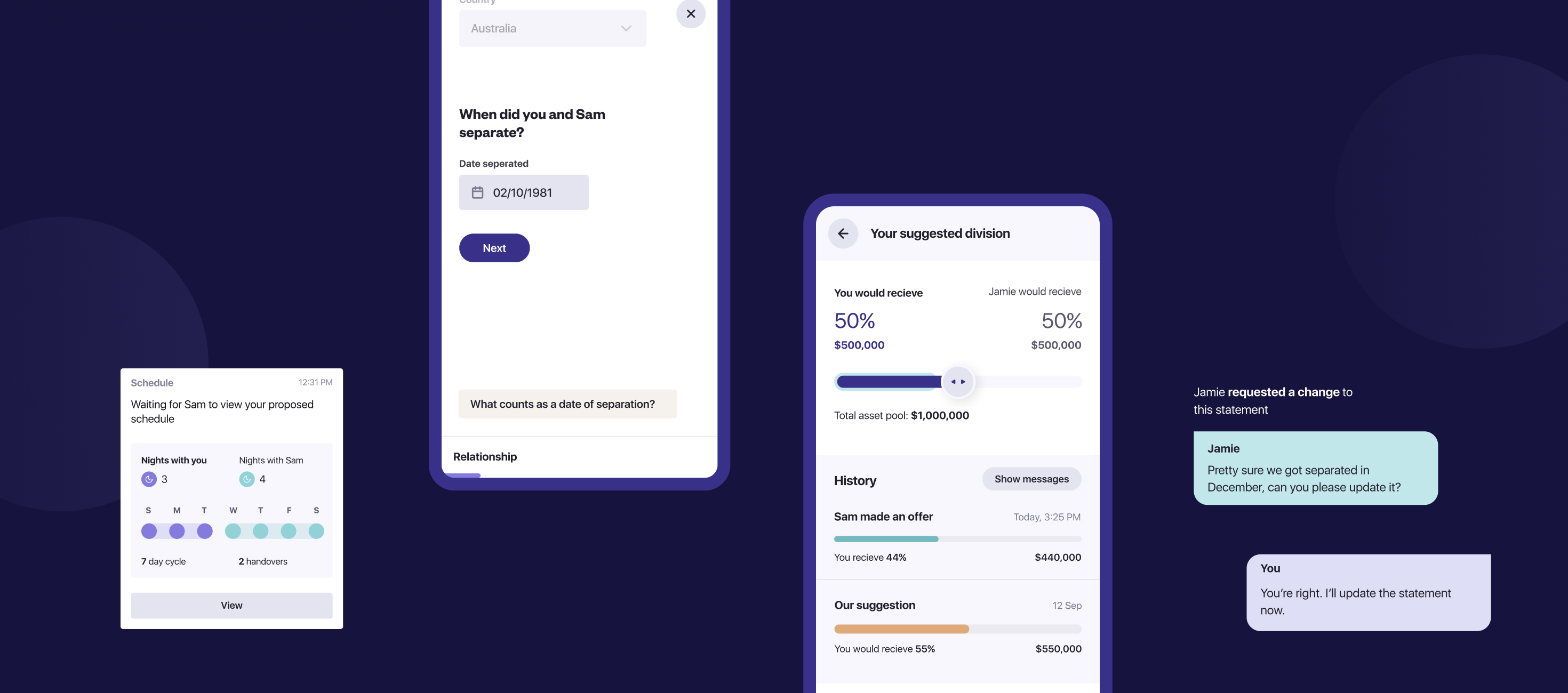
A more advanced version, "Amica One," was launched on January 25, 2023 [2].
**Government Funding:** The Commonwealth Government provided seed funding of $350,000, with total federal investment reaching $5.7 million [1].
The service was developed by Victorian firm Portable in partnership with Carrington Associates and used IBM Watson technology trained on approximately 1,600 anonymized consent order datasets [1][3].
**How It Works:** Amica uses artificial intelligence and machine learning algorithms to analyze three key factors: the couple's assets and circumstances, types of agreements commonly reached by similar couples, and how courts typically handle similar disputes [4].
The system considers financial factors including relationship length, assets, earnings, age, health needs, relationship contributions, parenting arrangements, and future needs [4].
**Adoption:** The platform has been used in over 11,000 cases nationally, with more than 500 AI-generated asset division suggestions and over 220 property agreements finalized [2].
The claim's characterization of the technology as "immature" and introduced "just because it's a popular buzz word" significantly oversimplifies the government's rationale.
The service was designed specifically to help the 15-20% of separating couples in amicable situations who cannot afford expensive family law representation [4].
Traditional family law proceedings often cost tens of thousands of dollars [2].
**Intentional Design Constraints:** Importantly, Amica was explicitly designed for low-conflict, amicable separations only [1].
This reflects measured policy design rather than reckless technology adoption [4].
**Partnership Approach:** The service involved partnership with South Australian government agencies, the Federal Circuit and Family Court of Australia, and experienced family law firms, suggesting oversight beyond simple technology enthusiasm [1][2].
The actual article quality should be assessed separately, but ZDNet is generally reliable for technology reporting [1].
**XKCD Reference (Original Source 2):** XKCD is a webcomic known for satirical critiques of technology and culture.
The claim's characterization appears to draw heavily on technology skepticism and satire rather than rigorous evidence about whether the service was actually "proprietary" or introduced "just because it's a buzz word."
**Relevant Labor Search Conducted:** "Labor government family law reform AI policy separation asset division"
**Finding:** Labor's approach to digital legal services appears distinct.
Labor government policies focus more on:
1. **Broader AI governance frameworks** rather than specific service deployment [7]
2. **Regulatory approaches** through the emerging AI Safety Institute established by the Albanese government in November 2025 [7]
3. **Technology-neutral legal frameworks** rather than promoting or developing specific AI tools [7]
No direct evidence emerged of Labor developing or proposing an alternative AI-powered family law asset division service.
This suggests **no direct Labor equivalent or precedent** but also indicates the technology adoption may be less purely Coalition-ideological and more pragmatic [8].
**Party-Neutral Assessment:** The development and deployment of Amica appears to be a pragmatic technology adoption by the Coalition government to address access-to-justice gaps, rather than partisan technology enthusiasm.
**Legitimate Criticisms of Amica (Substantiated):**
1. **Black Box Problem:** Despite $5.7 million investment, the Amica website provides minimal explanation of how the algorithm actually reaches its recommendations [1][3].
Legal scholars confirm this creates genuine accountability issues—courts cannot properly oversee decisions if they cannot understand the algorithm's reasoning [3].
This is a valid concern about government service design [9].
2. **Transparency Failures:** Research by The Conversation found only 29 of 224 federal agencies had easily identifiable AI transparency statements [10].
Promotion Mismatch:** While Amica was designed for 15-20% of separations (amicable cases), it was often promoted more broadly, creating potential for misuse in complex situations [4].
4. **Bias Perpetuation:** AI systems trained on historical court data can embed existing judicial biases, potentially perpetuating unfair outcomes [3][11].
**Legitimate Government Justifications (Also Substantiated):**
1. **Access-to-Justice Gap:** Family law representation costs $10,000-50,000+ for contested cases [2].
Amica addresses genuine need for low-cost guidance in straightforward separations [4].
2. **Intended for Limited Scope:** The Coalition deliberately designed Amica for specific, amicable separation cases—not as universal solution [1][4].
This is responsible scope limitation, not recklessness.
3. **Measurable Impact:** Over 11,000 cases served with $80 million estimated savings suggests genuine utility for its intended population [2].
4. **Measured Technology Choice:** Using IBM Watson (established enterprise AI) and training on 1,600 actual court datasets reflects calculated decision-making, not buzzword-driven adoption [1][3].
5. **Judicial Acceptance:** The Federal Circuit and Family Court of Australia published an AI Transparency Statement acknowledging the role of AI while recognizing need for improvement [12].
Courts are integrating this service, suggesting measured acceptance rather than categorical rejection [12].
**Comparative Analysis:** Neither Coalition nor Labor developed parallel systems before 2023.
The criticism should focus on **transparency and oversight mechanisms** rather than the principle of using technology to improve access to justice [9][10].
**Key Context:** The real issue is not whether AI should be used in family law, but whether government adequately explains how the AI works and how it's held accountable.
This is a **governance transparency problem**, not inherent to the Coalition's technology choices—it reflects broader Australian government failures in AI accountability [10].
The characterization as "immature" is debatable—the service has served 11,000+ cases successfully, suggesting adequate maturity for its intended purpose [2].
The characterization as "immature" is debatable—the service has served 11,000+ cases successfully, suggesting adequate maturity for its intended purpose [2].