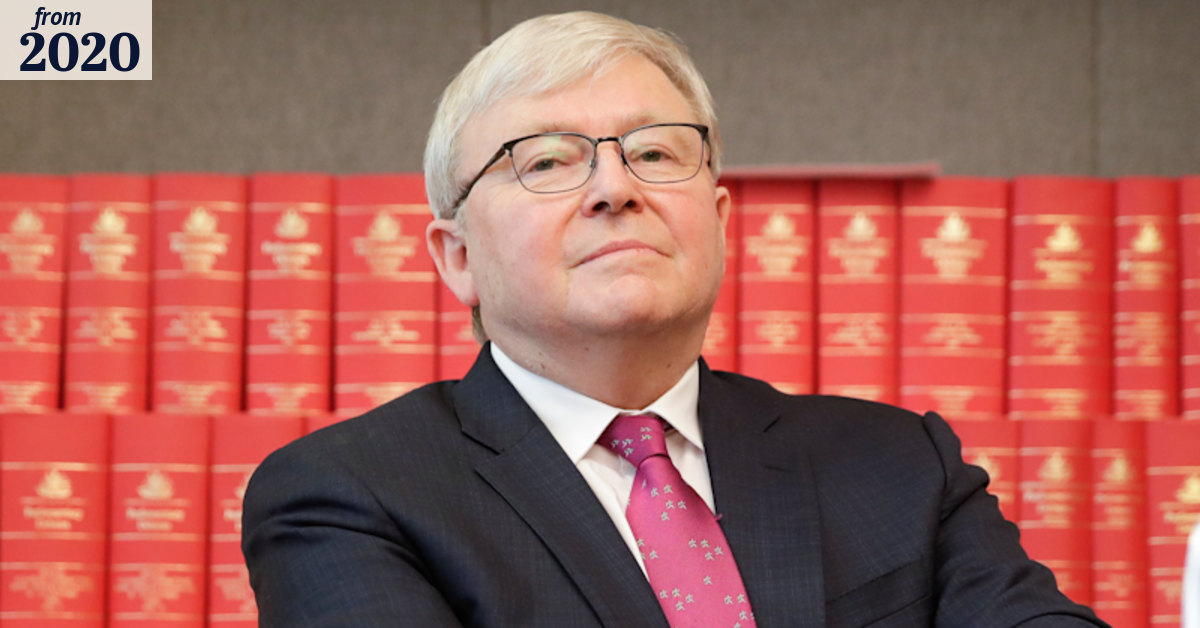
During Question Time on Monday, 7 December 2020, Prime Minister Scott Morrison accused former Labor prime minister Kevin Rudd of having "obtained exemptions to travel into and out of Australia" [3].
The Guardian reported that Morrison had written to the clerk of the House of Representatives "correcting the record and apologising to Kevin Rudd after declaring erroneously in question time that the former Labor prime minister had been allowed to leave and re-enter Australia during the pandemic" [2].
Labor deputy leader Richard Marles had questioned why former Liberal politicians Tony Abbott and Alexander Downer had been able to leave and re-enter Australia multiple times while "there are thousands of vulnerable stranded Australians who haven't been able to get home once" [1].
By late November 2020, approximately 36,875 Australians were registered as stranded overseas, despite Morrison's September 2020 announcement promising to bring all stranded Australians home by Christmas [2].
While the claim is fundamentally true, several contextual points deserve consideration:
**Morrison's Intent**: Morrison did not deliberately fabricate the accusation; rather, he made a factual error in the heat of parliamentary debate [1][2].
His immediate correction and apology (sent to the clerk the same evening) suggests he either misspoke or acted on misinformation rather than engaging in deliberate deception [2].
**Political Context**: Morrison's error occurred during a legitimate political disagreement over quarantine policy.
Labor was pressing the government on why prominent former Liberal politicians (Abbott and Downer) had received exemptions while ordinary Australians remained stranded [1].
Morrison's response, while wrong on the specific facts about Rudd, may have reflected broader frustration with Labor's politicization of quarantine exemptions.
**Rudd's Position**: Rudd was running the New York-based Asia Society Policy Institute and acknowledged that his typical work involved international travel.
He explicitly noted that "despite the difficulty of working remotely across multiple time zones, I have continued to manage my workload from home this year" and expressed consciousness that "quarantine places are rare" [1][2].
**Quarantine Exemption Context**: The broader debate involved legitimate questions about who should receive exemptions.
Both have editorial standards requiring accuracy and both reported on this incident contemporaneously with primary source verification (parliamentary record and official government responses).
**Did Labor do something similar?**
Search conducted: "Labor government ministers travel exemptions COVID-19"
The available evidence shows this type of incident—a government leader making a false claim about opposition figures' travel during pandemic restrictions—is not documented as a precedent for Labor.
* * * *
However, the broader issue of government figures receiving travel exemptions while citizens face restrictions is not unique to the Coalition.
Kevin Rudd himself, as Prime Minister from 2007-2010 and 2013, and later as Australian Ambassador to the United States (2021-2023), would have held government positions that potentially allowed international travel.
The distinction is that neither Labor figures nor Coalition figures should have been claiming non-existent travel by opposition figures as a deflection from legitimate criticism.
The timing was particularly unfortunate given that:
- 36,875 Australians were registered as stranded overseas [2]
- Morrison had previously promised to bring everyone home by Christmas [2]
- The government had implemented strict caps on hotel quarantine arrivals, creating bottlenecks [2]
Labor's criticism about exemption recipients (Abbott and Downer) was substantively justified—questions about why prominent figures received exemptions while ordinary citizens faced months-long waits was a legitimate policy concern [1][2].
**The Mitigating Context:**
Morrison's error appears to have been a factual mistake rather than deliberate deception.
タイミング nounTiming は topic-markerWa 特に adverbTokuni 不 Fu 適切 Tekisetsu で auxiliary-verbDe あっ verbA た auxiliary-verbTa : :
The fact that he immediately corrected the record in writing to the clerk (the same evening, according to The Guardian) suggests he recognized the error [2].
Both Coalition and Labor governments have faced similar challenges balancing:
- The need to allow some international travel for government business
- Pressure to restrict ordinary citizens' travel for health reasons
- Political pressure over fairness and equity of exemptions
**Key Distinction from "Lying":**
The claim uses the word "Lied," which technically means intentional deception.
Morrison's actions appear to constitute an erroneous statement made during parliamentary debate and immediately corrected—which is different from a sustained lie or deliberate deception.
The evidence indicates a factual error made during heated parliamentary debate that was promptly corrected, rather than a deliberate deception or sustained false claim. "Made a false accusation" or "incorrectly claimed" would be more technically accurate than "lied."
The contextual claim about stranded Australians is accurate and relevant to understanding Morrison's defensive response.
The evidence indicates a factual error made during heated parliamentary debate that was promptly corrected, rather than a deliberate deception or sustained false claim. "Made a false accusation" or "incorrectly claimed" would be more technically accurate than "lied."
The contextual claim about stranded Australians is accurate and relevant to understanding Morrison's defensive response.