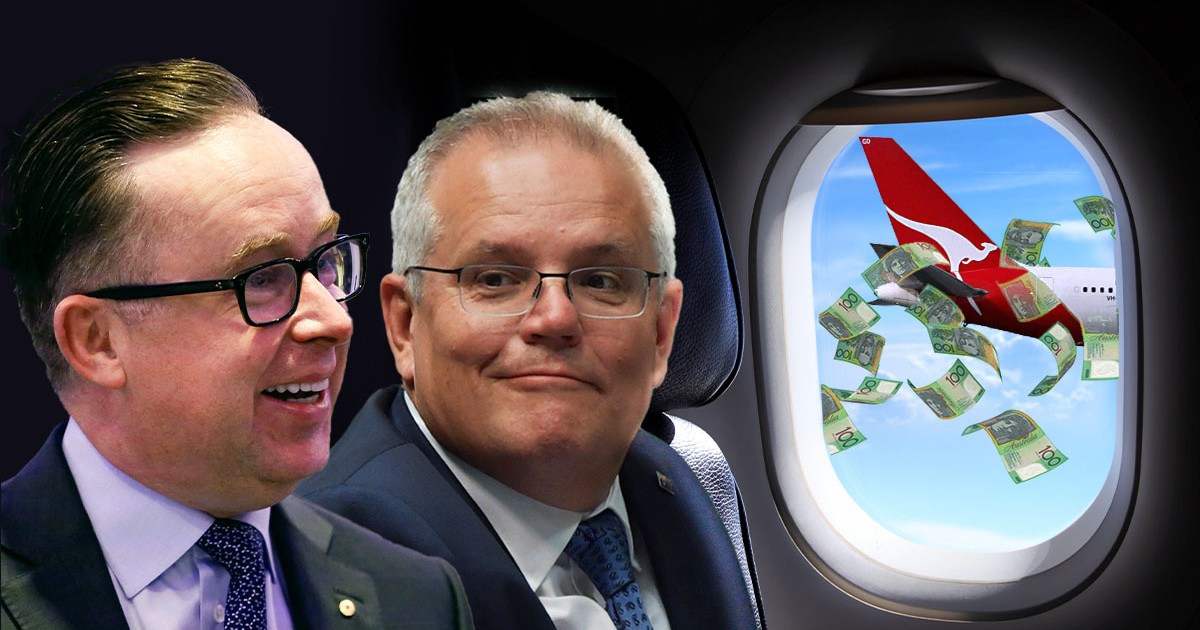
The claim contains elements of truth but requires significant clarification regarding the scope and nature of government support.
**Total Support Amount:** Qantas did receive substantial government support totaling approximately $1.2-1.34 billion [1], though this figure includes multiple components.
The Australian Government's Aviation Support Package announced in March 2021 was a $1.2 billion industry-wide package [2], with Qantas receiving the majority of this support [1].
According to The New Daily reporting, this support included "more than $1.2 billion in direct payments, waived charges and underwritten flights" [1].
**Package Components:** The Aviation Support Package consisted of several elements, not purely direct cash payments [3]:
- Refunding and ongoing waiving of aviation fuel excise
- Waiving of Airservices Australia charges on domestic airline operations
- Waiving of domestic and regional aviation security charges
- Half-price airfare subsidies for regional tourism routes ($800,000 airfares subsidized across 13 regions) [2]
- Support for maintaining regional routes [2]
The package was explicitly framed by the government as supporting tourism recovery and maintaining regional aviation connectivity [4], not solely as direct business support.
**JobKeeper Component:** Qantas received $726 million in JobKeeper wage subsidy payments [1].
JobKeeper was a broader government program applying to all eligible businesses, not a Qantas-specific payment.
**Redundancy Costs:** The claim that "Qantas spent most of that paying redundancy packages" is partially supported.
**When the redundancies occurred:** Qantas announced its 6,000-8,500 job cuts in June-July 2020, before the Aviation Support Package was announced in March 2021 [5].
The claim suggests government support was diverted to redundancies, but the redundancies were announced and largely executed during 2020 before the support package was finalized.
**Source of redundancy funding:** The $890 million in redundancy costs came from Qantas's own balance sheet and operations, not directly from the government support package.
While the government support may have indirectly enabled these costs, the causal claim "Qantas spent most of that paying redundancy packages" misrepresents the financial flows.
**Ongoing wage subsidies:** JobKeeper was designed to subsidize wages for retained employees to prevent layoffs.
The High Court rejected a union challenge to this practice in June 2021 [6].
**Illegal sacking incident:** Qantas made 1,820 ground staff redundant in 2020 through outsourcing, which was later found to be illegal by the Federal Court in 2024 [7].
This provides context for the claim that jobs were being cut despite government support, though it also shows these redundancies had significant legal consequences.
**Post-support outcomes:** Despite receiving the support, Qantas continued cost-cutting measures.
In 2021, Qantas outsourced 1,700 ground handling jobs, claiming it would save $100 million annually, but this decision was challenged and found to be unlawful [8].
The articles cited do reference actual financial figures (Qantas's disclosed redundancy costs and JobKeeper payments), but the framing emphasizes the negative juxtaposition: "QantasKeeper" is a headline designed to mock the program rather than provide neutral analysis.
**Headline vs. substance:** The New Daily headlines are provocative ("QantasKeeper: The government has given $1.3 billion to national carrier") but the underlying articles do contain factual reporting of Qantas's own financial disclosures [1].
**Missing balance:** The original sources don't explain:
- The package's intended purpose (regional aviation and tourism support)
- Why the government viewed this as necessary policy
- That the redundancies preceded the support package
- That the support included structural waivers, not just direct payments
**Did Labor do something similar?**
Search conducted: "Labor government airline subsidies Virgin Australia stimulus support"
**Virgin Australia bailout (2020):** During the same COVID-19 crisis, the Labor-Opposition actually requested a $1.4 billion loan from the Morrison Government, which was rejected by the Coalition [10].
* * * *
Subsequently, Virgin Australia went into voluntary administration in April 2020.
Labor had advocated for supporting airlines, and the Coalition chose not to rescue Virgin Australia while providing support to Qantas and other carriers through the Aviation Support Package.
**Historical airline support:** Australia has a history of government support for airlines across political administrations.
The Essential Air Service program, providing subsidies for rural aviation routes, predates the Coalition government and has bipartisan support [11].
**Different approach to Qantas:** The Coalition's approach to Qantas was indirect (waived charges, fuel excise relief, wage subsidies through JobKeeper) rather than direct equity investment or loans.
Labor had proposed more direct intervention with Virgin Australia.
**Finding:** While Labor advocated for direct airline bailouts (notably Virgin Australia), they were not in government during COVID-19.
The Coalition's Aviation Support Package was structured differently—through industry-wide waivers and wage subsidies rather than targeted equity investment or loans.
**Government's stated rationale:** The Morrison Government framed the $1.2 billion Aviation Support Package primarily as economic stimulus supporting tourism and regional connectivity [4].
Scott Morrison stated: "Australia's airlines, hotels and caravan parks, restaurants and bars, travel agents and tourism operators are set for a rush of hundreds of thousands of tourists as part of a new $1.2 billion support package" [4].
The package included 800,000 half-price airfares to regional destinations, explicitly designed to stimulate domestic tourism and support regional economies [2].
**Context of support:** This decision occurred during unprecedented pandemic disruption.
The government's view was that maintaining airline viability was essential to maintaining travel infrastructure and tourism-dependent regional economies.
**The redundancy issue - complexity:** While the claim that Qantas "spent most of that paying redundancy packages" is technically inaccurate regarding cause-and-effect, it's true that:
1.
The company received an additional $1.2 billion in industry support (though industry-wide) [2]
This creates a legitimate criticism: the company was cutting jobs while receiving taxpayer subsidies intended to preserve employment.
However, context matters:
- **JobKeeper was employer-employee neutral:** The scheme was designed to preserve employment relationships by subsidizing wages.
Employers technically could still make redundancies (the scheme didn't prevent it) [12]
- **Redundancies preceded the package:** The major redundancies were announced in June 2020; the Aviation Support Package came March 2021
- **Industry-wide support:** Much of the $1.2 billion support was industry-wide (fuel excise waiver, Airservices charges waiver) benefiting all airlines, not Qantas specifically
- **Regional subsidy component:** The half-price flights were government-funded tourism stimulus, not company bailouts
**Scale comparison:** Qantas received approximately $726 million in JobKeeper (which it claimed for 5,000 retained staff) [1].
This was less than the $890 million spent on redundancy packages [1], suggesting the company absorbed significant costs from its own resources.
**Post-support conduct:** A material criticism is that despite receiving substantial support, Qantas continued aggressive cost-cutting.
The illegal sacking of 1,820 ground staff in 2020 and subsequent outsourcing of 1,700 ground handlers in 2021 (which was found unlawful) suggests the company pursued aggressive restructuring beyond what was necessitated by pandemic conditions [7][8].
**Key context:** The Aviation Support Package was not a Qantas-specific bailout but an industry-wide measure.
However, Qantas did receive the majority of benefits, and the company's simultaneous redundancy program during a period of taxpayer support raises legitimate questions about whether the support achieved its intended employment-preservation goals.
Qantas did receive approximately $1.34 billion in government support (combining JobKeeper payments, direct industry support, and waived charges), and it did undertake $890 million in redundancy costs.
The claim implies causation ("spent most of that paying redundancy packages") that is inaccurate—the redundancies largely preceded the Aviation Support Package and were funded from company resources
2.
The package was framed and designed as broader economic stimulus (tourism, regional connectivity) rather than direct business bailout, though Qantas was the primary beneficiary
3.
The claim simplifies a complex situation: while Qantas did cut jobs during a support period (legitimately criticizable), the government support was structured as wage subsidies (JobKeeper) and industry-wide relief rather than direct capital injection
4.
The claim doesn't acknowledge that much of the support ($1.2 billion Aviation Support Package) was industry-wide, not Qantas-specific
**The fair characterization:** Qantas received substantial government support during COVID-19 through various mechanisms.
Qantas did receive approximately $1.34 billion in government support (combining JobKeeper payments, direct industry support, and waived charges), and it did undertake $890 million in redundancy costs.
The claim implies causation ("spent most of that paying redundancy packages") that is inaccurate—the redundancies largely preceded the Aviation Support Package and were funded from company resources
2.
The package was framed and designed as broader economic stimulus (tourism, regional connectivity) rather than direct business bailout, though Qantas was the primary beneficiary
3.
The claim simplifies a complex situation: while Qantas did cut jobs during a support period (legitimately criticizable), the government support was structured as wage subsidies (JobKeeper) and industry-wide relief rather than direct capital injection
4.
The claim doesn't acknowledge that much of the support ($1.2 billion Aviation Support Package) was industry-wide, not Qantas-specific
**The fair characterization:** Qantas received substantial government support during COVID-19 through various mechanisms.