**Timeline and Key Events:**
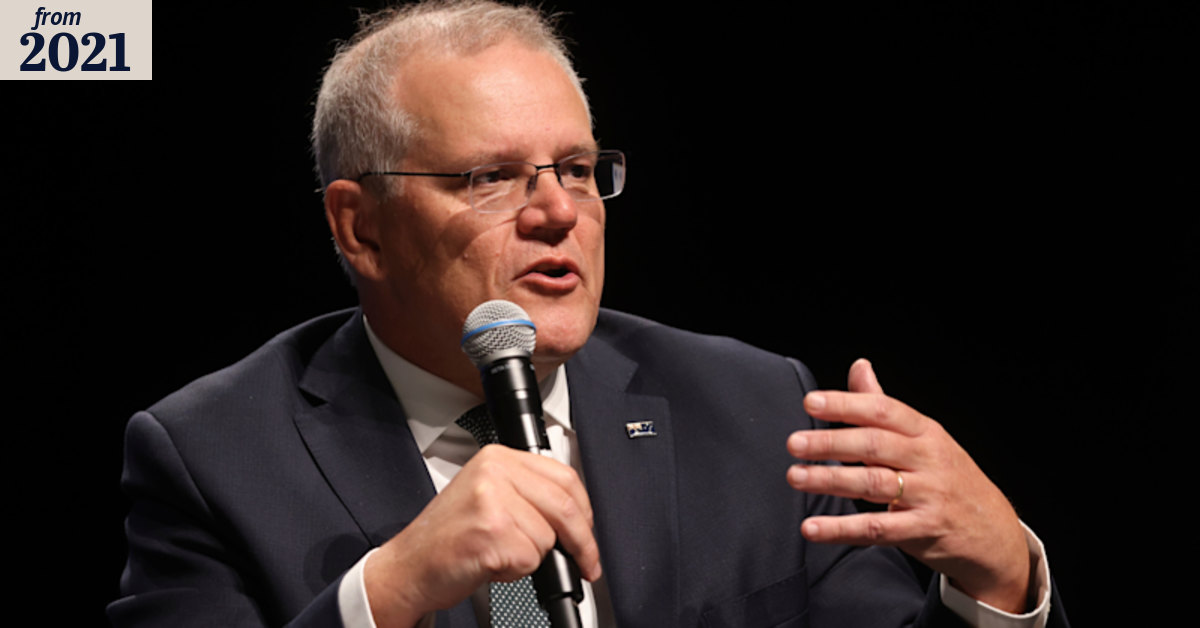
Scott Morrison first articulated his "can-do capitalism" philosophy at the Glasgow climate summit (COP26) in November 2021 [1].
Morrison stated: "We believe climate change will ultimately be solved by 'can do' capitalism; not 'don't do' governments seeking to control people's lives" [2].
On February 21, 2022, approximately three months after Morrison's November "can-do capitalism" statements, Morrison publicly criticized Mike Cannon-Brookes' bid to take over AGL Energy [1].
Cannon-Brookes, Australia's largest shareholder in Atlassian and one of the country's richest people, had proposed acquiring AGL with Brookfield and immediately transitioning its coal plants to closure by 2030 while building 8 gigawatts of renewable energy capacity [1].
Morrison's specific criticism focused on AGL's coal plants running "to the end of their scheduled operating life," with Morrison stating: "I was very committed to sweating those assets to ensure a reliable electricity supply at affordable prices" [1].
Deputy Prime Minister Barnaby Joyce was more forceful, arguing that wind and solar don't meet criteria for "affordable, deliverable, 24/7, no-questions-asked power" and that "poor people will pay for that problem" if coal was replaced prematurely [1].
Notably, two moderate Coalition MPs—Jason Falinski and Andrew Bragg—publicly supported the Cannon-Brookes bid, with Falinski calling it "the market working" and stating "This makes sense" [1].
He was not arguing against renewables; he was arguing against government-imposed timelines and regulations [2].
2. **Morrison's criticism of Cannon-Brookes focused on timing and reliability, not ideology**.
This is a legitimate policy disagreement about transition pace, not a fundamental rejection of renewable energy.
3. **Government investment was involved**.
Despite Morrison's "can-do capitalism" rhetoric, his government had committed at least $20 billion in funding through mechanisms like the Clean Energy Finance Corporation to support renewable development [4].
The Cannon-Brookes criticism occurred in **February 2022**—three months apart, not the same month [1][2].
5. **Cannon-Brookes' position was itself capitalist**.
The second is an opinion piece by Amy Remeikis, a political reporter, which explicitly labels itself as commentary ("commentisfree") and criticizes Morrison from the left.
The opinion piece asserts that Morrison's "can-do capitalism" is hypocritical because:
- The government was simultaneously subsidizing fossil fuels ($10+ billion in federal and state subsidies) [4]
- The government's "gas-led recovery" plan expanded gas use through 2050 [4]
- The government had repeatedly imposed "don't do" regulations (Indue welfare program, ABC oversight) [4]
These are legitimate critiques of inconsistency, though framed as opinion rather than straight fact.
**Did Labor have a comparable renewable energy transition position?**
Labor's approach was **markedly more aggressive** on coal transition timing:
Labor leader Anthony Albanese responded to Morrison's "can-do capitalism" by criticizing the lack of detail: "He's been in government – they are nearing the end of almost a decade in office...
* * * *
And he wants to pretend that the first decade just didn't happen" [2].
**Labor's actual 2022 election platform:**
- Committed to 82% renewable energy by 2030 (vs Coalition's 43%) [5]
- Did not propose accelerated coal plant closures in the same way Cannon-Brookes did, but supported faster renewable buildout [5]
- Proposed returning to Paris Agreement 2030 target of 45% emissions reduction [5]
**Key finding:** Labor's position was actually **more aligned with Cannon-Brookes than with Morrison**.
The claim that Coalition criticized "capitalist" Cannon-Brookes while advocating capitalism is somewhat backwards—both Cannon-Brookes and Morrison's critics (Labor, opinion writers) wanted *faster* private renewable investment.
Here's the fuller picture:
1. **Morrison's philosophical position was clear but complex**: He believed markets, not government mandates, should drive renewable transition.
However, this coexisted with:
- Government subsidies for fossil fuels [4]
- Government subsidies for renewables (Clean Energy Finance Corporation) [4]
- Government support for gas expansion [4]
2. **The criticism of Cannon-Brookes wasn't about capitalism vs. socialism**: It was about **accelerating** coal plant closures vs. letting them run to scheduled end-of-life.
Morrison believed faster closures would:
- Raise electricity prices (disputed by Cannon-Brookes, who said renewables would lower prices) [1]
- Affect reliability (disputed by Cannon-Brookes, who proposed battery storage) [1]
3. **Morrison wasn't alone in skepticism about aggressive coal transition**: Barnaby Joyce's argument reflected genuine concerns about transition costs and reliability—concerns that are legitimate even if one supports renewable energy.
Multiple countries and utilities have struggled with rapid coal transition logistics.
4. **Moderate Coalition MPs actually backed Cannon-Brookes**: Falinski and Bragg's support shows the Coalition wasn't uniformly opposed to faster private renewable investment [1].
This suggests the criticism came from a specific ideological faction (represented by Joyce) rather than Coalition-wide principle.
5. **The "hypocrisy" claim has merit, but with nuance**: The government's fossil fuel subsidies, gas expansion plans, and continued defense of coal-powered assets during speeches about "can-do capitalism" do suggest inconsistency [4].
The core facts are accurate: Morrison did criticize Cannon-Brookes' coal transition while promoting "can-do capitalism." However, the claim misrepresents both the nature of the criticism and the timeline.
He was criticizing the **pace and timeline** of coal plant closure, which is a legitimate policy disagreement separate from capitalism vs. government control.
The real critique—that Morrison advocated market-driven solutions while simultaneously subsidizing fossil fuels and defending coal assets—is more sophisticated than the claim suggests, and arguably more damaging to Morrison's position than the simple "contradiction" presented here.
The core facts are accurate: Morrison did criticize Cannon-Brookes' coal transition while promoting "can-do capitalism." However, the claim misrepresents both the nature of the criticism and the timeline.
He was criticizing the **pace and timeline** of coal plant closure, which is a legitimate policy disagreement separate from capitalism vs. government control.
The real critique—that Morrison advocated market-driven solutions while simultaneously subsidizing fossil fuels and defending coal assets—is more sophisticated than the claim suggests, and arguably more damaging to Morrison's position than the simple "contradiction" presented here.