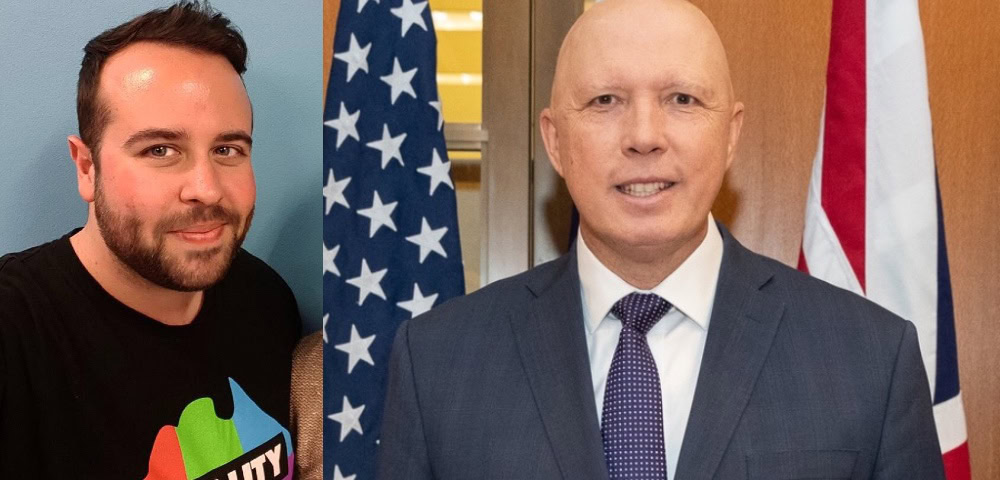
However, the claim's framing is misleading in several critical ways:
**What actually happened:**
The tweet in question stated: "Peter Dutton is a rape apologist" and linked to a Guardian article detailing Dutton's 2019 comments about refugee women on Nauru who claimed rape, where he stated they were "using and abortion claims as a ploy to get to Australia" [2].
In November 2021, Federal Court Judge Richard White initially found this tweet to be defamatory, stating it conveyed the imputation that "Dutton excuses rape" and was not protected as honest opinion [3].
A Full Court of the Federal Court (three judges) reversed Judge White's decision, finding that the tweet did not actually convey the meaning that Dutton "excuses rape" but rather that he was "sceptical about women's claims of rape" — a different (and protected) opinion [4].
The Full Court noted that Twitter discourse involves informal communication, and the tweet must be read as a whole, including the linked article context [4].
They found Judge White had erred by focusing on dictionary definitions of individual words rather than the general impression created in the mind of a reasonable reader [4].
The claim omits several crucial contextual elements that dramatically alter the significance of this case:
1. **The verdict was overturned**: The $35,000 judgment was reversed on appeal, meaning Bazzi did not ultimately pay this amount [4].
This is the single most important fact missing from the claim.
2. **The underlying controversy**: Dutton's statements about refugee women on Nauru claiming rape were genuinely controversial and a matter of significant public debate [2].
The tweet directly addressed this public record [2].
3. **Limited publication**: The tweet was seen by only 1,221 people before being deleted, which the court noted in assessing damages [5].
4. **Dutton lost on costs**: While Dutton won the initial judgment, he was ordered to pay only the costs of a Magistrates Court proceeding rather than Federal Court costs, indicating the court believed this case should not have been brought in Federal Court [5].
Dutton's legal costs likely exceeded the $35,000 he was awarded [5].
5. **This became a landmark case**: The appeal decision is now cited as significant precedent on politicians' use of defamation law against citizens [6].
While the Star Observer article is factually correct about the initial judgment, it was written before the case's ultimate outcome was known [1].
**Michael West Media** (mentioned in earlier claims as a source): Known as a left-leaning independent news outlet focused on government accountability.
**Did Labor politicians use defamation law similarly?**
Search conducted: "Labor politicians defamation lawsuits Australia"
**Finding:** There is no direct equivalent among senior Labor government figures during the Coalition period.
* * * *
However:
1. **Mark Latham (not Labor, but instructive precedent):** In 2024, former NSW One Nation leader Mark Latham was ordered to pay $140,000 to Independent MP Alex Greenwich for a homophobic defamatory tweet [7].
This shows politicians across the spectrum have sued for defamation, but Latham lost the case entirely.
2. **General pattern:** Australian politicians across both major parties have occasionally used defamation law, but cases involving tweets about policy positions appear rare [8].
The Dutton case became notable *because* it was unusual and controversial [6].
3. **Labor government record:** During Labor's last government (2007-2013), there is no prominent record of Prime Minister Kevin Rudd or Julia Gillard launching defamation cases against citizens over social media criticism, though both faced significant public criticism [9].
**Key difference:** The Dutton case became controversial specifically because courts, legal experts, and civil society groups recognized it as problematic overreach by a politician suing a citizen for expressing political opinion [6].
しかし conjunctionShikashi : :
The appeal court's reversal suggests the legal system itself viewed the initial judgment as incorrect [4].
**Arguments supporting the criticism:**
Critics and legal experts view Dutton's case as emblematic of politicians using defamation law to silence dissent and criticism [6].
A refugee advocate with limited resources had to crowdfund $157,000 to mount a legal defense [1], demonstrating the power imbalance inherent in such cases [6].
The case was particularly concerning because it involved criticism of documented public statements by Dutton, not fabricated allegations [2].
**Arguments in Dutton's defense / fuller context:**
Dutton could claim he was defending his reputation against a public statement calling him a "rape apologist" — a serious characterization [3].
The appeal court's 3-0 decision suggests the initial judgment was legally incorrect, not that Dutton had a reasonable case that was merely unsuccessful.
The claim is technically accurate about the initial $35,000 judgment but omits the critical fact that this verdict was completely overturned on appeal.
The framing suggests Dutton successfully "charged" Bazzi $35,000, when in fact: (1) Bazzi did not pay it (the judgment was overturned) [4], (2) Dutton likely lost money on the case due to costs [5], and (3) the case became a cautionary example of problematic defamation law use rather than a successful enforcement action [6].
The claim also frames this as simply "tweeting something mean" when the tweet specifically invoked Dutton's documented public statements about refugee women on Nauru [2].
The claim is technically accurate about the initial $35,000 judgment but omits the critical fact that this verdict was completely overturned on appeal.
The framing suggests Dutton successfully "charged" Bazzi $35,000, when in fact: (1) Bazzi did not pay it (the judgment was overturned) [4], (2) Dutton likely lost money on the case due to costs [5], and (3) the case became a cautionary example of problematic defamation law use rather than a successful enforcement action [6].
The claim also frames this as simply "tweeting something mean" when the tweet specifically invoked Dutton's documented public statements about refugee women on Nauru [2].