Parcialmente Verdadero

Calificación: 6.0/10

Labor
5.1

La Afirmación

“Legisló una reducción de emisiones del 43% para 2030 y cero neto para 2050 (septiembre de 2022)”
Fuente Original: Albosteezy

Fuentes Originales

VERIFICACIÓN DE HECHOS

La afirmación de que el gobierno de Albanese legisló un objetivo de reducción de emisiones del 43% para 2030 y cero neto para 2050 en septiembre de 2022 es **factualmente precisa**.
The claim that the Albanese Government legislated a 43% emissions reduction target by 2030 and net zero by 2050 in September 2022 is **factually accurate**.
El parlamento de Australia aprobó la Ley de Cambio Climático 2022 el 8 de septiembre de 2022, que consagra en la ley un objetivo de reducción de emisiones de gases de efecto invernadero del 43% por debajo de los niveles de 2005 para 2030 y emisiones netas cero para 2050 [1].
Australia's parliament passed the Climate Change Bill 2022 on September 8, 2022, which enshrines into law a greenhouse gas emissions reduction target of 43% below 2005 levels by 2030 and net zero emissions by 2050 [1].
La Cámara de Representantes aprobó el proyecto de ley por 89 votos a 55, y el Senado lo aprobó con el apoyo de los Verdes, la Red Jacqui Lambie y el senador independiente David Pocock [2].
The House of Representatives passed the bill by 89 votes to 55, and the Senate passed it with support from the Greens, Jacqui Lambie Network, and independent senator David Pocock [2].
La legislación crea un marco de rendición de cuentas que requiere que el Ministro de Cambio Climático presente una declaración anual al Parlamento sobre el progreso hacia estos objetivos, y faculta a la Autoridad Independiente de Cambio Climático para proporcionar asesoramiento experto sobre futuros objetivos [3].
The legislation creates an accountability framework requiring the Climate Change Minister to provide an annual statement to Parliament on progress toward these targets, and empowers the independent Climate Change Authority to provide expert advice on future targets [3].

Contexto Faltante

Sin embargo, la afirmación omite varios problemas contextuales críticos que cambian sustancialmente cómo debería evaluarse este logro: **1.
However, the claim omits several critical contextual issues that substantially change how this achievement should be evaluated: **1.
El objetivo del 43% ya se está logrando sin las políticas propuestas** Las proyecciones del propio gobierno de diciembre de 2024 indican que Australia puede estar cerca de cumplir su objetivo para 2030 con una reducción del 42,6% [4].
The 43% target is already being achieved without the proposed policies** The government's own December 2024 projections indicate Australia may already be close to meeting its 2030 target with a 42.6% reduction [4].
Esto significa que el logro principal de legislar el objetivo es algo engañoso: Australia está en camino de alcanzarlo en gran parte debido a las tendencias existentes (despliegue de energía renovable, cese del carbón) en lugar de políticas transformadoras nuevas introducidas por el gobierno. **2.
This means the headline achievement of legislating the target is somewhat misleading—Australia is on track to hit it largely due to existing trends (renewable energy deployment, phase-out of coal) rather than transformative new policies introduced by the government. **2.
La metodología del objetivo utiliza trucos contables que inflan las reducciones de emisiones** Una crítica importante se refiere a cómo Australia calcula sus reducciones de emisiones.
The target methodology uses accounting tricks that inflate emissions reductions** A major criticism concerns how Australia calculates its emissions reductions.
Las estimaciones gubernamentales de sumideros de Uso de la Tierra, Cambio de Uso de la Tierra y Silvicultura (LULUCF) han aumentado sistemáticamente año tras año, reduciendo así la cantidad de acción que Australia necesita tomar sobre las emisiones de combustibles fósiles [5].
Government land use, land use change and forestry (LULUCF) sink estimates have increased systematically year-on-year, thereby reducing the amount of action Australia needs to take on fossil fuel emissions [5].
Como resultado, excluyendo los sectores de tierra y energía, las emisiones de todos los demás sectores económicos se proyectan un 4,5% **por encima** de los niveles de 2005 en 2030 [5].
As a result, excluding the land and power sectors, emissions from all other economic sectors are projected to be 4.5% **above** 2005 levels in 2030 [5].
Esto significa que la agricultura, el transporte, la manufactura y otros sectores están aumentando las emisiones, no reduciéndolas. **3.
This means agriculture, transport, manufacturing and other sectors are actually increasing emissions, not reducing them. **3.
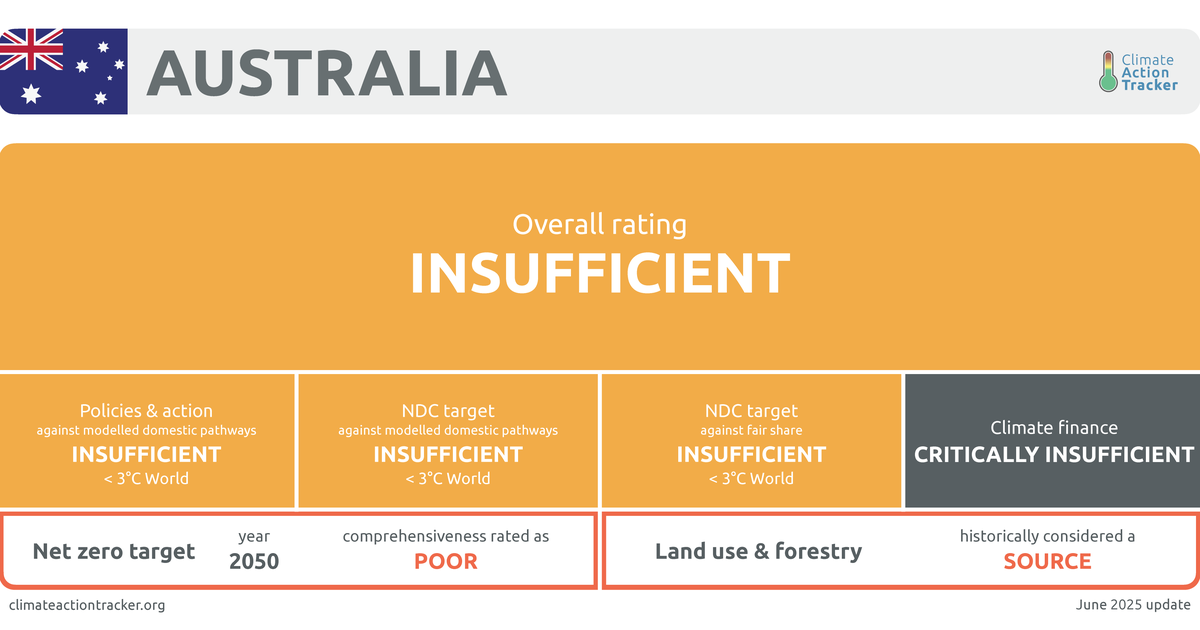
El objetivo es insuficiente para las metas climáticas** El Climate Action Tracker, una organización científica independiente, califica el objetivo de 2030 de Australia como «Insuficiente» en comparación con las trayectorias de emisiones necesarias para limitar el calentamiento a 1,5°C [6].
The target is insufficient for climate goals** The Climate Action Tracker, an independent scientific organization, rates Australia's 2030 target as "Insufficient" when compared to emissions pathways needed to limit warming to 1.5°C [6].
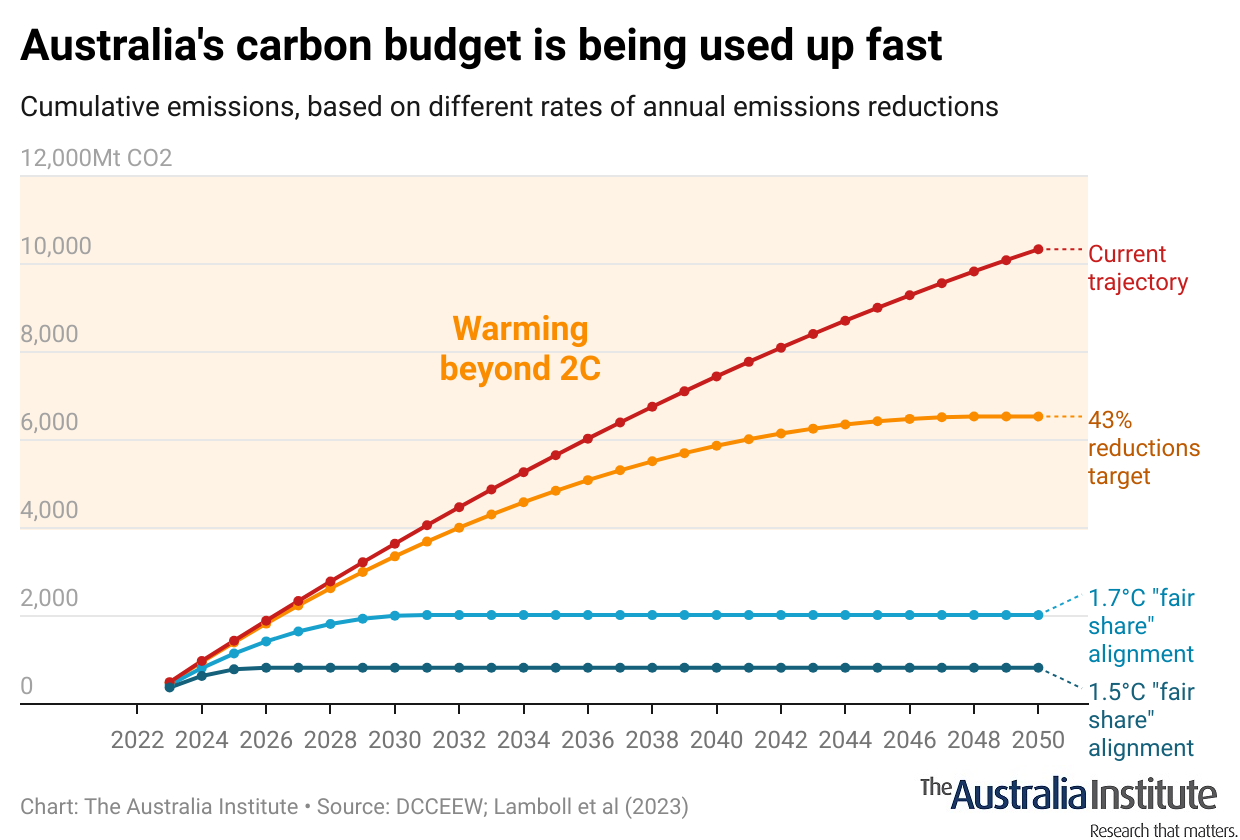
Múltiples análisis indican que el objetivo del 43% no está alineado con limitar el calentamiento a 1,5°C y representa un «truco de mano» que implica una fuerte dependencia de compensaciones y trucos contables en lugar de reducciones reales de emisiones [7]. **4.
Multiple analyses indicate the 43% target is not aligned with limiting warming to 1.5°C and represents a "sleight of hand" involving heavy reliance on offsets and accounting tricks rather than real emissions reductions [7]. **4.
Los principales problemas sectoriales siguen sin abordarse** - **Transporte**: Las emisiones de transporte en 2030 se proyectan similares a los niveles prepandemia, sin reducción neta [8] - **Agricultura**: Las emisiones agrícolas se proyectan que aumentarán a medida que se repoblen los hatos de ganado post-sequía [8] - **Emisiones industriales**: El Mecanismo de Salvaguarda (que cubre el 31% de las emisiones) no resultará en recortes directos de emisiones hasta finales de década [8] **5.
Major sectoral problems remain unaddressed** - **Transport**: Transport emissions in 2030 are projected to be similar to pre-pandemic levels, with no net reduction [8] - **Agriculture**: Agricultural emissions are projected to increase as post-drought cattle herds are restocked [8] - **Industrial emissions**: The Safeguard Mechanism (covering 31% of emissions) won't result in direct emissions cuts until the end of the decade [8] **5.
Déficit en el objetivo de energía renovable** Mientras el gobierno apunta al 82% de electricidad renovable para 2030, la Agencia Internacional de Energía proyecta que solo se logrará el 58% basándose en políticas actuales y tasas de despliegue: una brecha significativa [6].
Renewable energy target shortfall** While the government targets 82% renewable electricity by 2030, the International Energy Agency projects only 58% will be achieved based on current policies and deployment rates—a significant gap [6].

💭 PERSPECTIVA CRÍTICA

Cuando se examina en contexto, el «logro» de legislar un objetivo de reducción de emisiones del 43% revela la política climática del gobierno como más simbólicamente significativa que sustantivamente transformadora.
When examined in context, the "achievement" of legislating a 43% emissions reduction target reveals the government's climate policy as more symbolically significant than substantively transformative.
El gobierno puede reclamar crédito por aprobar legislación porque estaba en la oposición bajo el gobierno de la Coalición anterior, que había fijado el objetivo en 26-28%.
The government can claim credit for passing legislation because it was in opposition under the previous Coalition government, which had set the target at 26-28%.
Sin embargo, la trayectoria real de reducción depende fuertemente de: 1. **Tendencias preexistentes de cese del carbón** - Gran parte del 43% proviene del despliegue renovable existente y el retiro natural de plantas de carbón, no de políticas nuevas [4] 2. **Mecanismos contables** - La inclusión de créditos generosos de sumideros LULUCF permite al gobiermo reclamar reducciones de emisiones que no se traducen en recortes reales de emisiones en sectores clave [5] 3. **Implementación política insuficiente** - El análisis del propio gobierno muestra que los sectores principales (transporte, agricultura, industria) verán emisiones planas o crecientes [8] La legislación proporciona certeza y asegura el objetivo, haciéndolo más difícil para futuros gobiernos debilitarlo.
However, the actual reduction pathway relies heavily on: 1. **Pre-existing coal phase-out trends** - Much of the 43% comes from existing renewable deployment and natural coal plant retirements, not new policy [4] 2. **Accounting mechanisms** - The inclusion of generous LULUCF sink credits allows the government to claim emissions reductions that don't translate into actual emissions cuts in key sectors [5] 3. **Insufficient policy implementation** - The government's own analysis shows major sectors (transport, agriculture, industry) will see flat or increasing emissions [8] The legislation does provide certainty and lock in the target, making it harder for future governments to weaken it.
Sin embargo, el encuadre de esto como un logro importante oscurece el hecho de que la trayectoria real de Australia hacia cero neto sigue dependiendo fuertemente de soluciones tecnológicas (captura de carbono, hidrógeno) que no están probadas a escala, y el objetivo en representa una respuesta inadecuada a la ciencia climática [6].
However, the framing of this as a major achievement obscures the fact that Australia's actual path to net zero remains heavily dependent on technological solutions (carbon capture, hydrogen) that are unproven at scale, and the target itself represents an inadequate response to climate science [6].
Una comparación con pares de la OCDE es instructiva: Mientras Australia legisló el 43% para 2030, la UE se comprometió al 55% para 2030, el Reino Unido al 68% para 2030, y EE.UU. al 50% para 2030 (en su compromiso del Acuerdo de París).
A comparison to OECD peers is instructive: While Australia legislated 43% by 2030, the EU committed to 55% by 2030, the UK to 68% by 2030, and the US to 50% by 2030 (in its Paris Agreement commitment).
El objetivo de Australia, aunque más alto que el del gobierno de la Coalición anterior, sigue siendo uno de los más débiles de las economías desarrolladas [9].
Australia's target, while higher than the previous Coalition government's target, remains among the weaker of developed economies [9].

PARCIALMENTE VERDADERO

6.0

/ 10

La afirmación factual de que el gobierno legisló un objetivo de reducción de emisiones del 43% para 2030 y cero neto para 2050 en septiembre de 2022 es precisa.
The factual claim that the government legislated a 43% emissions reduction target by 2030 and net zero by 2050 in September 2022 is accurate.
Sin embargo, el contexto omitido —de que el objetivo depende de trucos contables, los sectores principales siguen aumentando las emisiones, el objetivo ya se está logrando sin intervención política, y el objetivo es científicamente insuficiente para las metas climáticas— significa que esto representa un logro mucho más modesto de lo que sugiere la afirmación.
However, the omitted context—that the target relies on accounting tricks, major sectors are still increasing emissions, the target is already being achieved without policy intervention, and the target is scientifically insufficient for climate goals—means this represents a much more modest achievement than the claim suggests.
La legislación proporciona certeza legal pero no acción climática transformadora.
The legislation provides legal certainty but not transformative climate action.

📚 FUENTES Y CITAS (9)

  1. 1
    dcceew.gov.au

    Climate Change Bill 2022 - DCCEEW

    Dcceew Gov

  2. 2
    pm.gov.au

    Australia Legislates Emissions Reduction Targets - Prime Minister of Australia

    The Albanese Government’s landmark Climate Change Bills have now passed the Senate, ensuring Australia's emissions reduction target of 43 per cent and net zero emissions by 2050 will be enshrined in legislation. For almost a decade, Australia stumbled from one policy to another, and our economy and communities missed out on billions of dollars in public and private clean energy investment. But today that changes.

    Prime Minister of Australia
  3. 3
    Climate Change Bill 2022 – Parliament of Australia

    Climate Change Bill 2022 – Parliament of Australia

    Helpful information Text of bill First reading: Text of the bill as introduced into the Parliament Third reading: Prepared if the bill is amended by the house in which it was introduced. This version of the bill is then considered by the second house. As passed by

    Aph Gov
  4. 4
    PDF

    Australia's 2030 Emissions Reduction Target - DCCEEW

    Dcceew Gov • PDF Document
  5. 5
    Sleight of hand: Australia's Net Zero target is being lost in accounting tricks, offsets and more gas - Climate Analytics

    Sleight of hand: Australia's Net Zero target is being lost in accounting tricks, offsets and more gas - Climate Analytics

    Australia is unlikely to achieve its net zero target. This is because of its support for fossil gas to 2050 and beyond, it’s long-term emissions reduction plan resorts to unrealistic technological fixes and emissions offsets and because its legislated target of a 43% emissions cut by 2030 is not…

    Climate Analytics
  6. 6
    Australia - Climate Action Tracker

    Australia - Climate Action Tracker

    Climateactiontracker
  7. 7
    Climate Change Bill 2022 - Australian Conservation Foundation

    Climate Change Bill 2022 - Australian Conservation Foundation

    The Albanese Government’s Climate Change Bill has passed the House of Representatives and been sent to the Senate. Its target to slash climate pollution…

    Australian Conservation Foundation
  8. 8
    New research shows our 2030 emission targets are woefully out of date - The Australia Institute

    New research shows our 2030 emission targets are woefully out of date - The Australia Institute

    The evidence is clear - our current policies and targets are insufficient to prevent dangerous global warming, and not aligned with latest scientific research.

    The Australia Institute
  9. 9
    kwm.com

    From ambition to action: understanding Australia's 2050 net zero plan - KWM

    Kwm

Metodología de la Escala de Calificación

1-3: FALSO

Fácticamente incorrecto o fabricación maliciosa.

4-6: PARCIAL

Algo de verdad pero falta contexto o está sesgado.

7-9: MAYORMENTE VERDADERO

Tecnicismos menores o problemas de redacción.

10: PRECISO

Perfectamente verificado y contextualmente justo.

Metodología: Las calificaciones se determinan mediante la verificación cruzada de registros gubernamentales oficiales, organizaciones independientes de verificación de hechos y documentos de fuentes primarias.