
The Claim
“Likened our humanitarian immigration program to war.”
Original Sources Provided
✅ FACTUAL VERIFICATION
The claim misrepresents what Tony Abbott actually said.
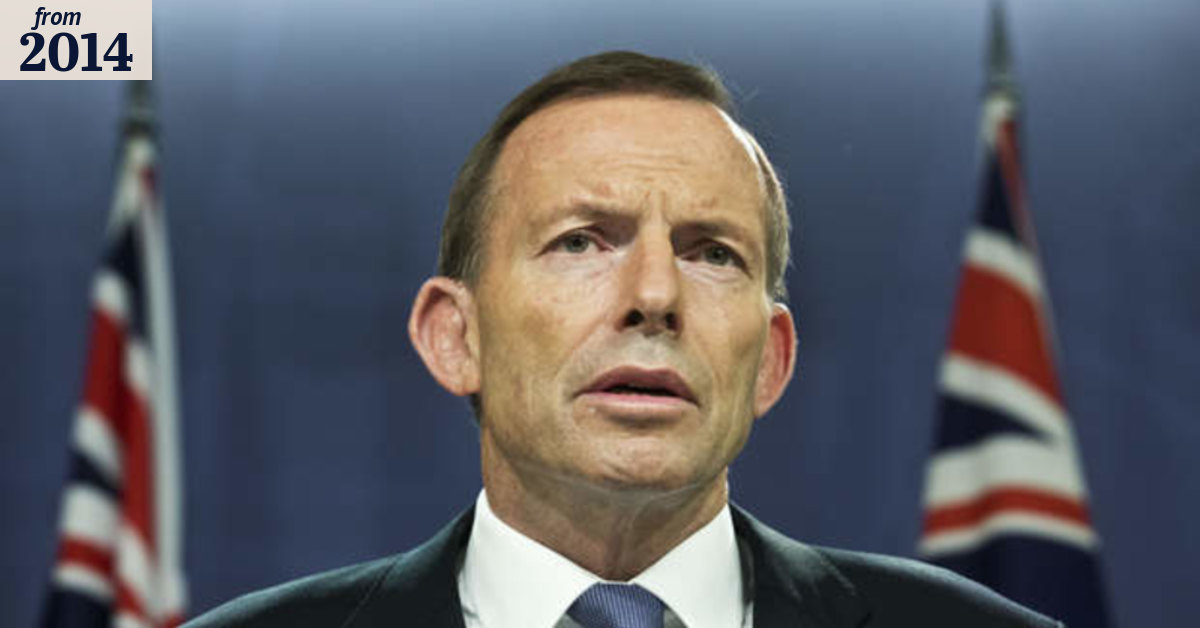
On January 10, 2014, Prime Minister Tony Abbott defended his government's secrecy regarding border protection operations by using a wartime secrecy analogy. His exact statement was:
"If stopping the boats means being criticised because I'm not giving information that would be of use to people smugglers, so be it... If we were at war we wouldn't be giving out information that is of use to the enemy just because we might have an idle curiosity about it ourselves." [1]
The context was Abbott defending the government's "closed book" approach to Operation Sovereign Borders amid controversy over reports that navy personnel had turned back asylum seeker boats to Indonesia [1]. The "enemy" Abbott referred to was explicitly people smugglers, not asylum seekers or the humanitarian program itself [2].
The claim inverts the actual meaning of Abbott's statement. He was not comparing the humanitarian immigration program to war - he was comparing the secrecy around operational border protection activities to wartime operational secrecy [3].
Missing Context
The claim omits several critical pieces of context:
What Abbott actually likened to war: It was operational secrecy, not the humanitarian program. Abbott stated: "I would not give information that would help a war enemy" in the context of defending the government's refusal to disclose details of navy operations that could assist people smugglers [1].
The "enemy" was people smugglers: Abbott's quote explicitly identified "people smugglers" as the target of the operational campaign, not asylum seekers themselves [1]. The claim leaves this crucial distinction unstated.
The policy context: The Coalition had implemented "Operation Sovereign Borders" in September 2013, a military-led operation involving the Australian Defence Force to prevent asylum seeker boat arrivals. The secrecy controversy emerged in early 2014 when reports emerged that navy personnel had turned back boats [1].
The humanitarian program is separate from border protection: Australia's Refugee and Humanitarian Program operates through official channels including offshore resettlement and onshore protection visas [4]. Abbott's comments related specifically to border protection operations targeting people smuggling, not the humanitarian intake itself.
Source Credibility Assessment
The original source is the Herald Sun, a News Corp Australia publication. News Corp publications have faced criticism for sensationalist headlines and partisan coverage, though the Herald Sun is a mainstream metropolitan newspaper [5].
The Herald Sun's headline "Tony Abbott compares stopping asylum-seeker boats to war" is technically accurate regarding the surface meaning but omits the crucial context that Abbott was referring to operational secrecy, not the humanitarian program itself [1]. The headline presents a more inflammatory interpretation than the actual quote warrants.
Other mainstream sources like the Sydney Morning Herald and ABC News reported the same event with more nuanced headlines emphasizing the secrecy comparison rather than suggesting Abbott likened the entire humanitarian program to war [1, 3].
Labor Comparison
Did Labor do something similar?
Search conducted: "Labor government asylum seeker boat policy Pacific Solution"
Finding: The Labor Party supported and maintained hardline asylum seeker policies throughout different periods:
The Pacific Solution (2001-2007): The Howard Government's policy of offshore processing on Nauru and Manus Island had bipartisan support from the Labor opposition at the time [6]. This policy involved the same basic approach of preventing boat arrivals through offshore detention.
Kevin Rudd's PNG Solution (2013): In July 2013, Labor Prime Minister Kevin Rudd announced that all asylum seekers arriving by boat would be sent to Papua New Guinea for processing and settlement, declaring "Asylum seekers who come here by boat without a visa will never be settled in Australia" [7]. This policy was arguably more restrictive than Abbott's approach as it permanently barred boat arrivals from settlement.
Labor maintained boat turnbacks: While the Rudd/Gillard governments initially abandoned turnbacks, by 2013 Labor had reintroduced similar measures [8].
The key difference is that Labor governments used similar operational secrecy around their border protection activities without the explicit "war" rhetoric [1, 7]. However, the core policy approaches - preventing boat arrivals, offshore processing, and operational secrecy - were consistent across both parties.
Balanced Perspective
The claim presents a distorted version of Abbott's remarks that conflates two distinct aspects of Australia's immigration system: the humanitarian program (official refugee resettlement) and border protection operations (preventing unauthorized boat arrivals).
What Abbott actually said: Abbott was defending the government's refusal to provide details about navy operations that could help people smugglers circumvent border protection measures. His "war" analogy was specifically about operational secrecy: "If we were at war we wouldn't be giving out information that is of use to the enemy" [1]. The enemy was identified as people smugglers, not refugees or asylum seekers.
The policy context: The Coalition's Operation Sovereign Borders, launched in September 2013, was indeed a militarized approach to border protection involving the Australian Defence Force [1]. While controversial, this approach succeeded in dramatically reducing boat arrivals [9].
Comparative context: Labor's PNG Solution (2013) and earlier Pacific Solution support demonstrate that hardline asylum seeker policies were not unique to the Coalition [6, 7]. Both parties have employed offshore processing, turnbacks, and operational secrecy when in government.
Key context: The claim misrepresents Abbott's statement by suggesting he likened Australia's humanitarian resettlement program to war. In fact, he was referring to the operational secrecy around border protection activities targeting people smugglers. This is misleading framing of the original quote.
MISLEADING
3.0
out of 10
The claim that Abbott "likened our humanitarian immigration program to war" is a misrepresentation. Abbott's actual statement, made on January 10, 2014, compared the government's secrecy around border protection operations to wartime operational secrecy, using the analogy: "If we were at war we wouldn't be giving out information that is of use to the enemy" [1]. The "enemy" in this context was explicitly identified as people smugglers, not asylum seekers or the humanitarian program [1].
The claim conflates two distinct policy areas: (1) the humanitarian program (refugee resettlement through official channels), and (2) border protection operations (preventing unauthorized boat arrivals). Abbott's remarks addressed only the latter [1, 4]. Furthermore, both major Australian political parties have implemented similar hardline asylum seeker policies, with Labor's PNG Solution (2013) being arguably more restrictive in permanently barring boat arrivals from settlement [6, 7].
Final Score
3.0
OUT OF 10
MISLEADING
The claim that Abbott "likened our humanitarian immigration program to war" is a misrepresentation. Abbott's actual statement, made on January 10, 2014, compared the government's secrecy around border protection operations to wartime operational secrecy, using the analogy: "If we were at war we wouldn't be giving out information that is of use to the enemy" [1]. The "enemy" in this context was explicitly identified as people smugglers, not asylum seekers or the humanitarian program [1].
The claim conflates two distinct policy areas: (1) the humanitarian program (refugee resettlement through official channels), and (2) border protection operations (preventing unauthorized boat arrivals). Abbott's remarks addressed only the latter [1, 4]. Furthermore, both major Australian political parties have implemented similar hardline asylum seeker policies, with Labor's PNG Solution (2013) being arguably more restrictive in permanently barring boat arrivals from settlement [6, 7].
📚 SOURCES & CITATIONS (9)
-
1
smh.com.au
Tony Abbott has defended his government's secrecy over its treatment of asylum seekers, saying he would not give information that would help a war enemy.
The Sydney Morning Herald -
2
abc.net.au
Prime Minister Tony Abbott has likened the Government's border protection approach to being at "war" with people smugglers. The Government has come under fire for refusing to release details of attempts to turn asylum seeker boats back to Indonesia. And yesterday the Chief of the Defence Force was forced to defend the actions of defence personnel, after a number of asylum seekers claimed they were mistreated by Australian authorities. This morning Mr Abbott told Channel Ten that releasing information would help people smugglers, and put asylum seekers' lives at risk. "We are in a fierce contest with these people smugglers," he said. "And if we were at war, we wouldn't be giving out information that is of use to the enemy just because we might have an idle curiosity about it ourselves."
Abc Net -
3
news.com.au
News Com
-
4

immi.homeaffairs.gov.au
Find out about Australian visas, immigration and citizenship.
Immigration and citizenship Website -
5
economist.com
Economist
-
6

en.wikipedia.org
Wikipedia -
7
abc.net.au
Four years ago, then-PM Kevin Rudd vowed to ban asylum seekers arriving by boat from ever settling in Australia. Now he says that wasn't the case.
Abc Net -
8

theguardian.com
'The point is to stop the boats,' says prime minister, after reports that navy is towing vessels back to Indonesia
the Guardian -
9

tonyabbott.com.au
Originally published in The Telegraph With more than 16,000 arrivals by small boat across the Channel so far this year, and 100,000 in the past five years, it’s no wonder that the Prime Minister has made stopping the boats one of the Government’s five priorities. While Britain’s predicament differs somewhat, I suspect there might be...
Tony Abbott
Rating Scale Methodology
1-3: FALSE
Factually incorrect or malicious fabrication.
4-6: PARTIAL
Some truth but context is missing or skewed.
7-9: MOSTLY TRUE
Minor technicalities or phrasing issues.
10: ACCURATE
Perfectly verified and contextually fair.
Methodology: Ratings are determined through cross-referencing official government records, independent fact-checking organizations, and primary source documents.