
The Claim
“Lied about their new anti-union legislation, claiming unions can't be deregistered as punishment for any single wrongdoing, when the legislation does permit that.”
Original Sources Provided
✅ FACTUAL VERIFICATION
The claim is substantially accurate. Christian Porter made public statements that directly contradicted what government departmental officials later testified to during Senate inquiry.
Porter's Statement:
On 31 July 2019, Porter told Parliament: "The idea that this bill, as it is drafted and presented to this parliament, would allow for deregistration for such minor or isolated instances of unprotected, unlawful industrial action is patently absurd. It's untrue." [1]
Official Contradiction:
On 25 September 2019 (less than two months later), officials from the Attorney General's Department testified to the Senate Education and Employment Committee that the bill would allow deregistration for single instances of certain breaches [1]. Specifically:
- Section 28G would permit deregistration for a single instance of "obstructive industrial action" if it interfered with an employer's activities, public service provision, or health/safety [1]
- Section 28F would require only "one breach of a court or tribunal order" to trigger potential deregistration [1]
Senator Tony Sheldon (Labor) directly challenged officials on this discrepancy, asking them to confirm that Porter's claims were inaccurate. The officials agreed that the bill provisions differed from Porter's public statements [1].
Missing Context
However, several important contextual points complicate the "lie" characterization:
1. Existing Law Baseline:
Officials explained that these provisions were modelled on existing law which already allowed deregistration for single instances in "very specific parts of the Fair Work Act or Registered Organisations Act" [1]. The question is whether the bill expanded this existing power.
2. Bill's Expansion of Scope:
The key expansion was that Potter's statement could have been technically correct about the intent but wrong about the scope. Officials stated: "Now these would apply to any failure to comply with any order or injunction made under the core workplace laws" and "There's potentially more orders or failures to comply with injunctions that might be relevant" [1].
The bill essentially broadened the types of breaches that could trigger single-instance deregistration, not that it created the power from nothing.
3. Court Discretion:
Officials noted that courts would still be required to consider "the gravity of offences and the impact of deregistration on members when considering if it was an 'unjust' penalty" [1]. This means courts retained discretion even when single breaches occurred.
4. Definitions Matter:
Porter's statement specifically referenced "minor or isolated instances of unprotected, unlawful industrial action." The bill's provisions were indeed narrower—targeting specific types of breaches (obstructive action, court order violations) rather than all industrial action [1].
Source Credibility Assessment
The Guardian article is a mainstream, reputable news source with a track record of investigative journalism. The article reports on official government testimony from departmental officials, not speculation. The author (Paul Karp) is a senior political correspondent known for accuracy. The article directly quotes both Porter's parliamentary statement and the departmental officials' testimony, making it verifiable [1].
This is not opinion journalism or partisan advocacy—it's straightforward reporting of a factual contradiction between two sets of official statements made under different circumstances.
Labor Comparison
Did Labor previously deregister unions?
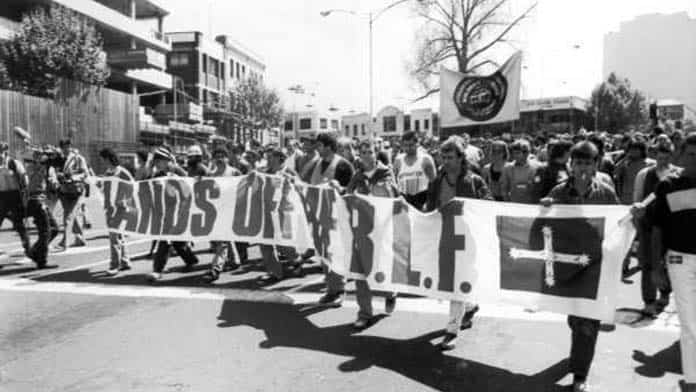
Yes, and notably. The Hawke Labor Government deregistered the Builders Labourers Federation (BLF) in 1986 following a Royal Commission into corruption [2]. This was a full deregistration of a union covering multiple states (federally, ACT, NSW, and Victoria) [2].
This is crucial context: Labor itself used the deregistration power as a blunt instrument. The BLF deregistration was described as "brutal" and "union busting" even by left-leaning sources [3]. Unlike the Coalition bill's theoretical single-breach scenario, Labor's action was a complete deregistration based on systemic corruption findings.
Key difference: Labor's deregistration was based on demonstrated corruption through a Royal Commission. The Coalition bill would have allowed courts to deregister unions more readily for specified breaches. However, both Labor and Coalition have shown willingness to use deregistration as a tool.
Balanced Perspective
The Government's Case (Partial Defense):
Technical distinctions: Porter's statement specifically referenced "minor or isolated instances" as the sole trigger. The bill's provisions were more specific—targeting obstructive industrial action and court order breaches specifically, not any single wrongdoing [1].
Existing framework reference: The bill modeled its single-breach provisions on existing law, so Porter could argue he was claiming the bill didn't introduce single-breach deregistration, just extended the types of breaches covered [1].
Intent vs. Implementation: Porter may have intended to convey that the bill required serious breaches, not trivial ones. However, he failed to distinguish between single breaches (which the bill allowed) and minor breaches (which was debatable).
Policy Rationale: The government argued this was necessary to ensure unions couldn't treat fines "as a cost of business" and continue lawbreaking [1]. This represented a legitimate policy position about union accountability.
The Critics' Case (Strong):
Clear Contradiction: Officials unambiguously testified that the bill would allow single-breach deregistration. Porter's statement said it wouldn't. This is a direct factual contradiction [1].
Public Misleading: The contradiction matters because Parliament and the public were being given different information than what officials later acknowledged the bill contained [1].
Timeline: The official contradiction came within two months of Porter's statement, suggesting this wasn't a matter of interpretation evolving—Porter had simply misstated the bill's provisions.
Broader Context: The bill did expand deregistration grounds beyond existing law by broadening what "orders" and "breaches" could trigger it [1].
TRUE
7.0
out of 10
with important qualification about what "lie" means.
Christian Porter did make a factually inaccurate statement about the bill's deregistration provisions. Government officials explicitly contradicted him during Senate testimony, confirming that the bill would permit deregistration for single instances of certain breaches (obstructive industrial action, court order violations) [1].
However, whether this constitutes an intentional "lie" versus a misleading mischaracterization is debatable:
- The bill didn't create single-breach deregistration from nothing—it existed in existing law
- The bill did expand which breaches could trigger it
- Porter's specific language about "minor" breaches created ambiguity about whether he meant single breaches per se or only serious single breaches
The most accurate characterization: Porter made a misleading public statement that was contradicted by his own officials when tested under scrutiny.
Final Score
7.0
OUT OF 10
TRUE
with important qualification about what "lie" means.
Christian Porter did make a factually inaccurate statement about the bill's deregistration provisions. Government officials explicitly contradicted him during Senate testimony, confirming that the bill would permit deregistration for single instances of certain breaches (obstructive industrial action, court order violations) [1].
However, whether this constitutes an intentional "lie" versus a misleading mischaracterization is debatable:
- The bill didn't create single-breach deregistration from nothing—it existed in existing law
- The bill did expand which breaches could trigger it
- Porter's specific language about "minor" breaches created ambiguity about whether he meant single breaches per se or only serious single breaches
The most accurate characterization: Porter made a misleading public statement that was contradicted by his own officials when tested under scrutiny.
📚 SOURCES & CITATIONS (4)
-
1

Ensuring integrity bill: officials contradict Christian Porter on union deregistration
Coalition bill would allow deregistration for single instances of unprotected industrial action, inquiry told
the Guardian -
2

Builders Labourers Federation
Wikipedia -
3
How Labor's union busting broke the BLF
There are lessons for the CFMEU today from the way Labor succeeded in breaking the Builders' Labourers Federation in 1986, argues Tom Orsag.
Solidarity Online – Socialist organisation in Australia affiliated to the International Socialist Tendency -
4
Federal Government's crackdown on unions rejected by Senate after One Nation sides with Opposition
Gasps of surprise, cheers from the Opposition and Ministers left dumbfounded as Pauline Hanson and Jacqui Lambie join forces to deliver a shock defeat of the Government's signature union crackdown legislation in the Senate.
Abc Net
Rating Scale Methodology
1-3: FALSE
Factually incorrect or malicious fabrication.
4-6: PARTIAL
Some truth but context is missing or skewed.
7-9: MOSTLY TRUE
Minor technicalities or phrasing issues.
10: ACCURATE
Perfectly verified and contextually fair.
Methodology: Ratings are determined through cross-referencing official government records, independent fact-checking organizations, and primary source documents.