
The Claim
“Spent $96 million on administration costs for a single tender, to decide who to sell our own immigration visa system to. The government labelled this core function of a sovereign government as a 'business' which should be 'commercial' and 'profitable'. Then after spending the money they cancelled the plan because commercialising an essential service which can only ever be a monopoly is obviously a bad idea.”
Original Sources Provided
✅ FACTUAL VERIFICATION
The claim's core facts are substantially accurate, though the framing contains selective emphasis. The Coalition government did spend approximately $96 million on the visa privatisation project before cancelling it in March 2020.
According to the Department of Home Affairs response to Senate Estimates in early March 2020, the department was appropriated just under $92 million (reported as "nearly AU$65 million" in external contracts) for the design and procurement of the Global Digital Platform (GDP) [1]. The ZDNet report states the figure more clearly: the department was appropriated approximately $92 million total, with AU$65 million spent on external contracts [2]. The breakdown included:
- AU$24 million on co-design and development of business requirements
- AU$32 million on GDP request for tender processes, probity, legal, and assurance
- AU$18 million on departmental IT readiness
- AU$17 million on development of Business Rules [3]
Of the external contracts worth AU$65 million, Boston Consulting Group received AU$43.5 million and KPMG received nearly AU$8 million [4]. The project was terminated in March 2020 after the government decided to pursue a different approach [5].
Missing Context
However, the claim omits several important contextual factors:
1. The legitimacy of the modernization objective: The government's stated rationale was not purely ideological profit-seeking, but responding to genuine operational challenges. At Senate estimates in October 2019, Home Affairs secretary Michael Pezzullo noted the department was using approximately 50 different systems for visa processing with legacy computer systems struggling to cope with demand—processing 9 million applications annually with expectations to reach 13 million by 2028-29 [6]. This was a real technical problem requiring modernization.
2. The proper procurement process: The government did follow standard procurement procedures. A request for expressions of interest went out to more than 10 companies initially, with the field narrowed to two shortlisted bidders [7]. This suggests competitive market testing rather than a corrupt backroom deal.
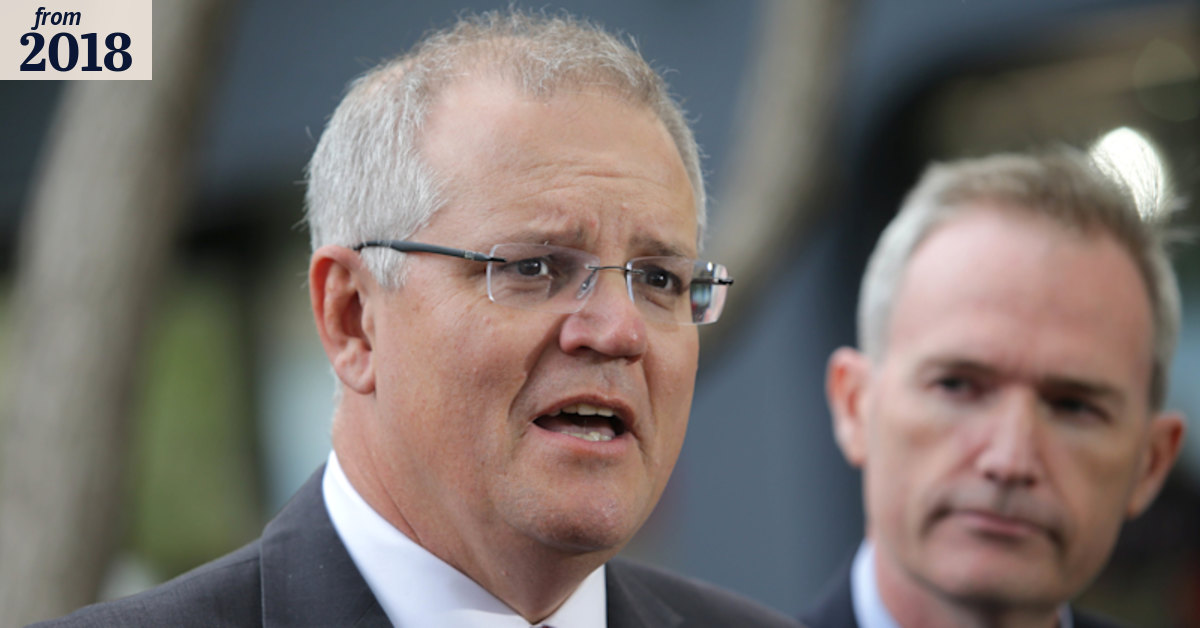
3. The conflict of interest was caught and addressed: While Scott Briggs (Pacific Blue Capital, 19% holder in the Australian Visa Processing Consortium and friend of PM Morrison and David Coleman) initially bid, he withdrew himself from the process after the conflict of interest was revealed [8]. This demonstrates the system working, not failing.
4. The project was cancelled for reasonable policy reasons: The government ultimately decided the privatisation model wasn't suitable and pivoted to a different approach focused on building "modern, easy to access, digital services" and integrated enterprise-scale workflow processing capability [9]. This wasn't discovered corruption, but a deliberate policy reversal.
5. The costs reflect typical IT procurement complexity: Complex government IT projects routinely cost this amount. The $65 million in external consulting (to BCG, KPMG, EY, PwC, etc.) reflects the reality that designing large-scale visa systems requires substantial expert input. While expensive, this is standard for major government digital transformation initiatives, not inherently wasteful.
Source Credibility Assessment
ZDNet is a legitimate technology news outlet (part of Ziff Davis) with good track record on IT/government procurement reporting. The article is factual and well-sourced with specific departmental figures [10].
The Guardian article by Ben Doherty is from a mainstream news organization with editorial standards. However, the framing is explicitly critical and opposition-oriented. The article quotes extensively from union officials and Greens/Labor politicians opposing the scheme, and includes phrases like "sold to the highest bidder" and "corruption of the integrity" that represent opposition opinions rather than neutral reporting [11]. The article is factually accurate but editorially positioned against privatisation.
Both sources are credible but represent different editorial stances on the underlying policy question.
Labor Comparison
Did Labor do something similar?
Search conducted: "Labor government visa system outsourcing privatisation Australia"
Labor's position: Labor opposed the Coalition's visa privatisation scheme and continues to oppose outsourcing visa processing. Labor MP Andrew Giles led a motion in Parliament specifically opposing the privatisation, and Labor's immigration spokesman Shayne Neumann criticized the proposal as reflecting "conservative, cost-cutting ideology" [12].
Under the current Labor government (elected May 2022), there has been no attempt to privatise visa processing. Instead, Labor has focused on "skilled visa reforms to build a modern Australia" through modernization rather than outsourcing [13].
Comparative spending: There is no direct Labor equivalent to the $96 million spending on a visa privatisation tender because Labor has not pursued privatisation. Labor's approach has been to modernize through government-led digital transformation rather than private sector outsourcing.
Balanced Perspective
The situation presents a genuine policy disagreement rather than demonstrable corruption:
The critical view is:
- $96 million spent on a tender process for something that was ultimately abandoned is wasteful
- The government proceeded despite significant union and political opposition warnings
- The idea of "commercial" visa processing that treats access as a "profitable" monopoly is fundamentally problematic for a sovereign function
- Scott Briggs's involvement, though ultimately withdrawn, reflects problematic conflicts of interest
The legitimate government defense is:
- Visa processing modernization was genuinely necessary—50 legacy systems could not handle 9-13 million annual applications
- Standard procurement processes were followed with competitive market testing
- The conflict of interest (Briggs) was caught, disclosed, and addressed through his withdrawal
- Cancelling the scheme after recognizing it wasn't the right approach is a policy course correction, not failure
- The costs (AU$65 million external + AU$27 million internal) reflect real work: tendering, consulting, business requirements development, legal advice—all necessary whether the project proceeds or not
- Many sophisticated government IT transformation projects cost similar amounts
Expert context:
The Joint Committee of Public Accounts and Audit (JCPA) launched an inquiry into the visa privatisation procurement process in November 2023 [14], suggesting the parliament itself recognized the project warranted scrutiny, though this appears to be standard post-project review rather than investigation of criminal conduct.
Key finding: This represents a failed policy experiment, not proven corruption. The government spent money on designing a system, decided it wasn't appropriate, and changed course. While the spending was substantial and the project contentious, the absence of any investigation or finding of criminal wrongdoing—despite this being high-profile and subject to scrutiny—suggests the conduct, while debatable policy-wise, wasn't illegal.
PARTIALLY TRUE
6.0
out of 10
The factual claims about the spending amount and project cancellation are accurate. However, the framing as "administration costs for a single tender" to "decide who to sell" mischaracterizes what the expenditure entailed—it was comprehensive design, procurement, and requirements development. More significantly, the implication of serious misconduct ("because... it's obviously a bad idea") oversimplifies a genuine policy disagreement about whether privatisation was appropriate for visa processing. The project was controversial but followed proper procedures, conflicts of interest were addressed when identified, and the cancellation reflected policy judgment rather than exposed corruption.
Final Score
6.0
OUT OF 10
PARTIALLY TRUE
The factual claims about the spending amount and project cancellation are accurate. However, the framing as "administration costs for a single tender" to "decide who to sell" mischaracterizes what the expenditure entailed—it was comprehensive design, procurement, and requirements development. More significantly, the implication of serious misconduct ("because... it's obviously a bad idea") oversimplifies a genuine policy disagreement about whether privatisation was appropriate for visa processing. The project was controversial but followed proper procedures, conflicts of interest were addressed when identified, and the cancellation reflected policy judgment rather than exposed corruption.
📚 SOURCES & CITATIONS (6)
-
1
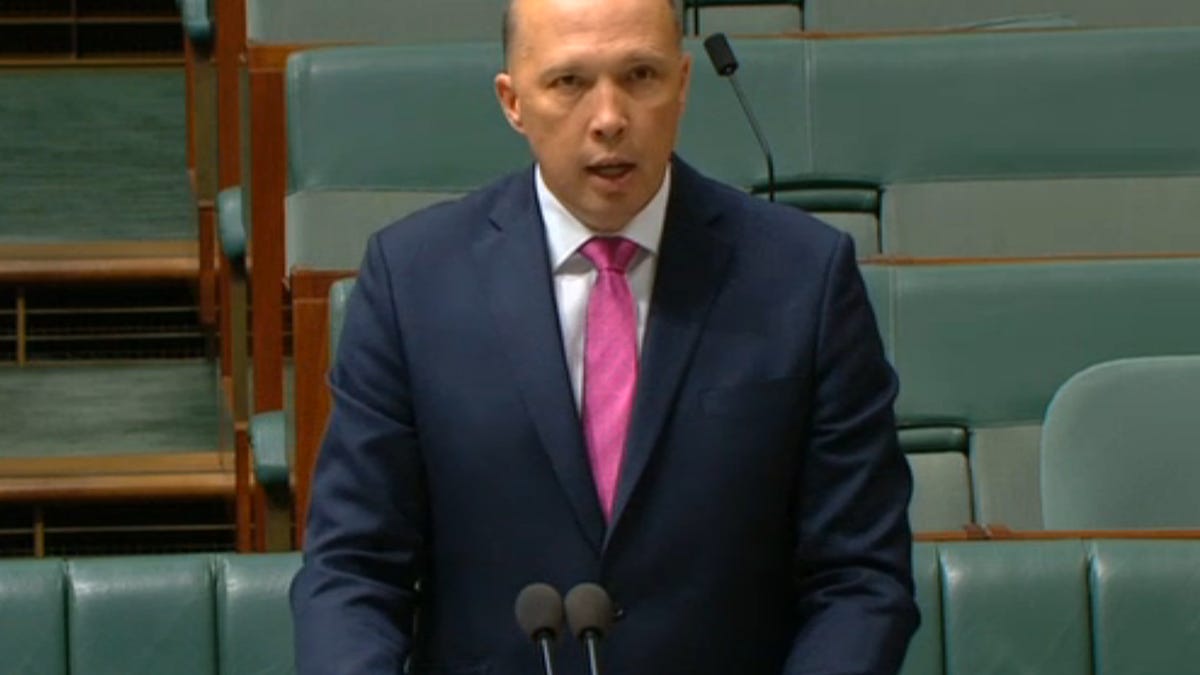
ZDNet - Canberra spent AU$92 million on the now-binned visa privatisation project
Boston Consulting Group walked away with AU$43.5 million of the total spend.
ZDNET -
2

The Guardian - Fears privatised visa system could see access to Australia 'sold to highest bidder'
Union warns up to 3,000 jobs and private information at risk under proposal that could include ‘premium services for high-value applicants’
the Guardian -
3
The Sydney Morning Herald - Millions on the table as government looks to privatise visa system
The deal could be signed off before the next federal election is called.
The Sydney Morning Herald -
4

SBS News - Fears government's outsourcing of visa processing just a privatisation smokescreen
The Morrison government has rejected claims it is privatising the visa processing system, downplaying fears over its outsourcing push.
SBS News -
5
DEWR - Skilled visa reforms to build a modern Australia
Ministers Dewr Gov
-
6

Parliament of Australia - Inquiry into the failed visa privatisation process
On 30 November 2023, the Joint Committee of Public Accounts and Audit adopted an inquiry into the procurement of the permissions capability to inquire into and report into the multi-stage procurement process commenced by the Department of Home Affairs in 2017 for a new IT workflo
Aph Gov
Rating Scale Methodology
1-3: FALSE
Factually incorrect or malicious fabrication.
4-6: PARTIAL
Some truth but context is missing or skewed.
7-9: MOSTLY TRUE
Minor technicalities or phrasing issues.
10: ACCURATE
Perfectly verified and contextually fair.
Methodology: Ratings are determined through cross-referencing official government records, independent fact-checking organizations, and primary source documents.