
The Claim
“Unemployment at 4.3% (November 2025), one of lowest rates in 50 years”
Original Sources Provided
✅ FACTUAL VERIFICATION
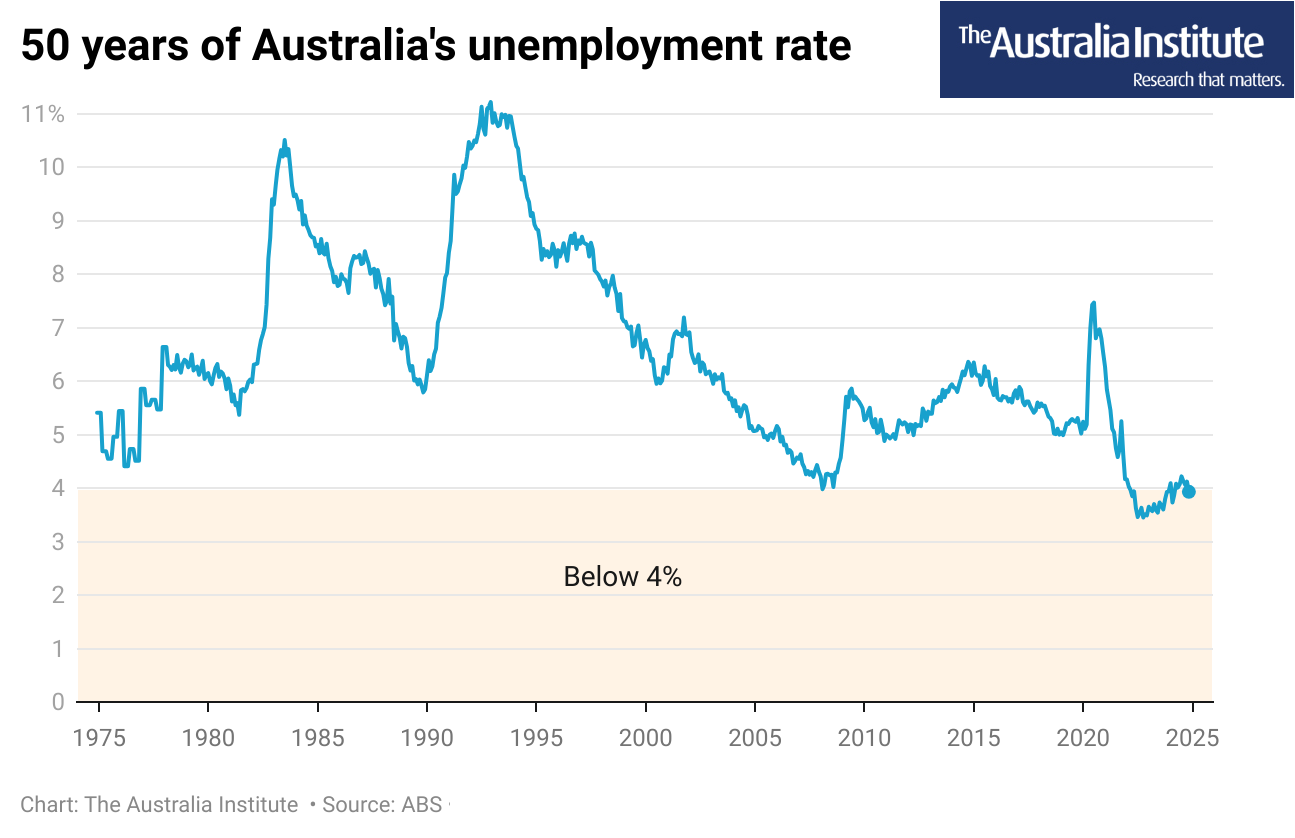
The November 2025 unemployment rate of 4.3% is accurate according to the Australian Bureau of Statistics [1]. However, the claim's framing is misleading. The lowest point Australia has reached in the past 50 years was 3.5% in June 2022 [2]—just before Labor took office in May 2022. More precisely, unemployment was 3.5% when Labor inherited office (September 2022) and has since risen to 4.3% [3][4].
The claim that 4.3% is "one of lowest rates in 50 years" is technically true—it is lower than pre-2022 unemployment for much of the period, with rates below 4% being rare historically [5]. However, the framing obscures the critical fact that unemployment has worsened under Labor's tenure.
Missing Context
1. Unemployment Rose Under Labor
The most important missing context is that when Labor took office in May 2022, unemployment was at a 50-year low of 3.5%. By November 2025, it had risen to 4.3%—an increase of 0.8 percentage points [2][3]. This is the opposite of an achievement; it represents deterioration from already low unemployment. The claim presents the current rate without mentioning this increase.
2. Labor Inherited the Strong Job Market
The 3.5% unemployment rate in mid-2022 was the result of the previous Coalition government's policies and the post-COVID labor market tightness. Labor inherited an exceptionally tight labor market—not achieved it. The current 4.3% represents a loosening of this inherited strength.
3. Underemployment at 12-Month Highs
While headline unemployment remained at 4.3% in November 2025, underemployment rose to 12-month highs according to ABC News reporting [6]. Underemployment measures workers wanting more hours (particularly part-time workers seeking full-time work). This indicates labor market weakness masked by the headline unemployment figure.
4. Part-Time Work Dominance
Labor's job creation (discussed in point 1.3) heavily skewed toward part-time roles. According to the ABS, nearly half of underemployed part-time workers preferred to work full-time hours [7]. The composition of employment—shifting toward part-time and casual work—is not reflected in the headline unemployment rate.
5. Labor Force Participation Context
Labor force participation increased from 65.3% to 67.0% between 2022-2025 [8]. While this appears positive, much of this was driven by women entering the workforce (participation rising 3.1 percentage points for women age 25-54) [9]. This increase in labor supply competing for jobs, combined with population growth from high migration, likely explains why unemployment rose despite "1.2 million jobs created"—the jobs barely kept pace with new entrants to the labor force.
6. Population Growth Masking Real Labor Demand
Australia's unemployment rise must be understood in context of the highest net migration in the country's history during Labor's term. Population grew faster than employment, which is why unemployment rose despite job creation figures appearing strong. This is similar to point 1.3's critique.
💭 CRITICAL PERSPECTIVE
The claim "unemployment at 4.3%, one of the lowest rates in 50 years" uses accurate data but deceptive framing. Here's the fuller story:
Inherited vs Achieved: Australia inherited 3.5% unemployment (50-year low) from the Coalition government. Labor's term saw unemployment rise to 4.3%. This is not an achievement—it's deterioration from an already exceptional starting position.
Headline vs Reality: The 4.3% headline unemployment rate masks rising underemployment at 12-month highs [6]. Workers want more hours than they're getting. The labor market is actually weaker than the unemployment figure suggests.
Job Quality Decline: Most new jobs were part-time. Full-time employment growth lagged population growth. Workers are getting less hours, not more—underemployment tells this story.
Supply vs Demand: Population growth and record migration meant the labor market had to create jobs just to keep unemployment from rising further. The 1.2 million jobs created must be understood as barely matching supply growth.
Historical Comparison Dishonesty: Saying "one of the lowest in 50 years" when unemployment rose during your term from the actual 50-year low is misleading. It's technically true but designed to obscure the relative deterioration.
Labor didn't maintain the strong labor market it inherited—it allowed unemployment to rise while population surged. This is the opposite of a positive claim.
MISLEADING
3.0
out of 10
The unemployment figure (4.3%) is accurate, and it technically is low by 50-year standards. However, the claim is designed to mislead by:
- Not disclosing that unemployment rose from 3.5% (the actual 50-year low) to 4.3% under Labor
- Not mentioning rising underemployment at 12-month highs
- Not explaining that job creation barely kept pace with population growth from migration
- Presenting inherited strength as if it were maintained or improved
The claim frames a deteriorating labor market as an achievement.
Final Score
3.0
OUT OF 10
MISLEADING
The unemployment figure (4.3%) is accurate, and it technically is low by 50-year standards. However, the claim is designed to mislead by:
- Not disclosing that unemployment rose from 3.5% (the actual 50-year low) to 4.3% under Labor
- Not mentioning rising underemployment at 12-month highs
- Not explaining that job creation barely kept pace with population growth from migration
- Presenting inherited strength as if it were maintained or improved
The claim frames a deteriorating labor market as an achievement.
📚 SOURCES & CITATIONS (9)
-
1
Unemployment rate remains at 4.3%
Australian Bureau of Statistics -
2

Australia's jobless rate at 50-year low of 3.5%
Fall in unemployment rate from 3.9% to 3.5% is higher than forecast and may add to pressure on the Reserve Bank to continue raising interest rates
the Guardian -
3
Unemployment rate remains at 3.5%
Australian Bureau of Statistics -
4

3.5% unemployment: Australia's jobless rate at its lowest since 1974
Australia has its lowest unemployment rates in almost 50 years – helped along by high numbers of employees off work sick.
The Conversation -
5
Let's celebrate the new normal of unemployment below 4%
Those arguing that Australia cannot sustain unemployment below 4.5% without rising prices and wages have been found to be completely wrong. And it is time they admitted it.
The Australia Institute -
6
Australia's unemployment rate remains at 4.3 per cent, but the underemployment rate jumps to 12-month high
Australia's unemployment rate holds steady at 4.3 per cent in November, but the underemployment rate jumps to 12-month high.
Abc Net -
7
Underemployed workers, February 2025
Employed people who want to work more hours or worked reduced hours, including preferred hours and usual hours not worked, and underemployment ratios.
Australian Bureau of Statistics -
8
Labour Force, Australia, October 2025
Headline estimates of employment, unemployment, underemployment, participation and hours worked from the monthly Labour Force Survey
Australian Bureau of Statistics -
9
Changes in participation rates for men and women in Australia
Long term trends in the participation rate
Australian Bureau of Statistics
Rating Scale Methodology
1-3: FALSE
Factually incorrect or malicious fabrication.
4-6: PARTIAL
Some truth but context is missing or skewed.
7-9: MOSTLY TRUE
Minor technicalities or phrasing issues.
10: ACCURATE
Perfectly verified and contextually fair.
Methodology: Ratings are determined through cross-referencing official government records, independent fact-checking organizations, and primary source documents.