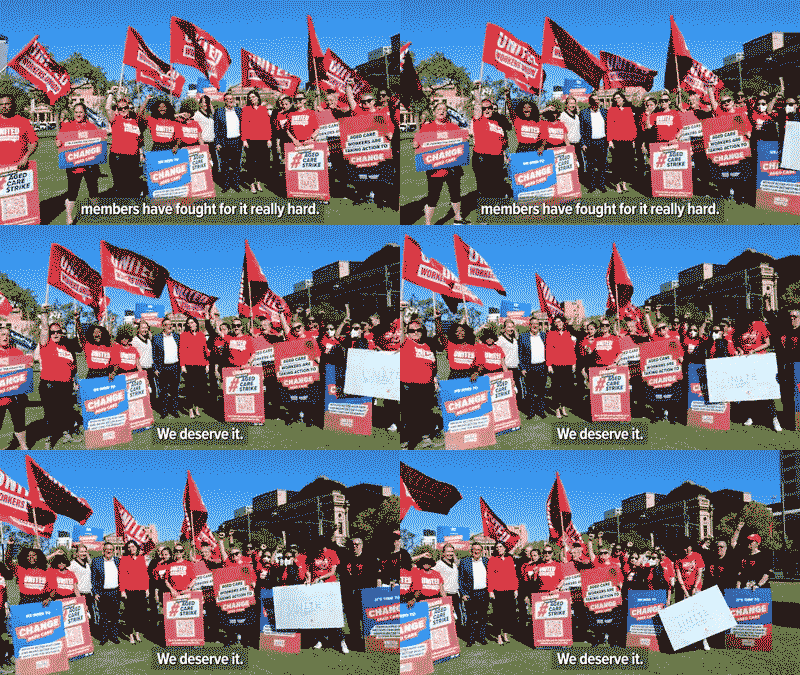
Dawa mein kai haqaeeqi izharein hain jo jaanch talab hain: 1. **$15.1 billion ka sarmaya kari**: Hukumat alag alag tareeqon se alag tadadein bayan karti hai.
The claim contains multiple factual assertions that require examination:
1. **$15.1 billion investment**: The government claims different figures depending on the context.
Asli 2023 Budget ne **$11.3 billion** ka wada kiya tha 15% izafe ke liye [1][2].
The original 2023 Budget committed **$11.3 billion** for the 15% increase [1][2].
Lehin, dawa mein zikr shudah $15.1 billion ki raqam January 2025 ke izafon aur hukumati taawun ko shamil karti hai.
However, the $15.1 billion figure cited in the claim appears to include subsequent January 2025 increases and government co-contributions.
Yeh raqam qabil e etebaar hai lekin hukumat isay barah raas muntakhab nahi karti [1][2][3]. 2. **July 2023 se 15% izafa**: Yeh DURUST hai.
This figure is plausible but the government doesn't consistently cite it as the primary number [1][2][3].
2. **15% increase from July 2023**: This is ACCURATE.
Fair Work Commission ne 30 June 2023 se amal avar hone wala 15% intehrimi izafa diya [1].
The Fair Work Commission awarded a 15% interim increase effective from 30 June 2023 [1].
Yeh residential buzurg negahdari mein sidhi dekhbhal karne walon par lagu hua [1].
This applied to direct care employees in residential aged care [1].
Hukumat ne is izafe ko $11.3 billion se funded kiya [1][2]. 3. **January 2025 se mazeed izafe**: Yeh DURUST hai lekin na mukammal.
The government funded this increase at $11.3 billion [1][2].
3. **Further increases from January 2025**: This is ACCURATE but incomplete.
Awards ko 1 January 2025 se barhaya gaya, jis mein aam mazdooron ko 3% izafe mile [3].
Awards were increased from 1 January 2025, with general workers receiving 3% increases [3].
Lehin, mazeed izafe 1 October 2025 ko hue jab Fair Work Commission ne mazeed izafon ka total 28.5% tak faisla sunaya (khaas tor par January 2025 nahi, lekin yeh 2025 ke taqweem saal mein hua) [4].
However, additional increases occurred on 1 October 2025 when the Fair Work Commission awarded further increases of up to 28.5% total (not specifically January 2025, but this occurred in the 2025 calendar year) [4].
Haqaeeqi daawe bunyadi tor par durust hain lekin framing chuninda hai ke kaun se izafe shaamil hain.
The factual claims are substantially accurate but the framing is selective about which increases count.
غائب سیاق و سباق
Lehin, dawa ahem zawabiq ko posheda karti hai jo kaamyabi aur iski munsifanai ko buniyadi tor par badal deti hain:
However, the claim obscures critical context that fundamentally misrepresents the achievement and its effectiveness:
### 1. Izafa Fair Work Commission Ne Diya, Hukumat Ne Nahi
### 1. The Increase Was Mandated by Fair Work Commission, Not Government Initiative
Dawa tankhwa mein izafe ko hukumati karwai ke tor par paish karta hai—"Labor ki" kaamyabi.
The claim frames the pay rise as government action—"Labor's" achievement.
Yeh fareb hai. 15% izafa Fair Work Commission ke work value assessment ke jawab mein aya [1].
This is misleading.
Hukumat ne isay FUND kiya, lekin CREATE nahi kiya [1][2].
The 15% increase resulted from a Fair Work Commission decision in response to work value assessment [1].
Yeh farq zaroori hai: Hukumat ka award wage faisla ko fund karna policy innovation nahi hai; yeh azad adalat ke faisle ko qubool karna hai.
The government FUNDED it, but didn't CREATE it [1][2].
Hukumat FWC ke faisle ko refuse nahi kar sakti thi bina pure award nizam ko undermine kiye [1].
The distinction matters: Government funding an award wage decision is not policy innovation; it's accepting an independent tribunal's determination.
Is ke ilawa, mazeed izafe (January 2025 aur October 2025) bhi FWC ke faisle the, hukumati policy nahi [3][4].
The government could not have refused to fund the FWC decision without undermining the entire award system [1].
Hukumat ka kirdar funding compliance tha, izafon ko agay barhane mein nahi [3].
Furthermore, the subsequent increases (January 2025 and October 2025) were also FWC decisions, not government policy [3][4].
### 2. Izafon Ne Workforce Crisis Hal Nahi Kiya
The government's role was funding compliance, not driving the increases [3].
Dawa tankhwa mein izafon ko buzurg negahdari ke buhran ko hal karne ke tor par paish karta hai.
### 2. The Increases Have NOT Solved the Workforce Crisis
Mojooda saboot dikhate hain ke isay hal Nahi kiya gaya: **Qowat ki kami 15% izafon ke bawajood barqaraar hai [5]:** - CEDA ne 2030 tak **110,000 sidhi buzurg negahdari mehnat kashon ki kami** ka andaza lagaya hai [5] - Yeh kami projection 15% izafe ke amal avar hone ke baad bhi hai [5] - Dehati aur door daraz ilaqon mein 50% tak qowat ki kami ka samna hai [5] **Barkhutagi ab bhi kamzor hai [5]:** - Tankhwa mein behtari ke bawajood, buzurg negahdari facilities ko "barti hui barkhutagi ke chailenj" ka samna hai [5] - Sector mein qowat ka tabadla ab bhi mushkil hai behtar pay ke bawajood [5] **Kam staff hone se dekhbhal ki mayar kharab hoti hai [5]:** - Mehnat kashon ko "shadeed karmakon ki kami ka samna hai jis se Australia ke sab se kamzoron ko zaruri dekhbhal ke liye bohat intezar karna parta hai" [4] - Yeh suratehal 15% izafe ke baad bhi barqaraar hai [4] 15% izafa, jab ke substantial tha, ne workforce ki kamzori ko roka nahi hai ya barkhutagi mein behtari nahi layi—yeh ishara hai ke buniyadi masael tankhwa se zyada gehre hain [4][5].
The claim presents wage increases as addressing the aged care crisis.
### 3. Mehangai Ki Kaat
Current evidence shows they have NOT:
**Workforce shortage persists despite 15% increases [5]:**
- CEDA forecasts a shortage of **110,000 direct aged care workers by 2030** [5]
- This shortage projection exists AFTER the 15% increase was implemented [5]
- Rural and remote areas face up to 50% workforce shortages [5]
**Retention remains poor [5]:**
- Despite wage increases, aged care facilities continue facing "mounting retention challenges" [5]
- The sector continues to struggle with workforce turnover despite improved pay [5]
**Understaffing worsens care quality [5]:**
- Workers "struggling with severe understaffing that left some of Australia's most vulnerable waiting too long for essential care" [4]
- This situation persists even after the 15% increase [4]
The 15% increase, while substantial, has not halted workforce decline or improved retention—suggesting the fundamental issues are deeper than just compensation [4][5].
Dawa tankhwa mein izafon ko mehangai ke khilaf zawal nahi deta: - Buzurg negahdari mehnat kashon ko July 2023 mein 15% izafa mila [1] - July 2023 se December 2024 tak (18 mahine) mehangai lagbhag 3-4% thi [6] - Mehnat kashon ne lihaza is izafe se **11-12% asli tankhwa kharidari qowat** hasil ki [1][6] - Lehin, July 2023 se pehle, buzurg negahdari ki tankhwayein saalon se jamood ka shikar thi jab mehangai barh rahi thi, jis se cumulative real wage decline hua [4] 15% izafa accumulated real wage losses se jismani recovery ko zahir karta hai, genuine wage growth nahi jo mayari zindagi mein behtari laye [4][6].
### 3. Cost of Living Erosion
### 4. Alag Alag Care Categories Mein Barabari Nahi
The claim doesn't contextualize pay rises against cost of living:
- Aged care workers received 15% increase July 2023 [1]
- Inflation from July 2023 to December 2024 (18 months) was approximately 3-4% across sectors [6]
- Workers therefore gained approximately **11-12% in real wage purchasing power** from this increase [1][6]
- However, prior to July 2023, aged care wages had stagnated for years while inflation rose, creating cumulative real wage decline [4]
The 15% increase represents partial recovery from accumulated real wage losses, not genuine wage growth that improves living standards [4][6].
Dawa tankhwa mein izafe ko buzurg negahdari ke sector mein mutahid paish karta hai.
### 4. Unequal Application Across Care Categories
Yeh fareb hai: - **Sidhi dekhbhal karne wale mehnat kash**: 15% izafe mile (Cert III personal care: $24.76 → $32.21/ganta) [4] - **Ta'awun karne wale mehnat kash** (catering, safai, kapra dhona): Sirf 7% izafa mila [4] - Baad ke izafe (2025) bhi alag alag classifications par barabar nahi the [3] United Workers Union ne note kiya: "catering, safai aur kapra dhoney ke ta'awun karne wale jinhein sirf 7% izafa mila" undervalued hain facility ke amal ke liye zaruri hone ke bawajood [4].
The claim presents unified pay rises across aged care sector.
Yeh androoni na barabari dawe ki mutahid izafe ki paishkashi se posheda hai [4].
This is misleading:
- **Direct care workers**: Received 15% increases (Cert III personal care: $24.76 → $32.21/hour) [4]
- **Support workers** (catering, cleaning, laundry): Received only 7% increase [4]
- Later increases (2025) also applied unevenly across classifications [3]
The United Workers Union noted: "support workers in catering, cleaning and laundry who received only a 7% increase" are undervalued despite being essential to facility operations [4].
### 5. Funding Model Par Pae'dari Ke Sawalat
This internal inequality is hidden by the claim's presentation of unified increases [4].
Dawa nahi batata ke hukumat mazeed tankhwa izafon ko kaise fund karegi: - Asli 15% 2023-24 Budget ($11.3 billion) se funded tha [1] - January 2025 ke izafe baad ke budgets se funded the [3] - October 2025 ke izafe (28.5% tak) ke liye mazeed hukumati funding chahiye [4] - Hukumat ne buzurg negahdari tankhwon ke liye kul deirpa funding wada publish nahi kiya [3] Yeh ghair yaqeeni paida karta hai: Kya yeh one-time izafe hain ya mustaqil policy?
### 5. Sustainability Questions on Funding Model
Hukumat waqt ke sath cumulative izafon ko kaise fund karegi?
The claim doesn't address how the government will fund ongoing pay increases:
- Initial 15% funded from 2023-24 Budget ($11.3 billion) [1]
- January 2025 increases funded from subsequent budgets [3]
- October 2025 increases (up to 28.5%) require additional government funding [4]
- Government hasn't published total long-term funding commitment for aged care wages [3]
This creates uncertainty: Are these one-time increases or permanent policy?
Deirpa wabasta ke baghair, mehnat kashon aur farahmi kanadaron ko budget ghair yaqeeni ka samna hai [3].
How will government fund cumulative increases over time?
### 6. Buzurg Negahdari Farahmi Kanadaron Ka Mali Buhran
Without long-term commitment, workers and providers face budget uncertainty [3].
Dawa tankhwa mein izafon ki taqreeb karta hai bina is ke qayem ki ke ye lagaat sector mein mali dabeaw peda kar rahi hai: - Buzurg negahdari farahmi kanadaron ko FWC award tankhwain ada karni chahiye [3] - Residential buzurg negahdari funding models tankhwa izafon ke sath mukammal tor par agey nahi barhe hain [3] - Kanadar barhti hui munasibat ke darmiyan munasibat aur mayari dekhbhal ke darmiyan chunna mushkil pa rahe hain [3] - Kuch kanadar ghante kam kar rahe hain ya tankhwa lagaat ke intizam ke liye khidmaton mein katauti kar rahe hain [3] Hukumat sector par tankhwa lagaat thop rahi hai jab ke munasib funding yakeeni nahi bana rahi—ek aisa nizam paida kar rahi hai jahan kanadar tankhwa ke ta'qat aur mayari dekhbhal ke darmiyan chunte hain [3].
### 6. Aged Care Provider Financial Crisis
### 7. Framing Un Cheezon Ko Nazar Andaaz Karti Hai Jo Hasil Nahi Hui
The claim celebrates wage increases without acknowledging the cost is creating financial stress in the sector:
- Aged care providers are required to pay FWC award wages [3]
- Residential aged care funding models haven't fully kept pace with wage increases [3]
- Providers increasingly struggle with profitability while maintaining quality care [3]
- Some providers reducing hours or cutting services to manage wage cost increases [3]
The government is imposing wage costs on the sector while not ensuring adequate funding—creating a system where providers choose between wage compliance and service quality [3].
Dawa tankhwa ko kaamyabi ke tor par paish karta hai bina is ke tasleem kiye ke: - **Workforce crisis jari hai**: 2030 tak 110,000 mehnat kashon ki kami ka projection tankhwa izafon ke bawajood [5] - **Barkhutagi behtar nahi hoti**: Mehnat kash ab bhi 15% izafe ke bawajood chhor rahe hain [4][5] - **Dekhbhal ki mayar kharab ho rahi hai**: Karmakon ki kami aur intezar barqaraar hain [4] - **Kaam ke halat behtar nahi hue**: 7% ta'awun karne wale mehnat kashon ko ab bhi minimal izafe mil rahe hain [4] - **Dehati/door daraz ki rasai kharab ho rahi hai**: Izafon ke bawajood door daraz ilaqon mein 50% ki kami [5] Tankhwa mein izafe akelay, comprehensive workforce strategy ke baghair, nizami masael hal nahi karte [4][5].
### 7. The Framing Ignores What Wasn't Achieved
💭 تنقیدی نقطہ نظر
Dawa **buniadi kaamyabi ko jamee kamyabi ke tor par paish karna** buzurg negahdari workforce policy mein hai.
The claim represents **partial achievement presented as comprehensive success** in aged care workforce policy.
Yahan poora zawabiq hai:
Here's the full context:
### Kya Hua
### What Happened
1.
1.
Fair Work Commission ne work value assessment kiya [1] 2. 15% intehrimi izafa diya, hukumati funding ($11.3B) se taeyun shuda [1][2] 3.
Fair Work Commission conducted work value assessment [1]
2.
Mazeed izafe hue (January 2025, October 2025) [3][4] 4.
Awarded 15% interim increase, backed by government funding ($11.3B) [1][2]
3.
Sidhi dekhbhal karne walon ke liye kul izafe 28.5% tak pohanche jab stage izafe mukammal hue [4] Yeh haqeeqi taraqqi hai—buzurg negahdari mehnat kashon ko qabil e ta'reef tankhwa izafe mile [1][4].
Additional increases followed (January 2025, October 2025) [3][4]
4.
### Kya Nahi Hua
Total increases for direct care workers reached 28.5% when staged increases complete [4]
This is genuine progress—aged care workers did receive substantial wage increases [1][4].
1. **Workforce shortage ulat gayi**: Ab bhi 2030 tak 110,000 mehnat kashon ki kami ka samna hai [5] 2. **Barkhutagi behtar hui**: Tabadla tankhwa ke bawajood masla barqaraar hai [4][5] 3. **Dekhbhal ki mayar behtar hui**: Karmakon ki kami aur lambe intezar barqaraar hain [4] 4. **Barabar muamla**: Ta'awun karne walo ko sirf 7% mila jab ke sidhi dekhbhal ko 28.5% mila [4] 5. **Nizam ki pae'dari ka khayal**: Kanadar tankhwa mandate ke bawajood funding gaps ka samna kar rahe hain [3] 6. **Deirpa wabasta hasil hui**: Mehangai ke sath tankhwain index karne ka hukumati wada nahi [3]
### What Didn't Happen
### Maahirana Tajweez
1. **Workforce shortage reversed**: Still facing 110,000 worker deficit by 2030 [5]
2. **Retention improved**: Turnover remains problematic despite wages [4][5]
3. **Care quality enhanced**: Understaffing and long waits persist [4]
4. **Equal treatment**: Support workers received only 7% while direct care got 28.5% [4]
5. **System sustainability addressed**: Providers face funding gaps despite wage mandates [3]
6. **Long-term commitment secured**: No government commitment to index wages with inflation [3]
**Hukumat ka dawa**: Tankhwa izafe buzurg negahdari workforce crisis ko hal kar rahe hain [1] **Sector ki haqeeqat**: - CEDA: "Australia agle decade mein kam az kam 110,000 sidhi buzurg-dekhbhal mehnat kashon ki kami ka samna kar rahi hai" [5] - United Workers Union: "Hamara kaam saalon se durust qadar nahi kiya gaya" aur nizami tabdeeli tankhwon se zyada chahiye [4] - Buzurg Negahdari kanadar: Tankhwa lagaat se peda hone wali funding gaps [3] **Tajweez**: Tankhwa izafe zaroori hain lekin nakaafi hain.
### Expert Assessment
Hukumat ne ek adalat ke faisle ko fund kiya bina jamee workforce strategy ke jo kami, barkhutagi, ya kaam ke halat ko hal kar sake [4][5].
**Government's claim**: Wage increases are addressing aged care workforce crisis [1]
**Sector reality**:
- CEDA: "Australia is facing a shortage of at least 110,000 direct aged-care workers within the next decade" [5]
- United Workers Union: "Our work has not been properly valued for years" and systemic change requires more than wages [4]
- Aged Care providers: Funding gaps created by unmatched wage cost increases [3]
**Assessment**: Wage increases are necessary but insufficient.
جزوی طور پر سچ
6.5
/ 10
Haqaeeqi tor par tankhwa izafe durust hain, lekin asar aur kaamyabi ke barey mein buniyadi tor par fareb.
Factually accurate on wage increases, but fundamentally misleading about impact and achievement.
Dawa technically tasdeeq shudah hai lekin stratejically framed hai: - FWC adalat ke faisle ko hukumati sarparasti ke tor par paish karta hai (funding ≠ policy creation) - Workforce nataej ke saboot ke baghair kaamyabi ka dawa karta hai - Tankhwa izafon ke bawajood 110,000 mehnat kashon ki kami ko nazar andaaz karta hai - Alag alag izafon (7% vs 28.5%) ko posheda karta hai alag alag mehnat kash categories mein - One-time/stage izafon ko masaili buhran ko hal karne ke tor par paish karta hai - Kanadaron par tankhwa mandate se peda hone wali funding gaps ko tasleem nahi karta - Tankhwa izafe ko jamee hal ke tor par paish karta hai jab ke yeh sirf ek element hai
The claim is technically verified but strategically framed:
- Presents FWC tribunal decision as government initiative (funding ≠ policy creation)
- Claims success without evidence of improved workforce outcomes
- Ignores persistent 110,000 worker shortage despite wage increases
- Hides unequal increases (7% vs 28.5%) across different worker categories
- Frames one-time/staged increases as addressing structural crisis
- Doesn't acknowledge provider funding gaps created by wage mandates
- Positions wage increase as comprehensive solution when it's only one element
حتمی سکور
6.5
/ 10
جزوی طور پر سچ
Haqaeeqi tor par tankhwa izafe durust hain, lekin asar aur kaamyabi ke barey mein buniyadi tor par fareb.
Factually accurate on wage increases, but fundamentally misleading about impact and achievement.
Dawa technically tasdeeq shudah hai lekin stratejically framed hai: - FWC adalat ke faisle ko hukumati sarparasti ke tor par paish karta hai (funding ≠ policy creation) - Workforce nataej ke saboot ke baghair kaamyabi ka dawa karta hai - Tankhwa izafon ke bawajood 110,000 mehnat kashon ki kami ko nazar andaaz karta hai - Alag alag izafon (7% vs 28.5%) ko posheda karta hai alag alag mehnat kash categories mein - One-time/stage izafon ko masaili buhran ko hal karne ke tor par paish karta hai - Kanadaron par tankhwa mandate se peda hone wali funding gaps ko tasleem nahi karta - Tankhwa izafe ko jamee hal ke tor par paish karta hai jab ke yeh sirf ek element hai
The claim is technically verified but strategically framed:
- Presents FWC tribunal decision as government initiative (funding ≠ policy creation)
- Claims success without evidence of improved workforce outcomes
- Ignores persistent 110,000 worker shortage despite wage increases
- Hides unequal increases (7% vs 28.5%) across different worker categories
- Frames one-time/staged increases as addressing structural crisis
- Doesn't acknowledge provider funding gaps created by wage mandates
- Positions wage increase as comprehensive solution when it's only one element