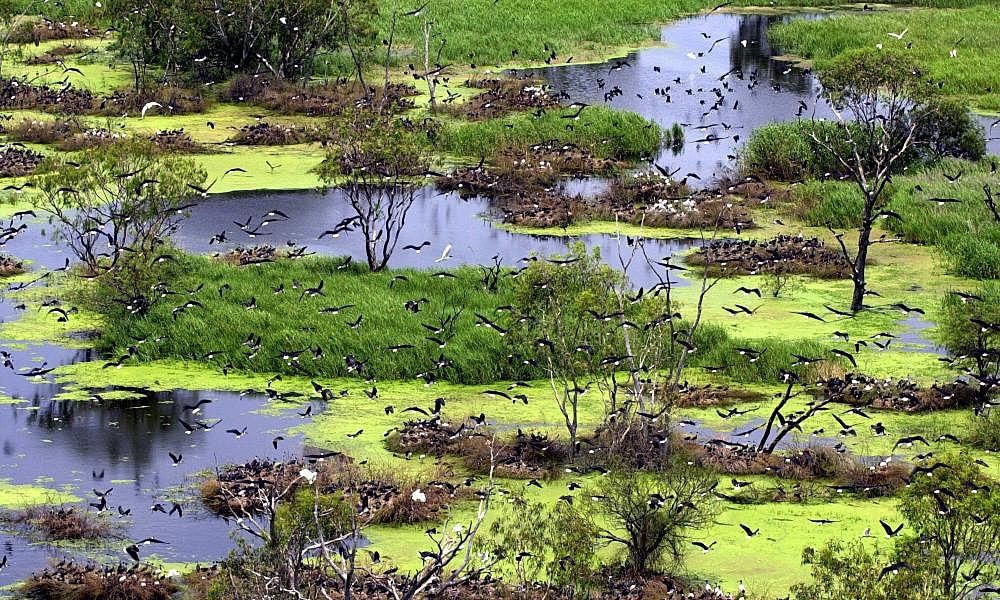
The Coalition government, under Environment Minister Greg Hunt, did indeed remove the Murray River and associated wetlands from the list of threatened ecological communities in December 2013 [1].
The disallowance motion passed by Parliament overturned the "critically endangered" designation that had been applied to significant stretches of the Murray-Darling system [3].
The claim omits critical context about the timeline and circumstances:
1. **The listing was extremely recent**: The "critically endangered" listing was only implemented on August 5, 2013, by then-Environment Minister Mark Butler (Labor) in the final months of the Rudd/Gillard Labor government [4].
It had been in effect for just over four months when the Coalition removed it.
2. **Labor's timing was politically significant**: The listing was made in the lead-up to the September 2013 federal election, which Labor lost [4].
The Coalition's removal of the listing came after they won government.
3. **The listing followed a campaign by the National Irrigators' Council**: The Coalition's decision to disallow the listing followed pressure from agricultural stakeholders, particularly the National Irrigators' Council, who argued the designation would impose unnecessary "green tape" and regulatory burdens on farming communities [5].
4. **The listing was eventually restored**: In January 2026, the Albanese Labor Government reinstated the critically endangered listing for the River Murray following a new scientific assessment [6].
While generally reputable for factual reporting, its environmental coverage tends to favor conservation perspectives over agricultural/industry concerns.
The headline framing ("to cut green tape") presents the Coalition's action in a negative light without explaining the full context of the very recent Labor-era listing.
**Did Labor do something similar?**
Search conducted: "Labor government Murray Darling Basin threatened listing removal environmental"
**Finding**: The historical context reveals a pattern of partisan reversal:
1. **Labor created the listing in 2013**: Mark Butler (Labor Environment Minister) listed the River Murray as critically endangered on August 5, 2013, just weeks before the election [4].
2. **Coalition removed it in 2013**: Greg Hunt (Coalition Environment Minister) disallowed the listing on December 11, 2013 [1][3].
3. **Labor restored it in 2026**: The Albanese Labor Government officially relisted the River Murray as critically endangered in January 2026 [6].
* * * *
This demonstrates that **both parties have used this ecological listing as a political football**.
While critics argue the Coalition "ignored one of the most highly respected scientific bodies in Australia" and "sold their constituents in the Murray Darling Basin down their own river" [7], the full story requires understanding:
**Coalition's stated rationale:**
- Environment Minister Greg Hunt argued the critically endangered listing was "unnecessary protection for the massive river system" [3]
- The Coalition framed this as reducing "green tape" and regulatory burden on agricultural communities [1]
- The Murray-Darling Basin was already subject to extensive management under the Water Act and Basin Plan [8]
**Agricultural community perspective:**
- The National Irrigators' Council campaigned against the listing, arguing it would duplicate existing regulations and create additional compliance costs for farmers without improving environmental outcomes [5]
- Rural communities viewed the Labor-era listing as last-minute environmental posturing before an election
**The scientific context:**
- The Threatened Species Scientific Committee had recommended the critically endangered listing based on environmental assessments
- However, the listing's effectiveness was debated - conservationists argued it provided vital protection, while agricultural groups argued the Murray-Darling Basin Plan already provided sufficient environmental safeguards
**Key context**: This was **not unique to the Coalition** - both major parties have reversed this specific environmental listing when changing government.
The claim presents a four-month-old Labor-era listing as established policy that the Coalition callously removed, when in reality it was a contested, recently-implemented designation that both parties have alternately implemented and removed based on electoral outcomes.
However, the claim presents this as a standalone anti-environmental act without crucial context: (1) the listing had only existed for four months, having been implemented by Labor in their final days before losing the 2013 election, (2) both parties have since alternately implemented and removed this listing based on who holds government, and (3) the removal followed significant agricultural community opposition.
The claim is technically true but misleadingly framed as a uniquely Coalition environmental rollback rather than part of a bipartisan pattern of policy reversal.
However, the claim presents this as a standalone anti-environmental act without crucial context: (1) the listing had only existed for four months, having been implemented by Labor in their final days before losing the 2013 election, (2) both parties have since alternately implemented and removed this listing based on who holds government, and (3) the removal followed significant agricultural community opposition.
The claim is technically true but misleadingly framed as a uniquely Coalition environmental rollback rather than part of a bipartisan pattern of policy reversal.