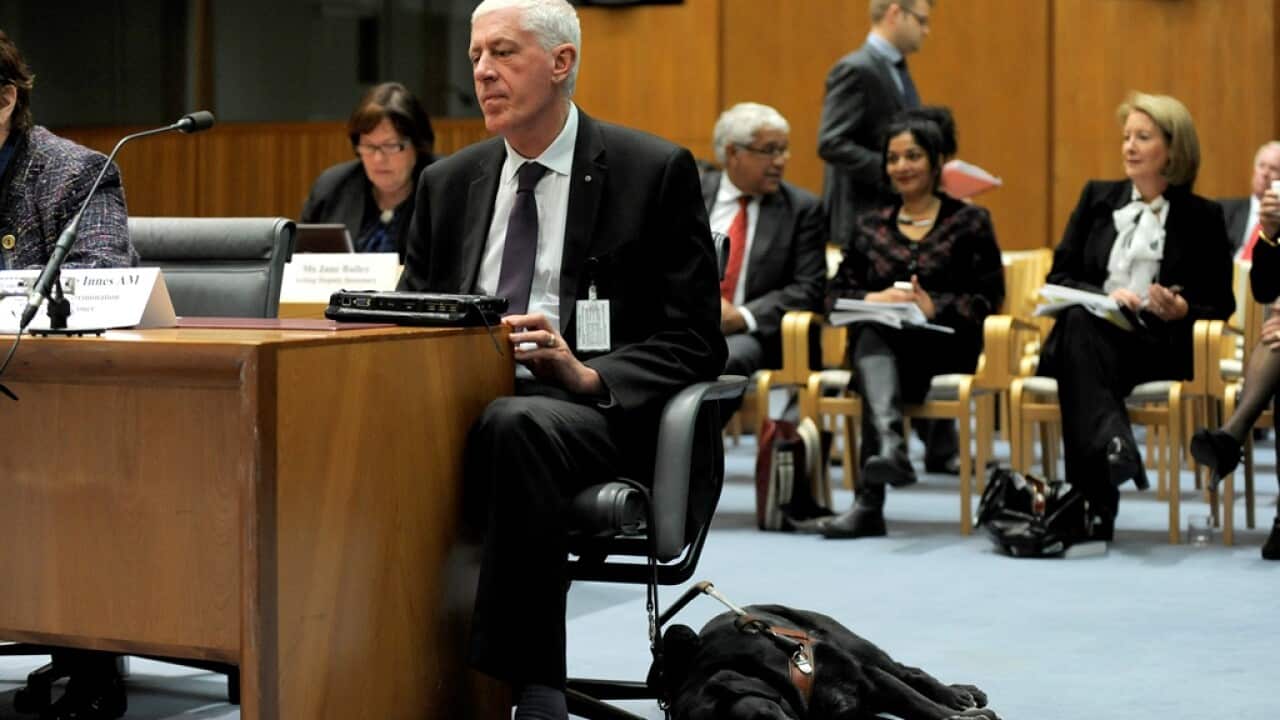
Graeme Innes served as Australia's Disability Discrimination Commissioner from December 2005 until July 2014, when his term ended and the position was not renewed [1].
The decision to abolish the position was announced in the May 2014 Budget, with the budget papers noting the dismissal would "achieve efficiencies within the Human Rights Commission" [3].
The government cut $1.7 million from the Australian Human Rights Commission (AHRC) budget [4], and the disability discrimination role was absorbed into the Age Discrimination Commissioner's portfolio [5].
Notably, at the same time the government abolished this position, it created a new "Freedom Commissioner" role (held by Tim Wilson, a former Institute of Public Affairs fellow and personal friend of Attorney-General George Brandis), which cost the AHRC over $700,000 [6].
The government reversed this decision in April 2016, announcing it would reinstate the full-time Disability Discrimination Commissioner position, two years after abolishing it [7].
Disability complaints were the largest category at the AHRC:** At the time of abolition, disability-related complaints constituted approximately 37-39% of the AHRC's total caseload - the largest single category, nearly double the next highest category [9].
The role was not completely eliminated:** The disability discrimination functions were technically merged into the Age Discrimination Commissioner's portfolio, making it a part-time responsibility rather than a dedicated full-time position [10].
The government argued that commissioners often served dual roles - indeed, Graeme Innes himself had previously held dual roles as Disability Discrimination Commissioner and Race Discrimination Commissioner for two years [11].
**3.
Position was reinstated after 2 years:** The government reversed the decision and reinstated the full-time commissioner in April 2016, before the federal election [12].
The same budget introduced multiple other cuts including to disability services, with the government arguing fiscal consolidation was necessary [13].
**5.
NDIS rollout context:** The abolition coincided with the beginning of the National Disability Insurance Scheme (NDIS) rollout, a major reform that advocates argued needed dedicated disability rights advocacy [14].
The Guardian Australia provides factual reporting but has editorial positions critical of conservative governments.
2. **Sydney Morning Herald (SMH)** - A mainstream Australian metropolitan newspaper (Fairfax Media, now Nine).
However, both outlets have editorial stances that have historically been critical of Coalition governments, which readers should be aware of when evaluating framing.
**Did Labor do something similar?**
The disability discrimination commissioner position was originally created in 1993 under a Labor government (Prime Minister Paul Keating), as part of the Disability Discrimination Act 1992 [15].
* * * *
Labor established the position as a full-time dedicated role.
There is no evidence that Labor sought to abolish, downsize, or merge the disability discrimination commissioner role.
**Labor's response and promise:**
When the Coalition abolished the position in 2014, Labor strongly criticized the decision.
The Coalition preempted this by announcing their own reinstatement the same day [17].
**Comparative assessment:**
This appears to be an action unique to the Coalition government.
Labor not only created the position but maintained it throughout their terms in government, and explicitly promised to restore it when campaigning against the Coalition's abolition.
**The government's position:**
The Abbott government argued that:
- Budget consolidation required difficult decisions across government agencies
- Commissioners often served dual roles, and this was not unprecedented
- The disability discrimination functions would continue under the Age Discrimination Commissioner
- The AHRC needed to absorb funding cuts like other government bodies [18]
**Critics' arguments:**
Disability advocates and critics argued that:
- Disability discrimination was the AHRC's largest workload (37-39% of complaints), justifying a dedicated commissioner
- The decision coincided with the NDIS rollout, when disability advocacy was most needed
- Creating a new "Freedom Commissioner" while abolishing the Disability Commissioner sent the wrong priorities signal
- People with disabilities faced significant barriers that required dedicated advocacy [19]
**The outcome:**
After two years and significant political pressure, the government reversed the decision and reinstated the position in April 2016, appointing Alastair McEwin (who had extensive disability advocacy experience) in July 2016 [20].
**Comparative context:**
Unlike many other claims in this dataset, this action does not appear to have precedent across both major parties.
The Coalition government did abolish the position of Disability Discrimination Commissioner in 2014, folding its responsibilities into the Age Discrimination Commissioner's portfolio as part of budget cuts to the AHRC.
Unlike many other Coalition actions, this does not appear to have Labor precedent - Labor created the position and maintained it throughout their governments.
The Coalition government did abolish the position of Disability Discrimination Commissioner in 2014, folding its responsibilities into the Age Discrimination Commissioner's portfolio as part of budget cuts to the AHRC.
Unlike many other Coalition actions, this does not appear to have Labor precedent - Labor created the position and maintained it throughout their governments.