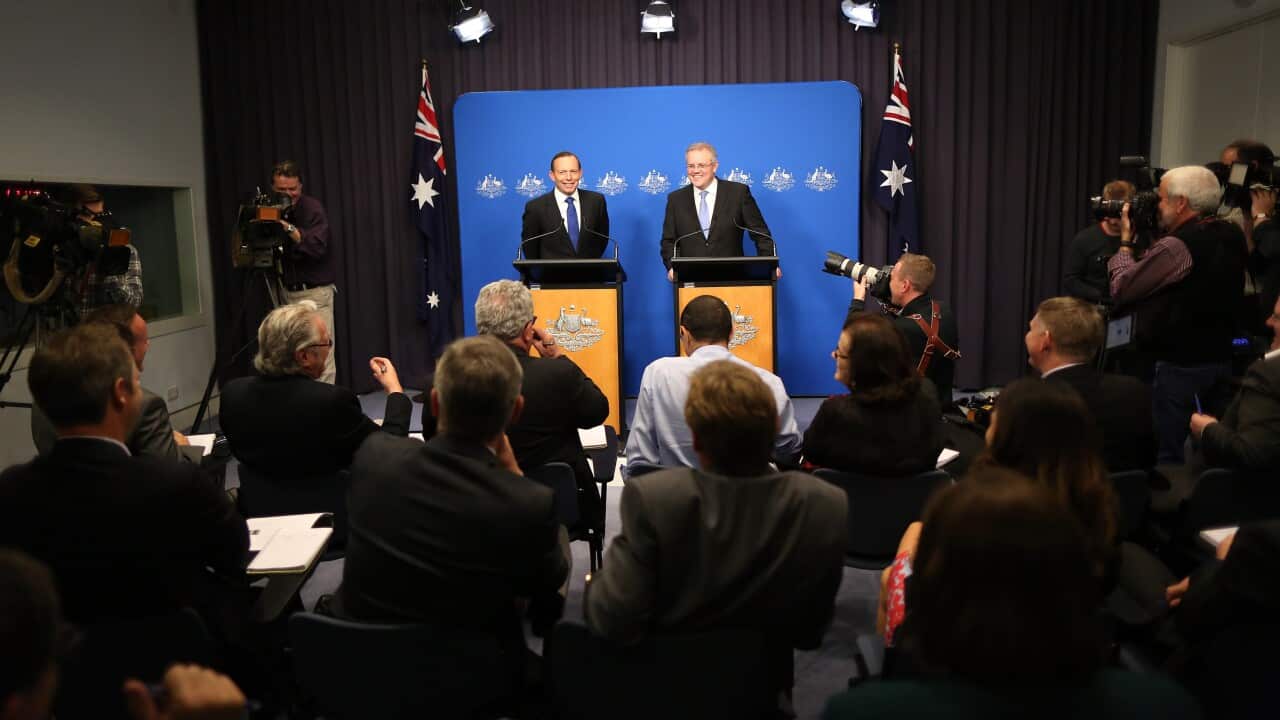
**Core facts verified:** The Abbott Coalition government significantly increased financial incentives for asylum seekers on Manus Island and Nauru to voluntarily return to their countries of origin in 2014 [1][2].
**Payment amounts increased:** The Coalition offered between $3,300 and $10,000 depending on nationality - Lebanese asylum seekers were offered $10,000, Iranians and Sudanese $7,000, Afghans $4,000, and Pakistani, Nepalese and Burmese $3,300 [1][2].
This represented a dramatic increase from the previous Labor government's offering of $1,500-$2,000 [2].
**Administration:** The payments were administered by the International Organization for Migration (IOM), a UN-related agency, not directly by the Australian government [1][3].
IOM has been implementing Assisted Voluntary Return and Reintegration (AVRR) programmes worldwide since 1979 as a "humane and dignified approach to return" [4].
**Government opposition confirmed:** Labor opposition immigration spokesman Richard Marles stated in June 2014: "when Scott Morrison was in opposition he opposed Labor's own re-integration packages and now he is offering sums that are triple the amount" [2].
Immigration Minister Scott Morrison stated: "It has been the standard practice for more than a decade for settlement packages to be offered to those who voluntarily return home" [2].
The Labor government under Julia Gillard had already been offering $1,500-$2,000 payments [2].
**Safety assessments:** The claim's emotive framing about returning to "war crimes, genocide, torture and persecution" is not fully accurate.
IOM's policy states they "do not facilitate involuntary returns" [1].
**Voluntary nature:** The claim omits that these were described as voluntary returns, and asylum seekers who accepted the payments reportedly spent their own money before receiving reimbursement upon return [5].
By June 2014, 283 people had voluntarily returned since September 2013 [1].
**International practice:** Assisted Voluntary Return programs are standard practice internationally, implemented by numerous countries including the UK, European nations, and others, often administered by IOM [4][6].
**PNG Supreme Court context:** The timing coincided with increasing legal pressure on offshore detention, including the PNG Supreme Court's 2016 ruling that detention on Manus was unconstitutional [7].
The SBS article provides balanced coverage including both government justification and opposition criticism [2].
**The New Parliament:** The other original source (thenewparliament.com) appears to be an advocacy/political blog.
Its credibility is questionable compared to mainstream news sources.
**Primary sources:** The most credible sources include direct quotes from government ministers (Morrison, O'Dwyer) and opposition spokesperson (Marles), as well as reporting from established outlets like Sydney Morning Herald [1][2].
Additionally, Labor reinstated offshore processing to Nauru and Manus Island in August 2012 after closing the Howard-era facilities in 2007 [8][9].
**Key comparison points:**
- Labor offered similar payments, but at significantly lower amounts ($1,500-$2,000 vs Coalition's $3,300-$10,000)
- Labor reinstated the Nauru and Manus Island detention centres in 2012
- Both parties maintained offshore detention as policy
- Both parties used IOM to administer voluntary return programs
**Scott Morrison's hypocrisy confirmed:** The claim correctly identifies that Morrison opposed Labor's payments when in opposition.
Richard Marles (Labor) confirmed: "when Scott Morrison was in opposition he opposed Labor's own re-integration packages and now he is offering sums that are triple the amount" [2].
The government maintained these were voluntary returns to safe destinations, administered by the UN-related IOM organization.
**Opposition and human rights criticism:** Labor criticized the government for offering "blank cheques" rather than processing claims [2].
Human Rights Watch's Elaine Pearson stated: "By making the conditions in Manus and Nauru so awful that people are encouraged to go back to active conflict zones, you are putting them in danger" [1].
**Comparative context:** This was not a uniquely Coalition policy - both major Australian parties have used voluntary return incentives, and the practice is common internationally.
The Coalition dramatically increased amounts that Labor had already established.
**Complexity:** The policy existed within the broader context of Australia's controversial offshore detention system, which has been criticized by the UN Human Rights Committee, UNHCR, and human rights organizations [7][9].
In January 2025, the UN Human Rights Committee ruled that Australia breached human rights treaties through its Nauru detention arrangement [9].
**Is this unique to the Coalition?** No.
The claim is factually accurate in its core assertions: the Coalition government did offer increased financial payments to Manus Island detainees for voluntary return [1][2], and Scott Morrison did oppose similar (though smaller) payments when in opposition [2].
The emotive description of returning to "war crimes, genocide, torture and persecution" overstates the situation - the government maintained returns were only to countries assessed as safe [2]
2.
The voluntary nature of the program and IOM's role is downplayed
The claim presents the policy as uniquely Coalition and uniquely cynical, when it was actually an expansion of existing Labor policy that both parties had used.
The claim is factually accurate in its core assertions: the Coalition government did offer increased financial payments to Manus Island detainees for voluntary return [1][2], and Scott Morrison did oppose similar (though smaller) payments when in opposition [2].
The emotive description of returning to "war crimes, genocide, torture and persecution" overstates the situation - the government maintained returns were only to countries assessed as safe [2]
2.
The voluntary nature of the program and IOM's role is downplayed
The claim presents the policy as uniquely Coalition and uniquely cynical, when it was actually an expansion of existing Labor policy that both parties had used.