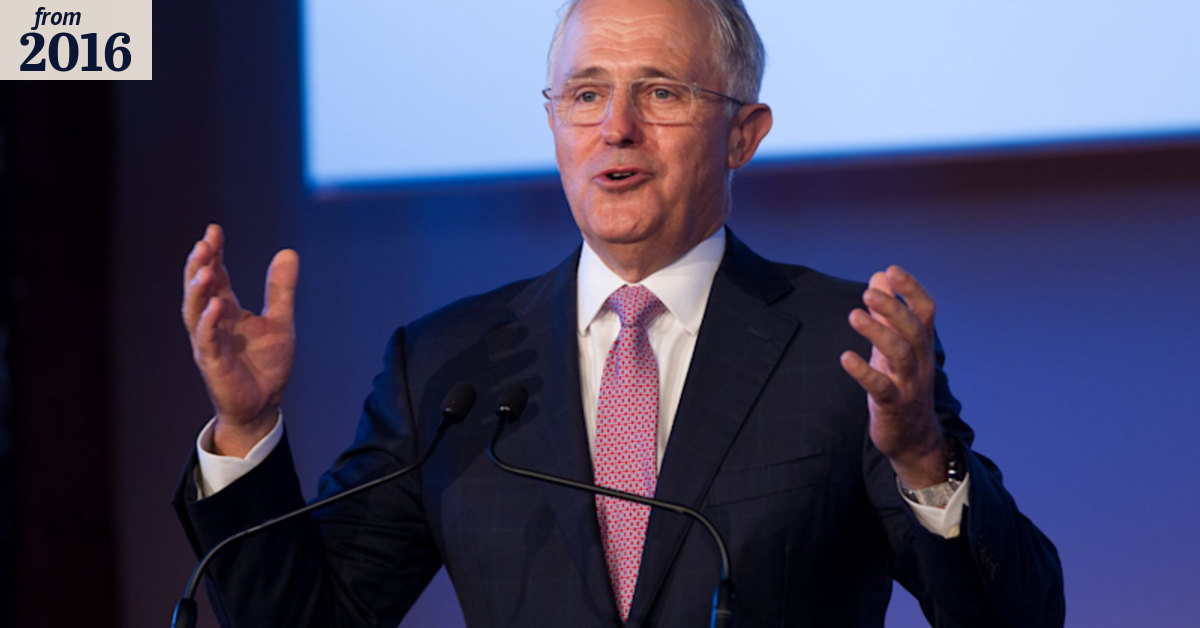
The lunch was attended by approximately 1,800 people (1,000 Australian business delegates and 800 Chinese businesspeople and government figures), costing approximately $160 per head [1].
The event was the "grand finale" of a week-long trade and investment showcase designed to promote Australian trade, investment, and tourism opportunities following the China-Australia Free Trade Agreement (ChAFTA) which came into force in December 2015 [1][2].
However, the total cost for the entire AWIC event was significantly higher—at least $850,000 including venue hire ($265,000 for the Shanghai Expo Centre across multiple events), conference facilities ($180,000), graphic design, AV equipment, transport, and marketing—plus travel costs for the Prime Minister, Trade Minister, and their entourages [1].
The claim omits critical context about the nature and scale of this event:
**It was not a private lunch for "business mates" but a formal government trade mission.** The lunch was part of "Australia Week in China 2016," described by the Trade Minister as "Australia's largest ever trade mission" [2].
The event involved more than 140 activities across 12 Chinese cities including Beijing, Shanghai, Hong Kong, Guangzhou, and others [1].
**The attendees included 800 Chinese businesspeople and government figures.** This was diplomatic and economic engagement with Australia's largest trading partner, not a private gathering of political donors or personal friends [1].
China represented $150 billion in two-way trade with Australia at the time [1].
**The cost per head was approximately $160.** For a formal business lunch in Shanghai involving international delegates and government officials, this is not exceptional [1].
**Previous Labor and Coalition governments conducted similar trade missions.** The first AWIC gala lunch in 2014, attended by former Prime Minister Tony Abbott, cost approximately $230,000 for venue hire and catering [1].
The 2016 event was 24% more expensive than the 2014 event.
**Austrade claimed measurable economic outcomes.** The agency stated the first AWIC event generated approximately $1 billion in export sales and $3 billion in investment for Australian businesses [1].
**The menu was designed to showcase Australian products**, supporting Australian agricultural and food exporters [1].
The SMH article's headline emphasizes the cost to taxpayers and describes attendees as "China's rich and powerful," which frames the story with a critical tone [1].
The article is factual reporting rather than an opinion piece, and it includes the government's justification for the event through the Austrade spokesperson.
**Did Labor conduct similar trade missions and official events?**
Australian governments of all political persuasions regularly conduct trade missions to major trading partners.
* * * *
While specific cost figures for Labor government trade missions to China during the Rudd/Gillard era (2007-2013) are not readily available in the searched sources, government trade promotion activities are standard practice across administrations.
**Comparison of scale:**
- The 2014 AWIC under Tony Abbott cost approximately $230,000 for the gala lunch
- The 2016 AWIC under Malcolm Turnbull cost approximately $285,000 for catering (24% increase)
- Both events were part of ongoing trade promotion activities following the ChAFTA negotiations (initiated under Labor, concluded under Coalition)
**Context on official hospitality:**
State dinners and official lunches for visiting dignitaries are standard diplomatic practice worldwide.
The 2023 White House state dinner for Australian Prime Minister Anthony Albanese (Labor) was a lavish event, though specific cost figures were not disclosed [3].
The claim implies this was unusual or excessive Coalition spending, but trade missions and diplomatic events are standard government functions regardless of which party is in power.
**What the claim gets right:**
- Taxpayers did fund a large-scale lunch costing approximately $300,000
- Business figures were the primary attendees
- The event was expensive
**What the claim obscures:**
- This was a formal trade mission, not a private party for "mates"
- The event served legitimate diplomatic and trade promotion purposes
- 44% of attendees were Chinese businesspeople and government officials, not just Australian "mates"
- The cost per attendee ($160) was not extravagant for an international business event
- Similar events occurred under previous governments
- The event was part of Australia's largest-ever trade mission to its largest trading partner
**Legitimate policy rationale:**
Following the implementation of the China-Australia Free Trade Agreement (ChAFTA), the government sought to maximize opportunities for Australian businesses.
Whether these figures represent direct causation is debatable, but the economic intent behind the event is clear.
**Comparative context:**
Government spending on diplomatic functions and trade promotion exists across all administrations.
The framing of this as "corruption" or indicative of cronyism is misleading—it was a publicly disclosed, officially sanctioned trade promotion event with legitimate diplomatic purposes.
Describing this as a lunch for "business mates" implies cronyism and private benefit, when it was actually a formal diplomatic and trade promotion event with 800 Chinese attendees, part of Australia's largest-ever trade mission to its largest trading partner.
The framing omits the legitimate economic and diplomatic purposes, the presence of foreign dignitaries, and the standard nature of such government activities.
Describing this as a lunch for "business mates" implies cronyism and private benefit, when it was actually a formal diplomatic and trade promotion event with 800 Chinese attendees, part of Australia's largest-ever trade mission to its largest trading partner.
The framing omits the legitimate economic and diplomatic purposes, the presence of foreign dignitaries, and the standard nature of such government activities.