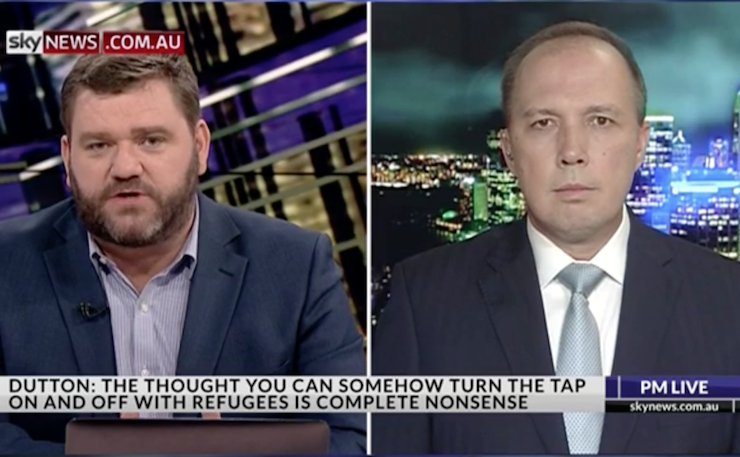
During an interview, Dutton stated that refugees "won't be numerate or literate in their own language, let alone English" and that "these people would be taking Australian jobs" while simultaneously arguing that "for many of them that would be unemployed, they would languish in unemployment queues and on Medicare" [1][2].
This creates a logical contradiction: the same group cannot simultaneously be taking jobs (employment) and languishing in unemployment queues while dependent on welfare.
Dutton made these comments in May 2016 during the 2016 election campaign in response to the Greens' proposal to increase Australia's annual humanitarian refugee intake to 50,000 [3].
The New Matilda article titled "Peter Dutton Bashes Refugees For Being Unemployed And Taking Jobs At The Same Time" was published on May 18, 2016, directly following Dutton's Sky News appearance on May 17, 2016 [1][2].
However, the claim omits crucial context about the actual economic evidence regarding refugee employment and welfare dependency:
**Refugee Employment Reality:** Dutton's claims about refugee literacy and employment prospects were contradicted by government data and research.
The Department of Social Services data showed that "the vast majority of recently arrived refugees are literate in their own language and have attended school in their home countries" [3].
Research findings from UNSW and other institutions found that "while refugees may find it difficult to get jobs initially, over time their labour participation rate becomes much the same as the rest of the community" [3].
**Long-term Economic Contribution:** A comprehensive review of studies examining the economic impact of refugees in Australia found "no evidence they impose a net cost on Australia in the long term" [3].
Australian Bureau of Statistics data from 2016 confirmed that refugees and recent migrants were more likely to participate in the labour force than the Australian-born population [5].
The Hugo Report on economic and civic contributions of refugees found "striking evidence of the economic contribution from people of refugee backgrounds, such as filling employment niches in regional Australia," with second-generation refugee families surpassing "the Australian average on most labour force measures" [5].
**Entrepreneurship:** Research cited in the UNSW analysis noted that "refugees have established thriving businesses and created employment for others" globally [3].
In one specific case, Karen refugees in the Victorian town of Nhill "helped tackle labour shortages and a declining population" and "boosted the local economy by an estimated A$41.5 million" [3].
The claim does not address that Dutton's position contradicts both government-collected data and peer-reviewed research on refugee outcomes in Australia.
The original source provided—New Matilda—is an independent online publication launched in 2004 that focuses on investigative journalism and analysis [1].
While New Matilda maintains a left-leaning editorial perspective and is critical of conservative governments, the specific claims made in the May 18, 2016 article accurately report what Dutton stated on Sky News [1][2].
The article's characterization of Dutton's statements is inflammatory ("Bashes Refugees For Being Unemployed And Taking Jobs") and the editorial commentary is clearly critical and opinion-driven [1].
However, the direct quotes and the core factual claim—that Dutton made contradictory statements—are verifiable and supported by multiple independent sources [1][2][4].
The source demonstrates bias in framing and tone (critical headlines, sarcastic commentary) but does not misquote or fundamentally misrepresent Dutton's statements [1][2].
**Did Labor make similar refugee policy claims or statements?**
Labor's approach to refugee policy during this period focused on increasing humanitarian intake rather than restricting it.
* * * *
The claim that prompted Dutton's response came from the Greens' proposal to increase refugee intake to 50,000 annually; Labor opposed this but from a different angle—advocating for orderly, managed intake rather than opposing refugees entirely [1][2].
While both major parties have used political messaging around refugees, Labor's framing during 2016 focused on criticizing Coalition refugee policies as inhumane rather than making claims about refugees' economic burden or welfare dependency [2].
However, it should be noted that both Coalition and Labor governments have used refugee policy as a political issue, though with different framing and emphasis.
**The Logical Problem:** Dutton's statements contain an internal logical contradiction—a fundamental problem independent of whether the underlying economic claims are true.
One cannot simultaneously argue that a group will "take our jobs" AND "languish in unemployment queues and on Medicare." These are mutually exclusive outcomes [1][2][4].
**The Evidence Problem:** Beyond the logical contradiction, Dutton's characterization of refugee literacy and employability was not supported by evidence available to the government at the time.
The government's own data showed refugees were more likely to be employed than the Australian-born population over time [5].
**Why the Contradiction Matters:** This contradiction is not merely a rhetorical inconsistency—it suggests either:
1.
Dutton was conflating different groups (recent arrivals vs. established refugees) without clarity
**Policy Rationale Context:** The Coalition's refugee policy during 2013-2022 was based on border security concerns and managed intake philosophy rather than economic burden arguments [4].
Dutton's comments appear to represent political rhetoric rather than policy analysis, as they contradict the government's own data and international evidence.
**Comparative Context:** Both major Australian parties have used refugee policy politically.
However, the specific contradiction highlighted in this claim—making opposite economic arguments simultaneously—is distinctive to Dutton's 2016 statement.
The claim accurately captures that he simultaneously argued refugees would "take our jobs" while also "languishing in unemployment queues and on Medicare." This is a factually accurate representation of contradictory rhetoric, regardless of the underlying economic realities.
While Dutton's underlying economic claims (about refugee welfare dependency and job competition) are contradicted by research and government data [3][5], the core claim being fact-checked is simply that he made contradictory statements—and this is demonstrably true.
The claim accurately captures that he simultaneously argued refugees would "take our jobs" while also "languishing in unemployment queues and on Medicare." This is a factually accurate representation of contradictory rhetoric, regardless of the underlying economic realities.
While Dutton's underlying economic claims (about refugee welfare dependency and job competition) are contradicted by research and government data [3][5], the core claim being fact-checked is simply that he made contradictory statements—and this is demonstrably true.