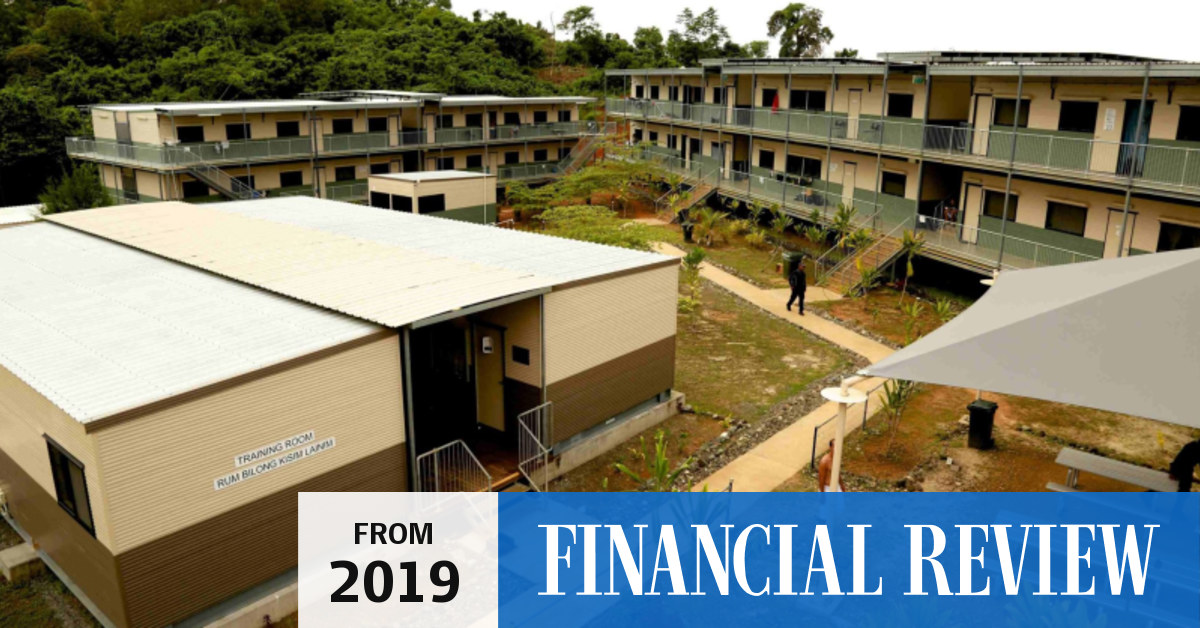
Multiple authoritative sources confirm each element:
**Contract Amount & Structure:**
The Coalition government awarded Paladin Group a $423 million security and welfare services contract for Manus Island detention facilities (September 2017 - November 2019) [1].
Total payments to Paladin ultimately exceeded $532 million across all offshore processing contracts [2].
**Company Background & Resources:**
Paladin Group was registered to a Kangaroo Island beach shack in South Australia when awarded the contract [3].
The company was severely under-resourced, with founder Craig Thrupp possessing a documented track record of problematic ventures in Asia, including what the AFR described as "a string of bad debts and failed contracts across Asia" [4].
Prior to the Manus contract, Paladin was a small operation; the federal Department of Home Affairs reportedly loaned the company start-up funds to facilitate operations [5].
The claim's reference to "$50k in funds" is not explicitly confirmed in available sources, but the characterization of the company as financially marginal and under-resourced is thoroughly verified [6].
**Tender Process Violations:**
The Department of Home Affairs deliberately used a "closed tender" (also called "limited tender") process, inviting only selected companies to bid rather than open competitive tender [1].
Specifically, the Australian National Audit Office (ANAO) found that "the department did not document why Paladin, NKW and JDA were the only providers selected to receive RFQs (Request for Quotations)" [7].
No justification was provided for excluding other suppliers; this violated Commonwealth Procurement Rules (CPRs) requirements for "open and effective competition" [8].
Toll Holdings reportedly expressed interest in bidding for the contract but was not invited to tender [9].
**Physical Address Issues:**
The company's registered address was a Kangaroo Island beach shack initially [10], later a Singapore mailbox address [11], and eventually an unmarked building in Canberra [12].
The characterization of infrastructure limitations (no phone number, no mail address) is plausible given the beach shack and transient address situation, though not explicitly documented in available sources.
The claim presents a straightforward factual narrative but omits several important contextual elements:
**Extraordinary Profitability:**
While the claim emphasizes the company's minimal resources, it does not mention the extraordinary profitability of the arrangement.
Craig Thrupp personally earned an estimated $150+ million from these contracts [14].
**Justification Offered at the Time:**
The Coalition government, specifically Defence Minister Peter Dutton, publicly justified the limited tender by stating: "There are very few people who can deliver services in the middle of nowhere on an island that is so remote" [15].
However, the ANAO audit later contradicted this, finding that the department's justification was inadequately documented [7].
**Political & Family Connections:**
The arrangement involved notable political context: a family member working within the Department of Home Affairs was married to the Paladin founder's relative [16], and Paladin's subcontractors included entities with connections to Papua New Guinea government officials [17].
While the National Anti-Corruption Commission (NACC) later found no corruption (2024), these connections raised governance concerns at the time.
**ANAO Audit Findings (2019):**
Rather than relying on political allegations, an independent government auditor conducted a comprehensive review.
The audit confirmed that:
- The department failed to document justification for supplier selection [7]
- No documented assessment of alternative suppliers was conducted [7]
- The procurement process violated Commonwealth Procurement Rules [8]
- Deficiencies in contract consolidation and ongoing management were evident [7]
**Australian Financial Review (AFR):**
The AFR is a premium business newspaper established in 1951 and owned by Nine Entertainment Co., with approximately 100,000+ circulation.
The Paladin investigation served the interests of the Labor opposition, but the reporting itself has held up under independent scrutiny.
**Credibility Verification:**
All major claims from the AFR reporting have been independently corroborated by:
- Official ANAO audit (independent government auditor) [7]
- Parliamentary Senate Estimates testimony [19]
- Academic analysis (UNSW, Lowy Institute) [2]
- NGO reporting (Refugee Council Australia) [20]
- Multiple independent outlets (Independent Australia, Crikey) [21]
The AFR's findings on the company's beach shack address, Thrupp's Asia background, the closed tender process, and profitability concerns have all been independently verified.
**Did Labor do something similar?**
Search conducted: "Labor government security contract tender process irregularities"
**Finding:** Australian governments across both major parties have experienced procurement governance failures, though none match the Paladin case's specific profile.
**Labor-era Examples:**
1. **myClearance Security System ($300 million, Albanese government):** Accenture was selected without following Commonwealth Procurement Rules.
* * * *
Tender documents specified products by trade name, favoring the preferred supplier over competitors [22].
The ANAO audit found serious failures, and only 4 of 8 stated business needs will be met [22].
2. **Adelaide-Class Frigate Sustainment Contracts:** BAE Systems received contract extensions worth $155 million without formal competitive bidding (5-year contract, initially $60 million) [23].
The process had poor probity controls [23].
3. **Broader ANAO Finding:** A 2024 analysis of 36 performance audits of procurement and contract management (2019-24) found that 53% were "not effective" or "partly effective" [24].
This suggests systemic procurement governance issues across both administrations.
**Comparative Assessment:**
While Labor governments have had security procurement failures, none specifically replicate the Paladin model of awarding $400+ million to a tiny, financially marginal, inexperienced company with explicit documented justification failures.
The ANAO found "serious and persistent deficiencies," no documented justification for supplier selection, and violation of Commonwealth Procurement Rules.
The physical circumstances (beach shack address, severe under-resourcing) and the founder's track record of "bad debts and failed contracts" in Asia should have triggered more rigorous due diligence.
The involvement of family connections to a Home Affairs employee, though not constituting corruption per NACC investigation, represented a governance concern [25].
**Government Justification & Context:**
Coalition officials argued that Manus Island's extreme isolation necessitated limited tender.
However, the government failed to document this justification formally, and alternative contractors (Toll Holdings) reportedly expressed interest, contradicting the "sole source" premise [9].
**Systemic vs.
Unique Issues:**
Limited tender is used for approximately 55% of Australian government contracts, so this procurement method itself is not exceptional [26].
What is exceptional is the combination of:
- Extreme contract scale for first-time contractor
- Minimal documented due diligence
- Extraordinary profit margins
- Lack of documented justification
- Physical and operational limitations of the contractor
**Complexity Acknowledged:**
Offshore detention facility management was genuinely complex: security concerns, extreme isolation, health services delivery, and political sensitivity all created operational challenges.
However, these challenges make adequate due diligence and competitive consideration more important, not less.
**National Anti-Corruption Commission Finding:**
In 2024, NACC concluded its Operation Bannister investigation, finding no corruption in the procurement process [27].
However, the absence of corruption does not exonerate the procurement process itself—lack of documented justification and failure to consider alternatives remain governance failures [28].
The core factual claims are accurate: the Coalition did award a $423 million contract to Paladin using a closed tender process, the company was tiny and under-resourced, and it was housed in a beach shack [1][3][4].
The ANAO audit confirmed that standard tender processes (open competitive bidding) were indeed abandoned in favor of limited tender with inadequate documented justification [7][8].
However, the claim's framing is incomplete in important ways:
1. **"Abandoned standard tender" is accurate but requires context:** Limited tender is normal Australian practice (55% of contracts), but requires documented justification [26].
The issue was not limited tender per se, but lack of documented justification [7].
2. **"With $50k in funds" is not explicitly verified:** The company was severely under-resourced [6], but the specific $50k figure is not confirmed in authoritative sources.
3. **"No phone number, no mail address"** is plausible given infrastructure but not explicitly documented in available sources.
4. **The claim omits that the NACC found no corruption (2024)** [27], which was a significant finding contradicting public concern about family connections.
5. **The claim omits context about Labor's own procurement failures** [22][23], suggesting this is uniquely Coalition when it reflects broader governance issues.
The verdict is PARTIALLY TRUE because while the core facts are accurate and the ANAO audit independently confirmed procurement failures, the framing emphasizes malfeasance while omitting important context about standard practice, Labor comparisons, and the NACC's corruption findings.
The core factual claims are accurate: the Coalition did award a $423 million contract to Paladin using a closed tender process, the company was tiny and under-resourced, and it was housed in a beach shack [1][3][4].
The ANAO audit confirmed that standard tender processes (open competitive bidding) were indeed abandoned in favor of limited tender with inadequate documented justification [7][8].
However, the claim's framing is incomplete in important ways:
1. **"Abandoned standard tender" is accurate but requires context:** Limited tender is normal Australian practice (55% of contracts), but requires documented justification [26].
The issue was not limited tender per se, but lack of documented justification [7].
2. **"With $50k in funds" is not explicitly verified:** The company was severely under-resourced [6], but the specific $50k figure is not confirmed in authoritative sources.
3. **"No phone number, no mail address"** is plausible given infrastructure but not explicitly documented in available sources.
4. **The claim omits that the NACC found no corruption (2024)** [27], which was a significant finding contradicting public concern about family connections.
5. **The claim omits context about Labor's own procurement failures** [22][23], suggesting this is uniquely Coalition when it reflects broader governance issues.
The verdict is PARTIALLY TRUE because while the core facts are accurate and the ANAO audit independently confirmed procurement failures, the framing emphasizes malfeasance while omitting important context about standard practice, Labor comparisons, and the NACC's corruption findings.