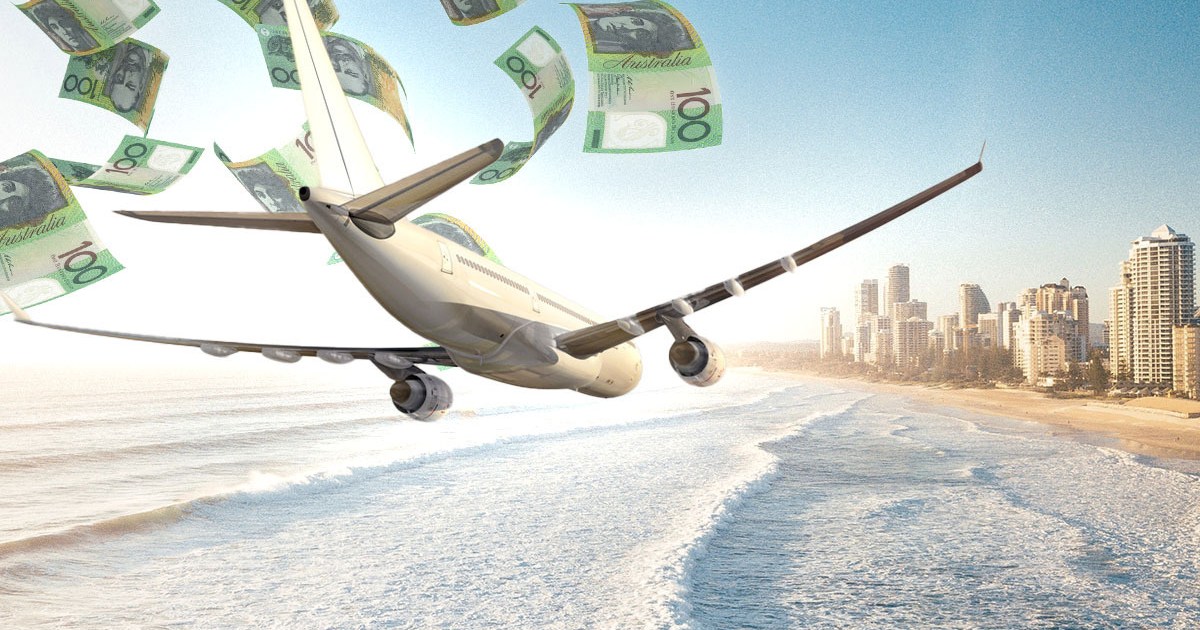
The Morrison government's $1.2 billion tourism support package announced in March 2021 included 800,000 half-price airfares to 13 tourism-dependent regions [1].
By May 14, 2021, taxpayers had already forked out more than $210 million to subsidise cheap flights, with airlines receiving approximately $400 million in total revenue under the scheme [1].
This came on top of $1.2 billion provided across seven separate COVID-19 programs, bringing Qantas' total pandemic government support to approximately $1.4-1.5 billion by mid-2021 [1].
Virgin Australia received $44 million under the half-price airfares scheme, and Regional Express (Rex) received $7 million [1].
**The critical claim about "surge costs":** The article states "the Morrison government has also agreed to underwrite surge costs on popular routes" [1].
According to the Department of Infrastructure, the published dollar figures were the maximum each airline could claim under the scheme—even though some tickets remained unsold and consumers decided which tickets to buy [1].
The Department of Infrastructure's statement indicates this was a capped grant program where airlines received fixed maximum allocations, not a cost-plus arrangement where taxpayers absorbed all surge-related costs [1].
Deputy Prime Minister Michael McCormack stated he would "quite potentially" release more tickets if they sold out before the July 31 deadline, suggesting the government was controlling ticket allocation, not simply underwriting airline costs [1].
The claim doesn't clarify that Qantas made $300 million in profit flying these routes, according to UNSW aviation professor Tony Webber, a former Qantas chief economist [1].
According to Media Bias/Fact Check, The New Daily is rated as **Left-Center biased** and **Mostly Factual** [2].
主な Omona 信頼 nounShinrai 性 Sei 要素 nounYouso : :
Key credibility factors:
- **Ownership:** Owned by Industry Super Holdings (ISH), a consortium of industry superannuation funds including AustralianSuper and Cbus, led by former Federal Labor Party Minister Greg Combet [2]
- **Bias:** "Based on an editorial perspective that moderately aligns with the left" with "minimally loaded wording in news articles" [2]
- **Factual Rating:** "Mostly Factual rather than high due to a lack of hyperlinked sourcing" [2]
- **No recent failed fact checks:** None identified in the last 5 years [2]
- **High credibility rating** from MBFC, despite left-center editorial leanings [2]
The original article cites specific figures from government grant notices and quotes UNSW aviation economist Tony Webber, a former Qantas chief economist with substantial credibility on aviation economics [3].
The article's factual claims about funding amounts and scheme mechanics appear accurate; the interpretive framing around "surge cost underwriting" as privatized profit is the subjective element.
**Did Labor do something similar?**
Search conducted: "Labor government airline subsidies aviation support regional"
**Finding:** The Rudd and Gillard Labor governments supported regional aviation, with Anthony Albanese (then Infrastructure and Transport Minister) stating in 2012: "The Gillard Labor Government understands the role aviation plays in connecting regional communities, as well as in stimulating regional growth" [4].
* * * *
However, no direct equivalent to the half-price airfares scheme was identified in Labor's historical record.
More recently, the Albanese Labor Government announced support for Regional Express (Rex) as of 2025, working with administrators during a competitive sale process to ensure regional aviation services continue [5].
The Albanese government has focused on different aviation support mechanisms, primarily targeting regional service continuity rather than demand-side subsidies [5].
**Comparative Finding:** While both Coalition and Labor governments provide aviation support, the specific mechanism of demand-side subsidies through taxpayer-funded discounted fares appears more characteristic of the Morrison government's approach.
This doesn't make it unique to Coalition policy—it reflects a specific policy choice during a particular crisis—but Labor's comparable support has focused more on supply-side measures (ensuring services continue) rather than demand-side stimuli (subsidizing passenger fares).
**The Policy Rationale:**
The Morrison government's half-price airfares scheme had stated objectives to support: (1) domestic tourism industry during pandemic-related border closures, (2) regional destinations that rely heavily on tourism, and (3) airline viability during severe demand collapse [1].
These were legitimate policy goals during the severe economic disruption of COVID-19 lockdowns.
**The Criticism:**
The claim accurately identifies a structural problem: when taxpayers fund passenger fare subsidies, profit from increased passenger volume flows to airlines as a private gain, while losses (if demand remained lower) would hypothetically be shared risk.
The $210 million invested generated $400 million in airline revenue, and Qantas made $300 million in profit from these routes [1].
* * * * 批判 nounHihan : : * * * *
Economists could argue this arrangement favored airline profitability over alternative uses of those funds.
**The Legitimate Explanation:**
However, the scheme's structure suggests less exposure to "open-ended underwriting" than the claim implies.
This is different from a cost-plus contract where airlines recover all additional expenses.
**Comparative Context:**
Both Liberal and Labor governments have supported aviation during crises.
Labor's preference appears to be supply-side support (ensuring services continue) while the Coalition chose demand-side support (subsidizing fares to encourage travel).
While Airlines did profit, the profit derived from stimulated demand, not from cost recovery arrangements.
**Key context:** This is a real policy choice with genuine trade-offs, but not unique to Coalition governance.
The Morrison government did agree to underwrite revenue support for airlines on popular tourism routes through the half-price airfares scheme, and airlines (particularly Qantas) did retain significant profits from this arrangement [1].
While the policy choice to subsidize demand rather than direct support is debatable, characterizing it as an undefined "off-book liability" misrepresents the scheme's actual design.
The Morrison government did agree to underwrite revenue support for airlines on popular tourism routes through the half-price airfares scheme, and airlines (particularly Qantas) did retain significant profits from this arrangement [1].
While the policy choice to subsidize demand rather than direct support is debatable, characterizing it as an undefined "off-book liability" misrepresents the scheme's actual design.