The core facts of this claim are substantially accurate, though require important clarification:
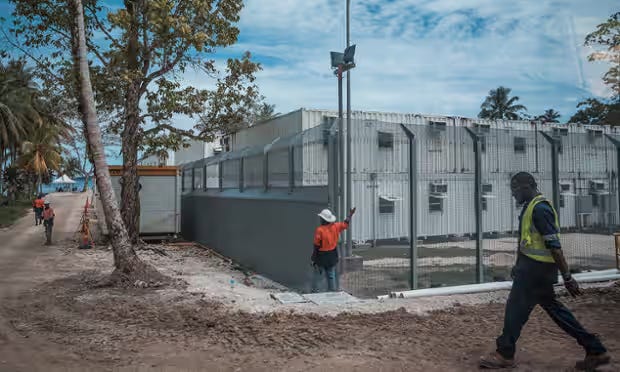
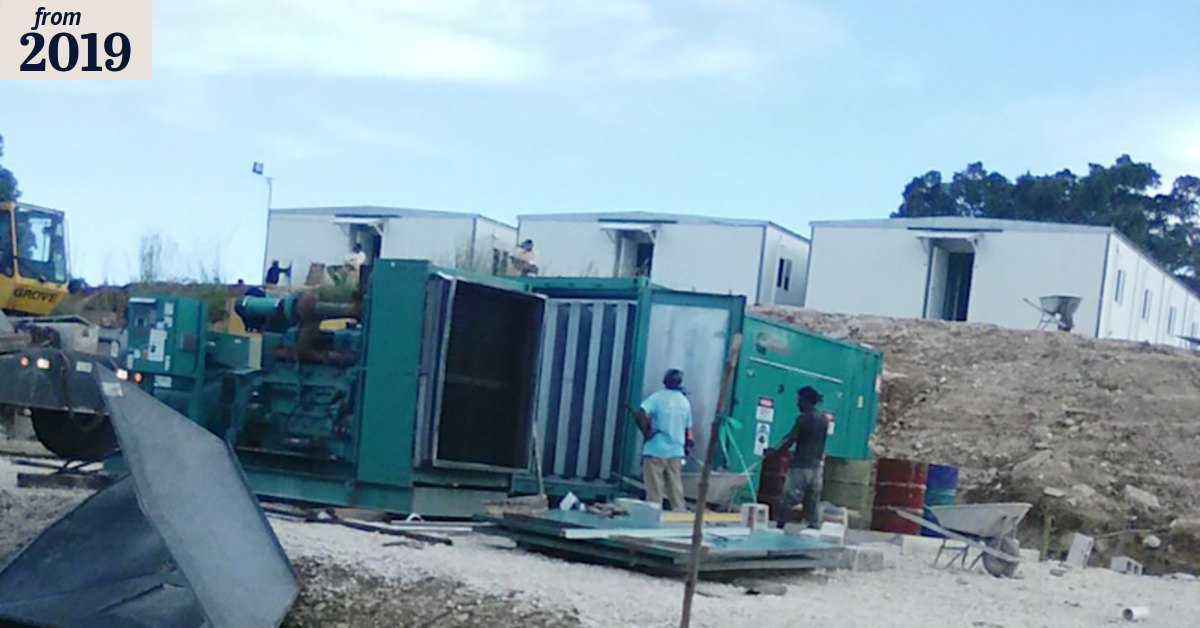
**$1,400 per day figure:** The SMH article confirms that "the $82 million paid to NKW means that it is costing Australian taxpayers just under $1400 per person per day to feed and house 209 asylum seekers at camps at West Lorengau Haus and Hillside Haus" [1].
However, this figure includes **both feeding AND housing** costs, not just food as the claim implies.
**$82 million contract:** Confirmed by the SMH article, which states "A Papua New Guinea company paid $82 million by Australian taxpayers to feed and house asylum seekers on Manus Island" [1].
The contract was initially valued at $21.8 million for two months, then increased by $49 million and another $10 million, with extension to June 2018 [1].
**Non-competitive tender process:** Confirmed.
Internal Home Affairs sources indicated "procurement officials within Home Affairs were upset by the way the NKW contract was entered into, with the department's operations command directing that it be done as one of a number of non-competitive limited tenders" [1].
**High-risk company status:** Confirmed.
According to the SMH article citing Bank South Pacific internal emails, NKW "was on Bank South Pacific's 'watchlist' for unpaid debts at the time it was engaged by Home Affairs" [1].
Bank South Pacific emails show NKW was a "watchlist client" because of existing debts, and the Australian government contract was viewed as "a much-needed lifeline" to the struggling company [1].
**Politically connected directors:** Confirmed.
The SMH article notes "Its directors include provincial government officials and retired PNG Supreme Court judge Don Sawong, who in 2017 unsuccessfully ran as a candidate for Prime Minister Peter O'Neill's political party.
Mr Sawong was last year appointed as PNG's next ambassador to China" [1].
**Suspicion of inflated invoices:** The claim is based on a Bank South Pacific manager's comment: "Australian Department of Immigration and Border Protection are paying every invoice – I suspect there are some inflated quotations and invoices" [1].
However, the SMH explicitly states: "The Age and Sydney Morning Herald make no accusation of wrongdoing against NKW, Mr Brunskill, Mr Sawong or any other of its directors, and are simply reporting the opinion of the company's bank manager that the invoices may have been inflated" [1].
Contract was for feeding AND housing, not just food:** The $1,400 per day includes both meals and accommodation costs at West Lorengau Haus and Hillside Haus facilities [1].
Circumstances forcing rapid procurement:** Home Affairs "advanced more than $5 million to NKW between September and November 2017" because the department faced an urgent crisis [1].
The regional processing centre had been on the Naval Base, but "the Australian government has been booted out of the Naval Base in Manus and are desperately in need to accommodate their 'guests'" according to NKW's own communications [1].
Previous contractor withdrawal:** The rapid procurement decision was forced when "Broadspectrum, a major Manus Island contractor, stopped all offshore detention work in October 2017" [1].
Limited contract documentation:** While the contract began in September 2017, "a proper contract between Home Affairs and NKW was not signed until well into 2018" [1].
No proven wrongdoing:** Despite suspicions from the bank manager about potential invoice inflation, neither the SMH nor subsequent investigations have substantiated actual overcharging [1].
ANAO and other oversight:** The Australian National Audit Office (ANAO) conducted performance audits of offshore processing procurement, identifying widespread shortcomings in the procurement process across multiple contracts, not just NKW [2].
The ANAO found "the Department of Home Affairs failed to demonstrate value for money for procurements of garrison support and welfare services" for offshore detention [2].
**The Sydney Morning Herald (SMH):**
- Mainstream, reputable Australian news organization
- Author Richard Baker is described as "a former multi-award winning investigative reporter for The Age"
- The article is based on leaked internal emails from Bank South Pacific, providing primary source material
- Important caveat: The SMH explicitly states it "make[s] no accusation of wrongdoing" against NKW directors, showing responsible journalism in distinguishing between speculation and proven facts
- The article thoroughly documents the bank manager's concerns about invoices but appropriately attributes these as opinion rather than fact
**YouTube source (unclear):**
- The YouTube link (youtu.be/aIGKCkS01EA?t=226) is provided but the specific content is not detailed in the claim
- Cannot assess credibility without knowing the source organization or creator
**Assessment:** The SMH article is credible journalism by a respected mainstream outlet.
**Did Labor do something similar?**
**Labor government initiated offshore detention policy:** This is crucial context—the Coalition inherited and expanded a policy Labor created.
* * * *
According to multiple sources, "In August 2012 Prime Minister Julia Gillard reopened Manus and Nauru as places of offshore detention" [3].
Labor's announcement was part of the "no advantage" policy, intended to deter boat arrivals [4].
**Labor's offshore detention costs:** The Gillard government's 2012 reopening of offshore detention "saw Australia spend $358.77 million on operating and capital costs for the two centres" [5].
This shows that high detention costs predated the Coalition's expansion—they were inherent to the policy Labor created.
**Coalition expansion of Labor's policy:** While the Coalition did not initiate offshore detention, they significantly expanded it.
An ABC News report noted that "when consolidating contracts for Nauru and Manus Island in 2013 and 2014, the bid for Manus Island exceeded historical costs by between $200 million and $300 million" [7].
**Direct comparison:** The issue is not unique to the Coalition.
However, the Coalition's 2013-2014 contract consolidation did increase costs beyond historical levels, and the NKW contract awarded in 2017 represented a particularly poor procurement decision with inflated costs and inadequate competitive evaluation.
**Comparison:** Both Labor and Coalition engaged in offshore detention with high costs.
The NKW contract specifically represents a Coalition-era failure in procurement, but not a unique commitment to expensive detention—that was Labor's legacy policy.
**The criticism is justified:** The claim correctly identifies genuine problems with the NKW contract:
1. **Non-competitive procurement:** Awarding an $82 million contract without competitive tender is a legitimate concern [1].
The ANAO found widespread procurement failures in offshore detention contracts, concluding the Department "failed to demonstrate value for money" [2].
2. **High-risk contractor selection:** Awarding a major contract to a company on a bank's "watchlist" for unpaid debts shows poor risk management [1].
The department failed to properly assess the financial stability and corruption risks of contracting in Papua New Guinea, according to internal Home Affairs audits [8].
3. **Excessive costs:** The per-person daily cost of approximately $1,400 is objectively high [1].
However, this includes accommodation as well as food, and reflects the premium costs of remote offshore detention operations.
**But the claim oversimplifies important context:**
1. **Cost comparison is misleading:** The "caviar and lobster" comparison is rhetorical exaggeration.
A proper comparison would require itemizing these costs separately, which the original sources don't do.
2. **Procurement crisis wasn't Coalition creation:** The rapid, non-competitive nature of the NKW procurement was driven partly by the urgent crisis created when the previous contractor withdrew and the department lost access to the Naval Base [1].
This doesn't excuse poor process, but explains the circumstances.
3. **Broader systemic problem:** The ANAO found procurement failures across multiple offshore detention contracts (Paladin, NKW, Broadspectrum), suggesting this was a systemic issue with offshore detention management rather than unique to NKW [2].
Paladin, another offshore detention contractor, received "$532 million to run the Manus Island detention centre" and was "never properly assessed for its ability to run the centre" according to internal Home Affairs audits [8].
4. **Labor's policy foundation:** While the Coalition made the 2017 NKW contract decision, offshore detention itself—with inherently high costs—was Labor's policy legacy [3][5].
The high cost-per-detainee was baked into the policy when Gillard reopened Manus and Nauru in 2012 [3].
**Key context:** The NKW contract represents a Coalition-era failure in procurement and contract management.
However, this is part of a broader systemic problem with offshore detention procurement affecting multiple contractors and government departments across Labor and Coalition administrations.
The core factual claims are accurate: the $82 million was paid to NKW Holdings, the $1,400 per day figure is correct (though it includes housing as well as food), the contract was awarded without competitive tender, and NKW was a high-risk company with political connections.
Not acknowledging that procurement failures were systemic across multiple contractors, not unique to NKW
The claim correctly identifies a genuine Coalition-era procurement failure, but frames it in a way that exaggerates the evidence and omits important context about Labor's role in creating the offshore detention system that produced these high costs.
The core factual claims are accurate: the $82 million was paid to NKW Holdings, the $1,400 per day figure is correct (though it includes housing as well as food), the contract was awarded without competitive tender, and NKW was a high-risk company with political connections.
Not acknowledging that procurement failures were systemic across multiple contractors, not unique to NKW
The claim correctly identifies a genuine Coalition-era procurement failure, but frames it in a way that exaggerates the evidence and omits important context about Labor's role in creating the offshore detention system that produced these high costs.