Parzialmente Vero

Valutazione: 6.0/10

Labor
5.1

L'Affermazione

“Legiferato riduzione delle emissioni del 43% entro il 2030 e zero netto entro il 2050 (settembre 2022)”
Fonte Originale: Albosteezy

Fonti Originali

VERIFICA DEI FATTI

L'affermazione che il governo Albanese ha legiferato un obiettivo di riduzione delle emissioni del 43% entro il 2030 e zero netto entro il 2050 nel settembre 2022 è **fattualmente accurata**.
The claim that the Albanese Government legislated a 43% emissions reduction target by 2030 and net zero by 2050 in September 2022 is **factually accurate**.
Il parlamento australiano ha approvato il Climate Change Bill 2022 l'8 settembre 2022, che sancisce in legge un obiettivo di riduzione delle emissioni di gas serra del 43% rispetto ai livelli del 2005 entro il 2030 e zero emissioni nette entro il 2050 [1].
Australia's parliament passed the Climate Change Bill 2022 on September 8, 2022, which enshrines into law a greenhouse gas emissions reduction target of 43% below 2005 levels by 2030 and net zero emissions by 2050 [1].
La Camera dei Rappresentanti ha approvato il disegno di legge con 89 voti a 55, e il Senato lo ha approvato con il sostegno dei Greens, del Jacqui Lambie Network e del senatore indipendente David Pocock [2].
The House of Representatives passed the bill by 89 votes to 55, and the Senate passed it with support from the Greens, Jacqui Lambie Network, and independent senator David Pocock [2].
La legislazione crea un quadro di responsabilità che richiede al Ministro per il Cambiamento Climatico di fornire una dichiarazione annuale al Parlamento sui progressi verso questi obiettivi, e conferisce poteri all'autorità indipendente Climate Change Authority per fornire pareri esperti sui futuri obiettivi [3].
The legislation creates an accountability framework requiring the Climate Change Minister to provide an annual statement to Parliament on progress toward these targets, and empowers the independent Climate Change Authority to provide expert advice on future targets [3].

Contesto Mancante

Tuttavia, l'affermazione omette diversi problemi contestuali critici che cambiano sostanzialmente come questo risultato dovrebbe essere valutato: **1.
However, the claim omits several critical contextual issues that substantially change how this achievement should be evaluated: **1.
L'obiettivo del 43% è già in via di realizzazione senza le politiche proposte** Le proiezioni del governo stesso del dicembre 2024 indicano che l'Australia potrebbe già essere vicina al raggiungimento del suo obiettivo 2030 con una riduzione del 42,6% [4].
The 43% target is already being achieved without the proposed policies** The government's own December 2024 projections indicate Australia may already be close to meeting its 2030 target with a 42.6% reduction [4].
Ciò significa che il risultato principale della legislazione sull'obiettivo è in qualche modo fuorviante—l'Australia è sulla strada giusta per raggiungerlo in gran parte grazie alle tendenze esistenti (dispiegamento di energia rinnovabile, eliminazione graduale del carbone) piuttosto che a politiche trasformative nuove introdotte dal governo. **2.
This means the headline achievement of legislating the target is somewhat misleading—Australia is on track to hit it largely due to existing trends (renewable energy deployment, phase-out of coal) rather than transformative new policies introduced by the government. **2.
La metodologia dell'obiettivo utilizza trucchi contabili che gonfiano le riduzioni delle emissioni** Una critica importante riguarda come l'Australia calcola le sue riduzioni delle emissioni.
The target methodology uses accounting tricks that inflate emissions reductions** A major criticism concerns how Australia calculates its emissions reductions.
Le stime governative dei sink di uso del suolo, cambiamento di uso del suolo e foreste (LULUCF) sono aumentate sistematicamente anno dopo anno, riducendo così la quantità di azione che l'Australia deve intraprendere sulle emissioni di combustibili fossili [5].
Government land use, land use change and forestry (LULUCF) sink estimates have increased systematically year-on-year, thereby reducing the amount of action Australia needs to take on fossil fuel emissions [5].
Di conseguenza, escludendo il settore terra ed energia, le emissioni da tutti gli altri settori economici si prevede saranno del 4,5% **superiori** ai livelli del 2005 nel 2030 [5].
As a result, excluding the land and power sectors, emissions from all other economic sectors are projected to be 4.5% **above** 2005 levels in 2030 [5].
Ciò significa che agricoltura, trasporti, manifatturiero e altri settori stanno effettivamente aumentando le emissioni, non riducendole. **3.
This means agriculture, transport, manufacturing and other sectors are actually increasing emissions, not reducing them. **3.
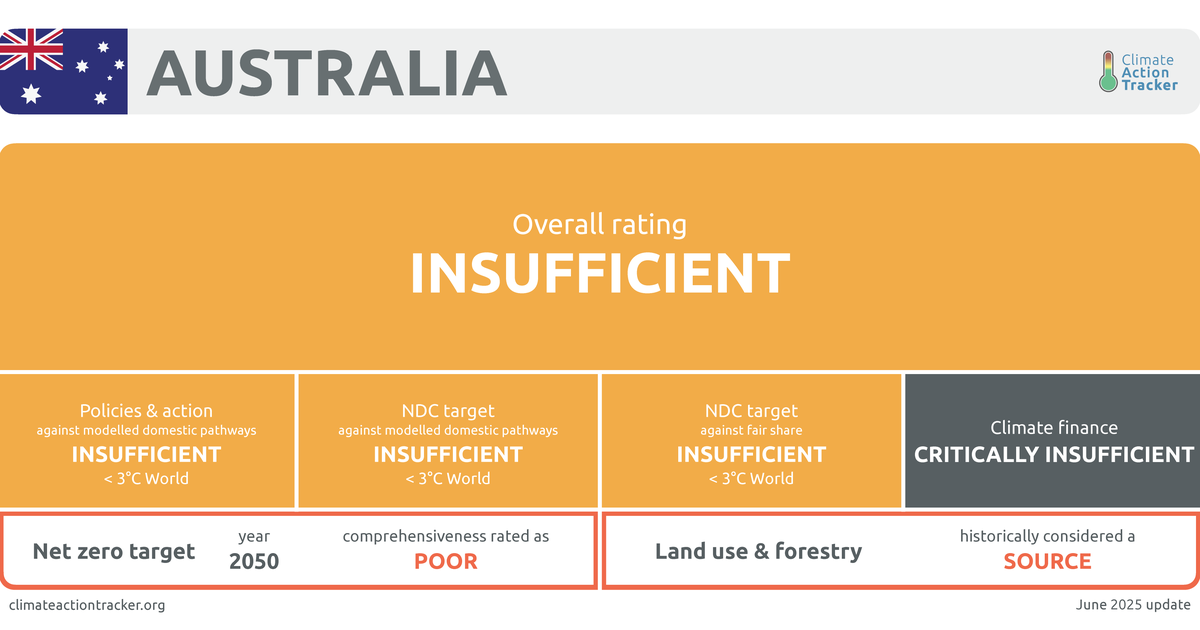
L'obiettivo è insufficiente per gli obiettivi climatici** Il Climate Action Tracker, un'organizzazione scientifica indipendente, valuta l'obiettivo 2030 dell'Australia come "Insufficiente" rispetto ai percorsi di emissioni necessari per limitare il riscaldamento a 1,5°C [6].
The target is insufficient for climate goals** The Climate Action Tracker, an independent scientific organization, rates Australia's 2030 target as "Insufficient" when compared to emissions pathways needed to limit warming to 1.5°C [6].
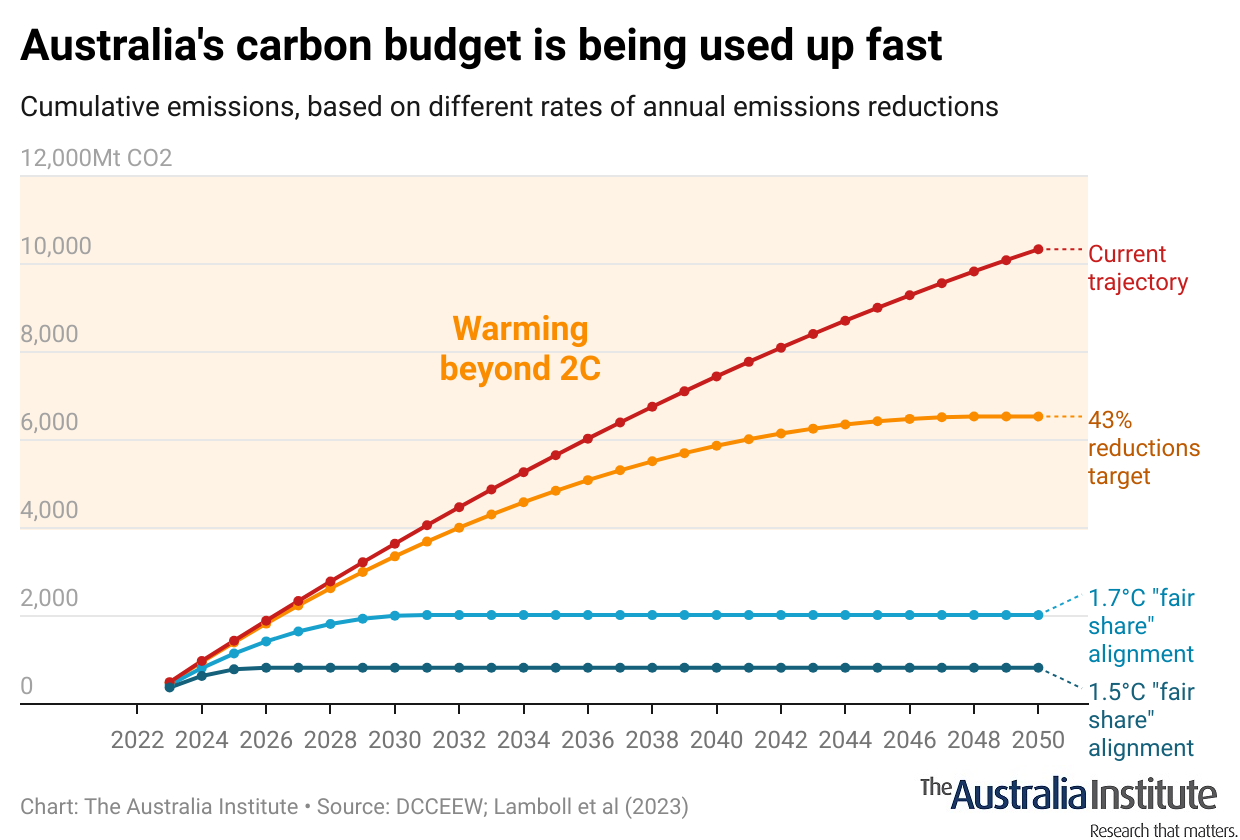
Molteplici analisi indicano che l'obiettivo del 43% non è allineato con il limitare il riscaldamento a 1,5°C e rappresenta un "gioco di prestigio" che comporta un forte affidamento su compensazioni e trucchi contabili piuttosto che su riduzioni reali delle emissioni [7]. **4.
Multiple analyses indicate the 43% target is not aligned with limiting warming to 1.5°C and represents a "sleight of hand" involving heavy reliance on offsets and accounting tricks rather than real emissions reductions [7]. **4.
I principali problemi settoriali rimangono irrisolti** - **Trasporti**: Le emissioni dei trasporti nel 2030 si prevede saranno simili ai livelli pre-pandemia, senza riduzione netta [8] - **Agricoltura**: Le emissioni agricole si prevede aumenteranno man mano che le mandrie post-siccita vengono ripopolate [8] - **Emissioni industriali**: Il Safeguard Mechanism (che copre il 31% delle emissioni) non produrrà tagli diretti delle emissioni fino alla fine del decennio [8] **5.
Major sectoral problems remain unaddressed** - **Transport**: Transport emissions in 2030 are projected to be similar to pre-pandemic levels, with no net reduction [8] - **Agriculture**: Agricultural emissions are projected to increase as post-drought cattle herds are restocked [8] - **Industrial emissions**: The Safeguard Mechanism (covering 31% of emissions) won't result in direct emissions cuts until the end of the decade [8] **5.
Carenza dell'obiettivo di energia rinnovabile** Mentre il governo punta all'82% di elettricità rinnovabile entro il 2030, l'Agenzia Internazionale dell'Energia prevede che solo il 58% sarà raggiunto sulla base delle politiche attuali e dei tassi di dispiegamento—un divario significativo [6].
Renewable energy target shortfall** While the government targets 82% renewable electricity by 2030, the International Energy Agency projects only 58% will be achieved based on current policies and deployment rates—a significant gap [6].

💭 PROSPETTIVA CRITICA

Esaminato nel contesto, il "risultato" della legislazione di un obiettivo di riduzione delle emissioni del 43% rivela la politica climatica del governo come più significativa simbolicamente che sostanzialmente trasformativa.
When examined in context, the "achievement" of legislating a 43% emissions reduction target reveals the government's climate policy as more symbolically significant than substantively transformative.
Il governo può rivendicare il merito di aver approvato la legislazione perché era all'opposizione sotto il precedente governo Coalition, che aveva fissato l'obiettivo al 26-28%.
The government can claim credit for passing legislation because it was in opposition under the previous Coalition government, which had set the target at 26-28%.
Tuttavia, il percorso effettivo di riduzione si basa pesantemente su: 1. **Tendenze pre-esistenti di eliminazione del carbone**—Gran parte del 43% deriva dal dispiegamento rinnovabile esistente e dai pensionamenti naturali degli impianti a carbone, non da nuove politiche [4] 2. **Meccanismi contabili**—L'inclusione di generosi crediti sink LULUCF consente al governo di rivendicare riduzioni delle emissioni che non si traducono in tagli effettivi delle emissioni nei settori chiave [5] 3. **Implementazione politica insufficiente**—L'analisi del governo stesso mostra che i settori principali (trasporti, agricoltura, industria) vedranno emissioni piatte o crescenti [8] La legislazione fornisce certezza e blocca l'obiettivo, rendendo più difficile per i futuri governi indebolirlo.
However, the actual reduction pathway relies heavily on: 1. **Pre-existing coal phase-out trends** - Much of the 43% comes from existing renewable deployment and natural coal plant retirements, not new policy [4] 2. **Accounting mechanisms** - The inclusion of generous LULUCF sink credits allows the government to claim emissions reductions that don't translate into actual emissions cuts in key sectors [5] 3. **Insufficient policy implementation** - The government's own analysis shows major sectors (transport, agriculture, industry) will see flat or increasing emissions [8] The legislation does provide certainty and lock in the target, making it harder for future governments to weaken it.
Tuttavia, la cornice di questo come un importante risultato oscura il fatto che il percorso effettivo dell'Australia verso lo zero netto rimane fortemente dipendente da soluzioni tecnologiche (cattura del carbonio, idrogeno) che non sono dimostrate su larga scala, e l'obiettivo stesso rappresenta una risposta inadeguata alla scienza climatica [6].
However, the framing of this as a major achievement obscures the fact that Australia's actual path to net zero remains heavily dependent on technological solutions (carbon capture, hydrogen) that are unproven at scale, and the target itself represents an inadequate response to climate science [6].
Un confronto con i pari OCSE è istruttivo: Mentre l'Australia ha legiferato il 43% entro il 2030, l'UE si è impegnata al 55% entro il 2030, il Regno Unito al 68% entro il 2030, e gli Stati Uniti al 50% entro il 2030 (nel loro impegno dell'Accordo di Parigi).
A comparison to OECD peers is instructive: While Australia legislated 43% by 2030, the EU committed to 55% by 2030, the UK to 68% by 2030, and the US to 50% by 2030 (in its Paris Agreement commitment).
L'obiettivo dell'Australia, sebbene superiore a quello del precedente governo Coalition, rimane tra i più deboli delle economie sviluppate [9].
Australia's target, while higher than the previous Coalition government's target, remains among the weaker of developed economies [9].

PARZIALMENTE VERO

6.0

/ 10

L'affermazione fattuale che il governo ha legiferato un obiettivo di riduzione delle emissioni del 43% entro il 2030 e zero netto entro il 2050 nel settembre 2022 è accurata.
The factual claim that the government legislated a 43% emissions reduction target by 2030 and net zero by 2050 in September 2022 is accurate.
Tuttavia, il contesto omesso—che l'obiettivo si basa su trucchi contabili, i settori principali stanno ancora aumentando le emissioni, l'obiettivo è già in via di realizzazione senza intervento politico, e l'obiettivo è scientificamente insufficiente per gli obiettivi climatici—significa che questo rappresenta un risultato molto più modesto di quanto suggerisca l'affermazione.
However, the omitted context—that the target relies on accounting tricks, major sectors are still increasing emissions, the target is already being achieved without policy intervention, and the target is scientifically insufficient for climate goals—means this represents a much more modest achievement than the claim suggests.
La legislazione fornisce certezza legale ma non azione climatica trasformativa.
The legislation provides legal certainty but not transformative climate action.

📚 FONTI & CITAZIONI (9)

  1. 1
    dcceew.gov.au

    Climate Change Bill 2022 - DCCEEW

    Dcceew Gov

  2. 2
    pm.gov.au

    Australia Legislates Emissions Reduction Targets - Prime Minister of Australia

    The Albanese Government’s landmark Climate Change Bills have now passed the Senate, ensuring Australia's emissions reduction target of 43 per cent and net zero emissions by 2050 will be enshrined in legislation. For almost a decade, Australia stumbled from one policy to another, and our economy and communities missed out on billions of dollars in public and private clean energy investment. But today that changes.

    Prime Minister of Australia
  3. 3
    Climate Change Bill 2022 – Parliament of Australia

    Climate Change Bill 2022 – Parliament of Australia

    Helpful information Text of bill First reading: Text of the bill as introduced into the Parliament Third reading: Prepared if the bill is amended by the house in which it was introduced. This version of the bill is then considered by the second house. As passed by

    Aph Gov
  4. 4
    PDF

    Australia's 2030 Emissions Reduction Target - DCCEEW

    Dcceew Gov • PDF Document
  5. 5
    Sleight of hand: Australia's Net Zero target is being lost in accounting tricks, offsets and more gas - Climate Analytics

    Sleight of hand: Australia's Net Zero target is being lost in accounting tricks, offsets and more gas - Climate Analytics

    Australia is unlikely to achieve its net zero target. This is because of its support for fossil gas to 2050 and beyond, it’s long-term emissions reduction plan resorts to unrealistic technological fixes and emissions offsets and because its legislated target of a 43% emissions cut by 2030 is not…

    Climate Analytics
  6. 6
    Australia - Climate Action Tracker

    Australia - Climate Action Tracker

    Climateactiontracker
  7. 7
    Climate Change Bill 2022 - Australian Conservation Foundation

    Climate Change Bill 2022 - Australian Conservation Foundation

    The Albanese Government’s Climate Change Bill has passed the House of Representatives and been sent to the Senate. Its target to slash climate pollution…

    Australian Conservation Foundation
  8. 8
    New research shows our 2030 emission targets are woefully out of date - The Australia Institute

    New research shows our 2030 emission targets are woefully out of date - The Australia Institute

    The evidence is clear - our current policies and targets are insufficient to prevent dangerous global warming, and not aligned with latest scientific research.

    The Australia Institute
  9. 9
    kwm.com

    From ambition to action: understanding Australia's 2050 net zero plan - KWM

    Kwm

Metodologia della Scala di Valutazione

1-3: FALSO

Fattualmente errato o fabbricazione malevola.

4-6: PARZIALE

Un po' di verità ma il contesto è mancante o distorto.

7-9: PREVALENTEMENTE VERO

Tecnicismi minori o problemi di formulazione.

10: ACCURATO

Perfettamente verificato e contestualmente equo.

Metodologia: Le valutazioni sono determinate attraverso il confronto incrociato di documenti governativi ufficiali, organizzazioni indipendenti di verifica dei fatti e documenti di fonti primarie.