Sebagian Benar

Penilaian: 6.0/10

Labor
5.1

Klaim

“Mencetak legislasi pengurangan emisi 43% pada tahun 2030 dan net zero pada tahun 2050 (September 2022)”
Sumber Asli: Albosteezy

Sumber Asli

VERIFIKASI FAKTA

Angka intinya akurat dan signifikan secara politis.
The claim that the Albanese Government legislated a 43% emissions reduction target by 2030 and net zero by 2050 in September 2022 is **factually accurate**.
Klaim bahwa Pemerintah Albanese mencetak legislasi target pengurangan emisi 43% pada tahun 2030 dan net zero pada tahun 2050 pada September 2022 adalah **fakta yang benar**.
Australia's parliament passed the Climate Change Bill 2022 on September 8, 2022, which enshrines into law a greenhouse gas emissions reduction target of 43% below 2005 levels by 2030 and net zero emissions by 2050 [1].
Parlemen Australia mengesahkan Climate Change Bill 2022 pada 8 September 2022, yang mengukuhkan ke dalam hukum target pengurangan emisi gas rumah kaca sebesar 43% di bawah level tahun 2005 pada tahun 2030 dan emisi net zero pada tahun 2050 [1].
The House of Representatives passed the bill by 89 votes to 55, and the Senate passed it with support from the Greens, Jacqui Lambie Network, and independent senator David Pocock [2].
Dewan Perwakilan Rakyat (House of Representatives) mengesahkan undang-undang dengan 89 suara melawan 55, dan Senat mengesahkannya dengan dukungan dari Partai Greens, Jaringan Jacqui Lambie, serta senator independen David Pocock [2].
The legislation creates an accountability framework requiring the Climate Change Minister to provide an annual statement to Parliament on progress toward these targets, and empowers the independent Climate Change Authority to provide expert advice on future targets [3].
Legislasi ini menciptakan kerangka akuntabilitas yang mengharuskan Menteri Perubahan Iklim memberikan pernyataan tahunan kepada Parlemen tentang kemajuan menuju target-target ini, dan memberdayakan Climate Change Authority yang independen untuk memberikan nasihat ahli tentang target masa depan [3].

Konteks yang Hilang

Namun, klaim ini mengabaikan beberapa masalah kontekstual kritis yang secara substansial mengubah bagaimana pencapaian ini harus dievaluasi: **1.
However, the claim omits several critical contextual issues that substantially change how this achievement should be evaluated: **1.
Target 43% sudah tercapai tanpa kebijakan yang diusulkan** Proyeksi pemerintah sendiri pada Desember 2024 mengindikasikan Australia mungkin sudah mendekati target tahun 2030nya dengan pengurangan 42,6% [4].
The 43% target is already being achieved without the proposed policies** The government's own December 2024 projections indicate Australia may already be close to meeting its 2030 target with a 42.6% reduction [4].
Ini berarti pencapaian legislasi target yang disebutkan agak menyesatkan—Australia berada pada jalur untuk mencapainya sebagian besar karena tren yang sudah ada (penerapan energi terbarukan, fase-out batu bara) daripada kebijakan transformatif baru yang diperkenalkan oleh pemerintah. **2.
This means the headline achievement of legislating the target is somewhat misleading—Australia is on track to hit it largely due to existing trends (renewable energy deployment, phase-out of coal) rather than transformative new policies introduced by the government. **2.
Metodologi target menggunakan trik akuntansi yang membengkak pengurangan emisi** Kritik utama menyangkut bagaimana Australia menghitung pengurangan emisinya.
The target methodology uses accounting tricks that inflate emissions reductions** A major criticism concerns how Australia calculates its emissions reductions.
Estimasi pemerintah untuk LULUCF (penggunaan lahan, perubahan penggunaan lahan dan kehutanan) telah meningkat secara sistematis tahun demi tahun, sehingga mengurangi jumlah aksi yang perlu Australia lakukan pada emisi bahan bakar fosil [5].
Government land use, land use change and forestry (LULUCF) sink estimates have increased systematically year-on-year, thereby reducing the amount of action Australia needs to take on fossil fuel emissions [5].
Akibatnya, tidak termasuk sektor lahan dan daya, emisi dari semua sektor ekonomi lainnya diproyeksikan akan menjadi 4,5% **di atas** level tahun 2005 pada tahun 2030 [5].
As a result, excluding the land and power sectors, emissions from all other economic sectors are projected to be 4.5% **above** 2005 levels in 2030 [5].
Ini berarti pertanian, transportasi, manufaktur, dan sektor lain sebenarnya meningkatkan emisi, bukan menguranginya. **3.
This means agriculture, transport, manufacturing and other sectors are actually increasing emissions, not reducing them. **3.
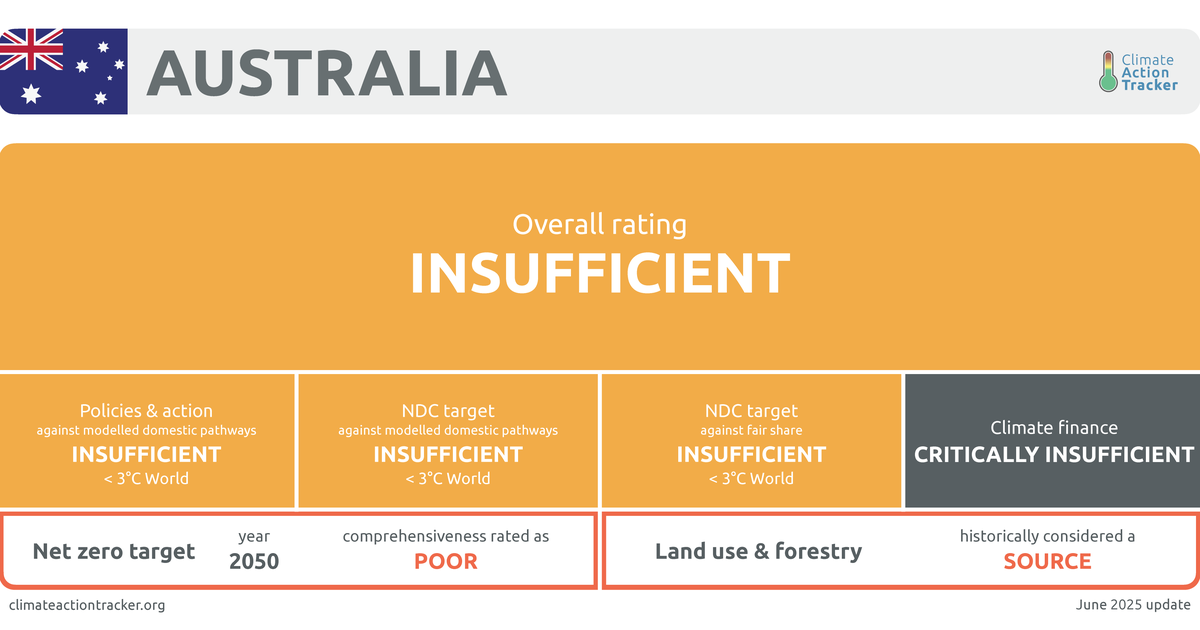
Target tidak memadai untuk tujuan iklim** Climate Action Tracker, organisasi ilmiah independen, menilai target tahun 2030 Australia sebagai "Tidak Memadai" (Insufficient) ketika dibandingkan dengan jalur emisi yang diperlukan untuk membatasi pemanasan hingga 1,5°C [6].
The target is insufficient for climate goals** The Climate Action Tracker, an independent scientific organization, rates Australia's 2030 target as "Insufficient" when compared to emissions pathways needed to limit warming to 1.5°C [6].
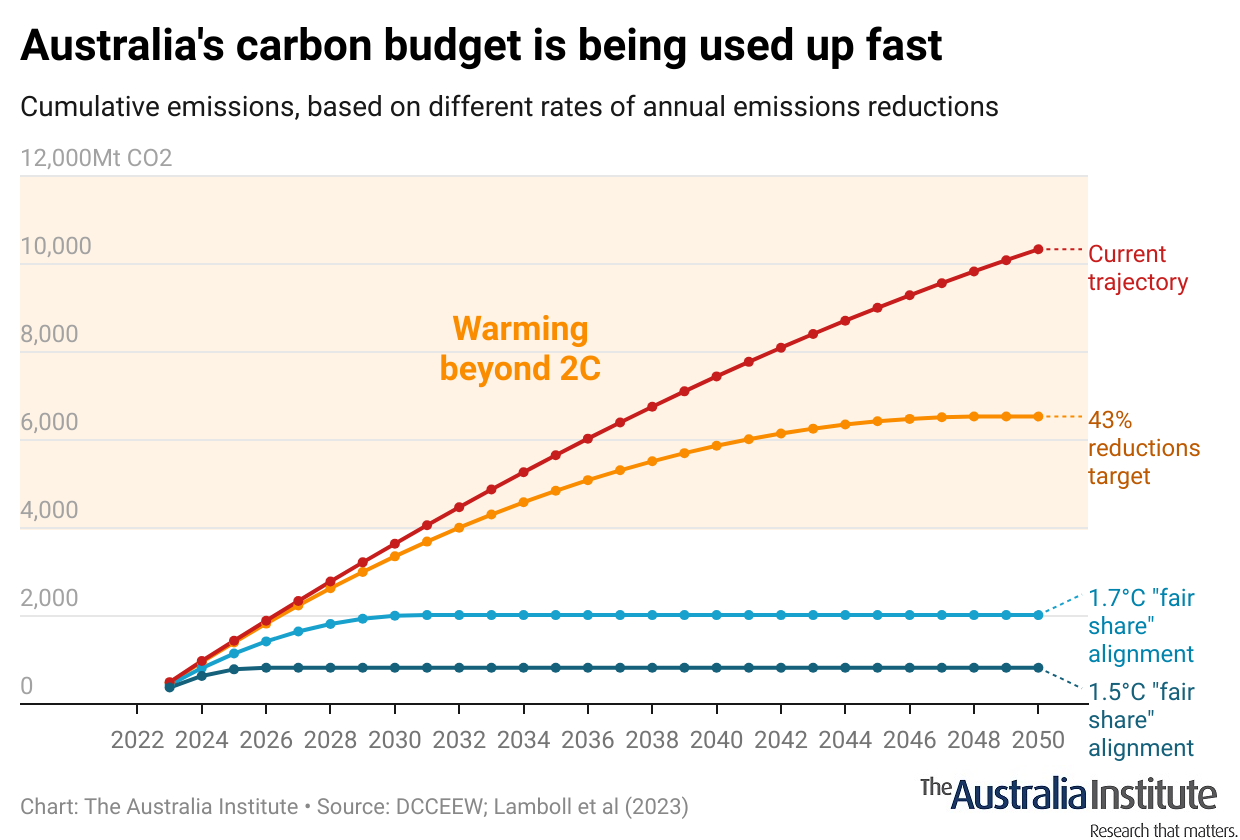
Beberapa analisis mengindikasikan target 43% tidak selaras dengan membatasi pemanasan hingga 1,5°C dan merupakan "triks sulap" yang melibatkan ketergantungan berat pada offset dan trik akuntansi daripada pengurangan emisi nyata [7]. **4.
Multiple analyses indicate the 43% target is not aligned with limiting warming to 1.5°C and represents a "sleight of hand" involving heavy reliance on offsets and accounting tricks rather than real emissions reductions [7]. **4.
Masalah sektoral besar tetap tidak terselesaikan** - **Transportasi**: Emisi transportasi pada tahun 2030 diproyeksikan akan mirip dengan level pra-pandemi, tanpa pengurangan bersih [8] - **Pertanian**: Emisi pertanian diproyeksikan akan meningkat saat populasi ternak pasca-kekeringan dipulihkan [8] - **Emisi industri**: Safeguard Mechanism (mencakup 31% emisi) tidak akan menghasilkan pemotongan emisi langsung hingga akhir dekade [8] **5.
Major sectoral problems remain unaddressed** - **Transport**: Transport emissions in 2030 are projected to be similar to pre-pandemic levels, with no net reduction [8] - **Agriculture**: Agricultural emissions are projected to increase as post-drought cattle herds are restocked [8] - **Industrial emissions**: The Safeguard Mechanism (covering 31% of emissions) won't result in direct emissions cuts until the end of the decade [8] **5.
Kekurangan target energi terbarukan** Meskipun pemerintah menargetkan 82% listrik terbarukan pada tahun 2030, International Energy Agency memproyeksikan hanya 58% yang akan dicapai berdasarkan kebijakan dan tingkat penerapan saat ini—sebuah kesenjangan signifikan [6].
Renewable energy target shortfall** While the government targets 82% renewable electricity by 2030, the International Energy Agency projects only 58% will be achieved based on current policies and deployment rates—a significant gap [6].

💭 PERSPEKTIF KRITIS

Ketika diperiksa dalam konteks, "pencapaian" mencetak target pengurangan emisi 43% mengungkapkan kebijakan iklim pemerintah lebih signifikan secara simbolis daripada substantif transformatif.
When examined in context, the "achievement" of legislating a 43% emissions reduction target reveals the government's climate policy as more symbolically significant than substantively transformative.
Pemerintah dapat mengklaim kredit untuk melewati legislasi karena berada dalam oposisi di bawah pemerintah Koalisi sebelumnya, yang telah menetapkan target 26-28%.
The government can claim credit for passing legislation because it was in opposition under the previous Coalition government, which had set the target at 26-28%.
Namun, jalur pengurangan aktual sangat bergantung pada: 1. **Tren fase-out batu bara yang sudah ada**—Sebagian besar dari 43% berasal dari penerapan terbarukan yang sudah ada dan penghentian alami pembangkit batu bara, bukan kebijakan baru [4] 2. **Mekanisme akuntansi**—Penggunaan kredit LULUCF yang murah hati memungkinkan pemerintah mengklaim pengurangan emisi yang tidak berarti pemotongan emisi aktual di sektor kunci [5] 3. **Implementasi kebijakan yang tidak memadai**—Analisis pemerintah sendiri menunjukkan sektor besar (transportasi, pertanian, industri) akan melihat emisi datar atau meningkat [8] Legislasi memang memberikan kepastian dan mengunci target, membuatnya lebih sulit bagi pemerintah masa depan untuk melemahkannya.
However, the actual reduction pathway relies heavily on: 1. **Pre-existing coal phase-out trends** - Much of the 43% comes from existing renewable deployment and natural coal plant retirements, not new policy [4] 2. **Accounting mechanisms** - The inclusion of generous LULUCF sink credits allows the government to claim emissions reductions that don't translate into actual emissions cuts in key sectors [5] 3. **Insufficient policy implementation** - The government's own analysis shows major sectors (transport, agriculture, industry) will see flat or increasing emissions [8] The legislation does provide certainty and lock in the target, making it harder for future governments to weaken it.
Namun, framing ini sebagai pencapaian besar mengaburkan fakta bahwa jalur Australia menuju net zero tetap sangat bergantung pada solusi teknologi (penangkapan karbon, hidrogen) yang belum terbukti dalam skala besar, dan target itu sendiri mewakili respons yang tidak memadai terhadap sains iklim [6].
However, the framing of this as a major achievement obscures the fact that Australia's actual path to net zero remains heavily dependent on technological solutions (carbon capture, hydrogen) that are unproven at scale, and the target itself represents an inadequate response to climate science [6].
Sebuah perbandingan dengan rekan-rekan OECD mencerahkan: Sementara Australia mencetak legislasi 43% pada tahun 2030, Uni Eropa berkomitmen pada 55% pada tahun 2030, Inggris pada 68% pada tahun 2030, dan AS pada 50% pada tahun 2030 (dalam komitmen Perjanjian Parisnya).
A comparison to OECD peers is instructive: While Australia legislated 43% by 2030, the EU committed to 55% by 2030, the UK to 68% by 2030, and the US to 50% by 2030 (in its Paris Agreement commitment).
Target Australia, meskipun lebih tinggi dari target pemerintah Koalisi sebelumnya, tetap berada di antara yang lebih lemah dari ekonomi maju [9].
Australia's target, while higher than the previous Coalition government's target, remains among the weaker of developed economies [9].

SEBAGIAN BENAR

6.0

/ 10

Klaim faktal bahwa pemerintah mencetak legislasi target pengurangan emisi 43% pada tahun 2030 dan net zero pada tahun 2050 pada September 2022 akurat.
The factual claim that the government legislated a 43% emissions reduction target by 2030 and net zero by 2050 in September 2022 is accurate.
Namun, konteks yang diabaikan—bahwa target bergantung pada trik akuntansi, sektor besar masih meningkatkan emisi, target sudah tercapai tanpa intervensi kebijakan, dan target tidak memadai secara ilmiah untuk tujuan iklim—berarti ini mewakili pencapaian yang jauh lebih sederhana daripada yang disiratkan klaim.
However, the omitted context—that the target relies on accounting tricks, major sectors are still increasing emissions, the target is already being achieved without policy intervention, and the target is scientifically insufficient for climate goals—means this represents a much more modest achievement than the claim suggests.
Legislasi memberikan kepastian hukum tetapi bukan aksi iklim yang transformatif.
The legislation provides legal certainty but not transformative climate action.

📚 SUMBER DAN KUTIPAN (9)

  1. 1
    dcceew.gov.au

    Climate Change Bill 2022 - DCCEEW

    Dcceew Gov

  2. 2
    pm.gov.au

    Australia Legislates Emissions Reduction Targets - Prime Minister of Australia

    The Albanese Government’s landmark Climate Change Bills have now passed the Senate, ensuring Australia's emissions reduction target of 43 per cent and net zero emissions by 2050 will be enshrined in legislation. For almost a decade, Australia stumbled from one policy to another, and our economy and communities missed out on billions of dollars in public and private clean energy investment. But today that changes.

    Prime Minister of Australia
  3. 3
    Climate Change Bill 2022 – Parliament of Australia

    Climate Change Bill 2022 – Parliament of Australia

    Helpful information Text of bill First reading: Text of the bill as introduced into the Parliament Third reading: Prepared if the bill is amended by the house in which it was introduced. This version of the bill is then considered by the second house. As passed by

    Aph Gov
  4. 4
    PDF

    Australia's 2030 Emissions Reduction Target - DCCEEW

    Dcceew Gov • PDF Document
  5. 5
    Sleight of hand: Australia's Net Zero target is being lost in accounting tricks, offsets and more gas - Climate Analytics

    Sleight of hand: Australia's Net Zero target is being lost in accounting tricks, offsets and more gas - Climate Analytics

    Australia is unlikely to achieve its net zero target. This is because of its support for fossil gas to 2050 and beyond, it’s long-term emissions reduction plan resorts to unrealistic technological fixes and emissions offsets and because its legislated target of a 43% emissions cut by 2030 is not…

    Climate Analytics
  6. 6
    Australia - Climate Action Tracker

    Australia - Climate Action Tracker

    Climateactiontracker
  7. 7
    Climate Change Bill 2022 - Australian Conservation Foundation

    Climate Change Bill 2022 - Australian Conservation Foundation

    The Albanese Government’s Climate Change Bill has passed the House of Representatives and been sent to the Senate. Its target to slash climate pollution…

    Australian Conservation Foundation
  8. 8
    New research shows our 2030 emission targets are woefully out of date - The Australia Institute

    New research shows our 2030 emission targets are woefully out of date - The Australia Institute

    The evidence is clear - our current policies and targets are insufficient to prevent dangerous global warming, and not aligned with latest scientific research.

    The Australia Institute
  9. 9
    kwm.com

    From ambition to action: understanding Australia's 2050 net zero plan - KWM

    Kwm

Metodologi Skala Penilaian

1-3: SALAH

Secara faktual salah atau fabrikasi jahat.

4-6: SEBAGIAN

Ada kebenaran tetapi konteks hilang atau menyimpang.

7-9: SEBAGIAN BESAR BENAR

Masalah teknis kecil atau masalah redaksi.

10: AKURAT

Terverifikasi sempurna dan adil secara kontekstual.

Metodologi: Penilaian ditentukan melalui referensi silang catatan pemerintah resmi, organisasi pemeriksa fakta independen, dan dokumen sumber primer.