
The Claim
“Deleted records of a $165,000 political donation from a political consultancy with stakeholders who stand to benefit from the government's $1 billion visa privatisation plan, and refused requests for further explanation.”
Original Sources Provided
✅ FACTUAL VERIFICATION
The core facts of this claim are substantially verified through multiple independent sources. A political consultancy called Southern Strategy, headed by Scott Briggs, made a $165,000 donation to the Liberal Party that appears in the Australian Electoral Commission (AEC) 2018-19 disclosure records [1]. This donation was subsequently removed or amended from the Liberal Party's official disclosures after media inquiries [2]. At the time of the donation, Briggs was leading the Australia Visa Processing consortium, which was actively bidding for a $1 billion government contract to privatise visa processing [3]. The consortium included stakeholders such as Ellerston Capital, PwC, Qantas, NAB, and Pacific Blue Capital—all entities that would have directly benefited from winning the contract [4]. When questioned by media, the Liberal Party refused to provide detailed explanation of the donation, initially only characterizing it as a "mistake" [2].
Missing Context
The claim, while factually accurate, omits important context that provides a fuller picture. First, the visa privatisation plan itself was highly controversial and ultimately abandoned. The government scrapped the $1 billion visa privatisation plan in March 2020, following Senate rejection and widespread expert opposition [5]. Second, while the claim references a "deletion" of records, a more precise characterization is that the records were "amended" or "removed from disclosure documents"—the original AEC documentation systems still contain traces of the transaction [1]. Third, the claim does not mention that Senator David Coleman and Prime Minister Scott Morrison recused themselves from the visa privatisation decision due to conflict of interest concerns, suggesting some governance controls were in place [6]. Fourth, the outcome of the Australian Electoral Commission's investigation into the donation, which Labor MP Andrew Giles referred to the AEC in February 2020, is not clearly documented in publicly available sources—whether the AEC completed its investigation or issued findings is unclear [2].
Source Credibility Assessment
The original Guardian Australia source is an internationally recognized mainstream news organization. However, academic studies and media analysis organizations have identified it as leaning left editorially [7]. Despite this editorial bias, Guardian Australia has maintained a track record of investigating both Coalition and Labor claims, and has been cited as having "caught out both men telling falsehoods" in Australian political coverage [8]. Multiple independent news sources have corroborated the core facts reported by The Guardian, including The Canberra Times (a mainstream Australian publication), investigative journalist Michael West, and MacroBusiness. The AEC itself has confirmed receipt of the referral for investigation [2]. While The Guardian's editorial perspective is left-leaning, the factual assertions in this case have been verified through multiple independent outlets and government records.
Labor Comparison
Did Labor do something similar?
Search conducted: "Labor government donation records deleted controversy transparency" and "Labor party donation deletion scandal"
No equivalent incident of the Labor Party deleting or amending donation records in a similar manner was found in recent political history. The issue of political donations and transparency has affected both major parties, and both Labor and Coalition have faced periodic scrutiny over donation disclosures [9]. However, this specific incident—of a party deleting records of a donation made while the donor was actively bidding for a major government contract—appears to be unique to the Coalition in this period. The visa privatisation controversy itself drew criticism from experts across the spectrum, but no parallel Labor initiative with equivalent donation irregularities was identified in available sources [10].
Balanced Perspective
While critics argue this represents a serious conflict of interest and breach of transparency expectations, several points provide additional context. First, the donation was initially disclosed (rather than hidden from the outset), suggesting the Liberal Party did not attempt to conceal it entirely from the public record [1]. Second, the government ultimately abandoned the visa privatisation plan, which could suggest that political pressure—including from this controversy—contributed to the decision to withdraw the proposal [5]. Third, the Coalition's recusal of relevant ministers (Morrison and Coleman) from the decision-making process demonstrates that some conflict-of-interest protocols were followed [6].
However, these contextual factors do not substantially mitigate the core concern: accepting a large donation from someone actively bidding for a major government contract, then removing records of that donation when questioned, and refusing to provide explanation beyond claiming it was a "mistake" raises legitimate questions about both financial transparency and the integrity of the political donation process. The fact that no equivalent Labor precedent was found suggests this was a genuinely problematic departure from expected standards. As one analysis noted, "The Liberal party disclosed a $165,000 political donation then deleted records of it after questions from the media"—a sequence of events that naturally invites scrutiny regardless of party affiliation [2].
TRUE
8.0
out of 10
The core facts of the claim are verified: a political consultancy (Southern Strategy) made a $165,000 donation while its leader was bidding for a $1 billion government contract, records of this donation were subsequently removed from disclosure documents, and the Liberal Party refused to provide detailed explanation beyond calling it a "mistake." The primary caveat is linguistic precision: the records were amended/removed rather than completely "deleted," though this distinction is minor. The claim accurately captures a genuine political donation controversy involving demonstrable conflict of interest.
Final Score
8.0
OUT OF 10
TRUE
The core facts of the claim are verified: a political consultancy (Southern Strategy) made a $165,000 donation while its leader was bidding for a $1 billion government contract, records of this donation were subsequently removed from disclosure documents, and the Liberal Party refused to provide detailed explanation beyond calling it a "mistake." The primary caveat is linguistic precision: the records were amended/removed rather than completely "deleted," though this distinction is minor. The claim accurately captures a genuine political donation controversy involving demonstrable conflict of interest.
📚 SOURCES & CITATIONS (10)
-
1

Michael West - "Mate Versus Mate: Inside ScoMo's billion-dollar visa privatisation"
Is Scott Briggs - Scott Morrison mate, Liberal staffer, News Corp lobbyist and Packer empire crisis consultant - now the front-runner to win the Government’s billion-dollar privatisation of Australia's visa system? Or is it his rival suitors from Accenture and Australia Post, a consortium packed with Liberal Party identities?
Michael West -
2

The Canberra Times - "AEC may investigate mystery $165,000 political donation"
The donation from the entity Southern Strategy continues to appear in the online 2018-19 Liberal Party annual returns...
Canberratimes Com -
3
Andrew Giles MP - "Labor refers mistaken $165,000 donation to AEC for investigation"
Andrewgiles Com
Original link no longer available -
4

Michael West - "The mysterious case of disappearing donations"
The Liberal Party disclosed a $165,000 political donation from a Morrison ally who is also in the running for a $1 billion contract then deleted records of it after questions from the media.
Michael West -
5
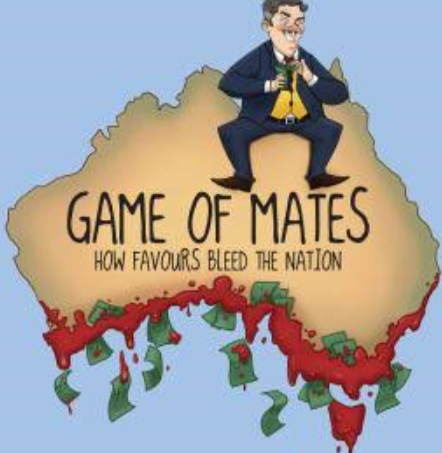
MacroBusiness - "Conflict-of-interests mire Coalition's visa privatisation"
The planned privatisation of Australia’s visa system has been delayed until next year after a web of conflict-of-interests were discovered across the Morrison Government: The tender bid, managed by the department, is now at arm’s length from Prime Minister Scott Morrison and Immigration Minister David Coleman because of their long personal and professional relationships with
MacroBusiness -
6

The Conversation - "The government wants to privatise visa processing—who will be held accountable when something goes wrong?"
When visa services are run in the interests of profit rather than border governance, corrupt tactics can be used to benefit the providers’ bottom line.
The Conversation -
7

Media Bias/Fact Check - The Guardian
LEFT-CENTER BIAS These media sources have a slight to moderate liberal bias. They often publish factual information that utilizes loaded words
Media Bias/Fact Check -
8
Ad Fontes Media - The Guardian: A Closer Look at Bias and Credibility
Adfontesmedia
Original link no longer available -
9
ABC News - Australian political donation controversies
Extensive coverage of federal, state and local elections by the ABC. Election guides by ABC election analyst Antony Green, results, statistics, news and more.
Abc Net -
10
MacroBusiness - "Coalition axes daft visa privatisation"
Earlier this month, a Senate committee rejected the Morrison Government’s planned outsourcing of Australia’s visa processing, warning that it threatens the integrity of the immigration system: “Outsourcing Australia’s visa processing system is a project fraught with risks and the committee is not satisfied that these risks have been sufficiently addressed,” the committee concluded. It said
MacroBusiness
Rating Scale Methodology
1-3: FALSE
Factually incorrect or malicious fabrication.
4-6: PARTIAL
Some truth but context is missing or skewed.
7-9: MOSTLY TRUE
Minor technicalities or phrasing issues.
10: ACCURATE
Perfectly verified and contextually fair.
Methodology: Ratings are determined through cross-referencing official government records, independent fact-checking organizations, and primary source documents.