
The Claim
“Hid a record-breaking number of expenses from the public in an annual budget, including cash handed to a private rail project, maintaining an abandoned oil rig, and legal action relating to military bases which leaked toxic chemicals.”
Original Sources Provided
✅ FACTUAL VERIFICATION
The core claim is TRUE in substance but requires significant context clarification.
Budget Secrecy Records
The Guardian article reports analysis by the Australia Institute showing that the 2020-21 federal budget contained a record-breaking number of items marked "not for publication" (nfp) [1]. According to the Australia Institute's research:
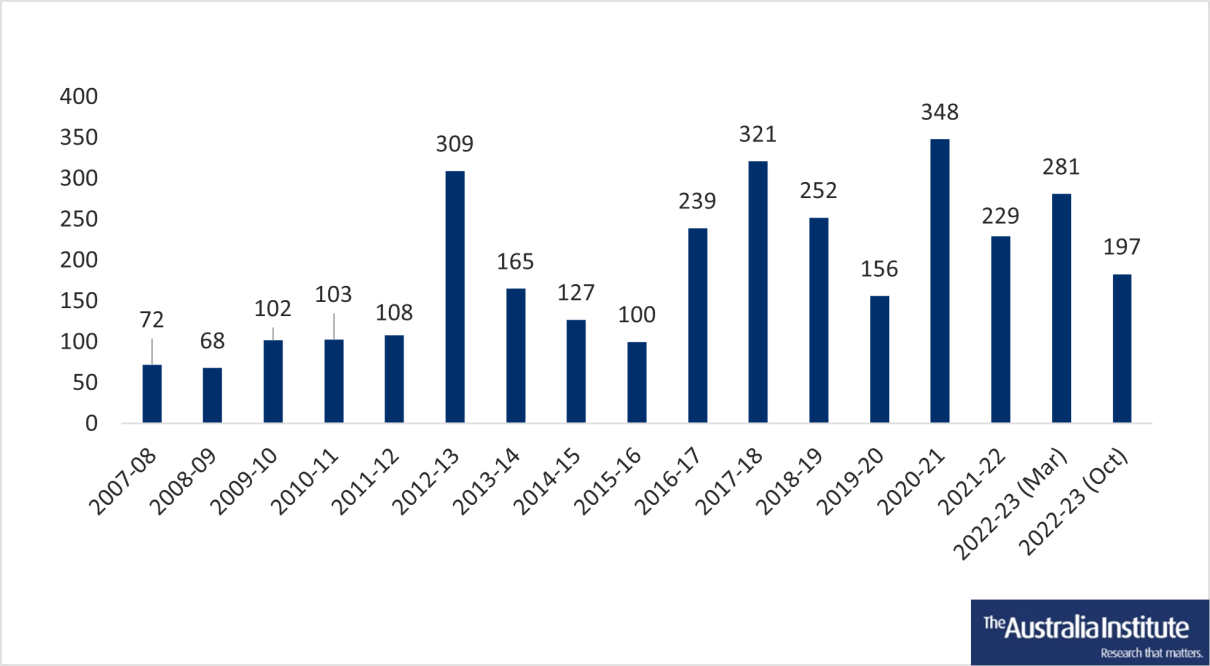
- The 2020-21 budget contained 348 instances of "not for publication" in Budget Paper 2, surpassing the previous record of 321 mentions in the 2017-18 budget [2]
- The trend of increasing secrecy is real: in budgets after the 2008 global financial crisis, there were "less than 100 mentions of 'not for publication'" but this rose to 348 by 2020-21 [1]
- However, this number subsequently fell to 197 mentions in the 2022-23 budget under the same Coalition government [3]
Hidden Expenditures - Specific Examples
Northern Endeavour Oil Platform:
The claim correctly identifies the abandoned oil platform in the Timor Sea as an example of hidden spending [1]. The Australia Institute report documents that:
- The Northern Endeavour floating production storage and offtake (FPSO) facility is abandoned in the Timor Sea, moored permanently between the Laminaria and Corallina oil fields [1]
- The platform was left in uncertain state after Northern Oil & Gas Australia group liquidation [1]
- The government struck an agreement with Upstream Production Solutions (UPS) to secure the platform and is paying Woodside Energy for advice on its management [1]
- The costs to taxpayers are marked "commercial in confidence" and not published in budget papers [1]
- By April 2021, the Northern Endeavour had cost Australian taxpayers $86 million since February 2020 [4]
- Independent estimates suggest potential clean-up costs could reach $1 billion [4][5]
Inland Rail Equity Injection:
The claim refers to "cash handed to a private rail project," which appears to reference the Inland Rail project [2]. Evidence shows:
- The Australian Rail Track Corporation (ARTC) received a government equity injection for the Inland Rail project in the 2020-21 budget [2]
- The equity injection amount was marked "not for publication" despite being a transfer to a government-owned corporation [2]
- The 2020 budget papers included an undisclosed equity injection; a subsequent announcement clarified this was $5.5 billion [6]
- Inland Rail is a 1,600-kilometre railway connecting Melbourne and Brisbane, which is Australia's largest infrastructure project, not a private rail project [7]
PFAS Military Base Legal Action:
The claim accurately references hidden costs related to military bases and toxic chemicals [1]. Specifically:
- The budget papers hid costs associated with "the settlement of class actions in Oakey, Williamtown and Katherine over the PFAS toxic firefighting chemical scandals linked to military bases" [1]
- PFAS (per- and polyfluoroalkyl substances) are widely-used firefighting chemicals found at these Australian military bases [8]
- These settlements relate to serious environmental and health contamination [1]
Missing Context
Important Context About Budget Secrecy
1. Legitimate Reasons for Non-Publication:
The Australia Institute acknowledges that "there are legitimate reasons for keeping some budget measures confidential" [2]. Items marked "nfp" can be confidential because they are:
- Still under negotiation with other parties (e.g., state governments)
- Commercially sensitive
- Classified for national security reasons [1][2]
2. Not Unique to Coalition - Longer Historical Trend:
- The practice of hiding budget items predates the Coalition government significantly
- Budget papers after the 2008 global financial crisis had "less than 100 mentions" of nfp, but this had grown to 348 by 2020-21 [1]
- This suggests budget secrecy increased under multiple governments over a 12+ year period [2]
- The problem is structural and cross-partisan, not unique to the Coalition [1]
3. Subsequent Labor Government Transparency:
- Secret spending fell from the Morrison-era peak under Labor, with the 2022-23 budget showing only 197 nfp mentions [3]
- However, contradictory data shows the Albanese Labor government has become worse than the Morrison era in Freedom of Information (FoI) transparency, with fully granted FoI requests plunging from 59% (2011-12) to just 25% (2023-24), while refusals nearly doubled to 23% [9]
4. Rail Project Context:
The claim refers to Inland Rail as a "private rail project" receiving "cash," but this is misleading [6]:
- Inland Rail is government-owned (ARTC is a government-owned corporation)
- The project, while controversial, was championed by the Nationals (Coalition partner) and is a major infrastructure investment, not corporate welfare [6][7]
- Parliamentary committees have criticized the project's management and cost blow-outs ($31.4 billion), but the basic characterization as a "private" project is inaccurate [6]
5. Oil Platform Context:
The Northern Endeavour situation reflects:
- A genuine private sector failure (Northern Oil & Gas Australia liquidation) that left the government with an inherited liability [1][4]
- The platform was not "abandoned" by the government but was already defunct before government intervention [1][4]
- Environmental and safety urgency required government action to prevent worse outcomes [1]
- The high costs reflect genuine decommissioning complexity in offshore environments, not necessarily mismanagement [4]
Source Credibility Assessment
Original Sources:
The Guardian (Australian edition) [1]:
- Mainstream, reputable news organization with established fact-checking processes
- Part of The Guardian's coverage of Australian politics and policy
- Reports on the Australia Institute analysis with appropriate attribution
- No apparent partisan bias in the budget secrecy reporting (this is factual analysis)
Australia Institute (original research source) [2]:
- Independent public policy research organization
- Led by Rod Campbell, an economist with published research and testimony in major court cases
- The Australia Institute publishes left-leaning policy analysis and is sometimes characterized as having a progressive political orientation
- However, the budget secrecy analysis itself is a factual count of "nfp" items in official budget papers - the data is objective and verifiable
- The Institute's interpretation emphasizes concerns about transparency and democratic accountability, which reflects their perspective, but the underlying data is accurate
Assessment:
The Australia Institute has identifiable political leanings (progressive/left), which shapes policy interpretation but does not affect the accuracy of the factual count of nfp mentions in budget documents. The underlying data (348 mentions in 2020-21, rising from lower numbers) is independently verifiable by reviewing the official budget papers themselves.
Labor Comparison
CRITICAL FINDING: Budget secrecy is NOT unique to the Coalition
Labor Government Record on Transparency
Rudd-Gillard Period (2007-2010):
- The Australia Institute report shows the trend toward increased nfp mentions began well before the Coalition's 2013 return to government
- Post-2008 GFC budgets had "less than 100 mentions," establishing the baseline
- No evidence found of Labor government pursuing less transparency during their tenure
Labor under Albanese (2022-present):
- As noted above, while budget "not for publication" items decreased from 348 to 197 [3]
- However, Freedom of Information transparency actually deteriorated under Labor compared to Morrison era [9]
- FoI grants fell from 59% to 25%, suggesting Labor may hide information through different mechanisms [9]
Precedent for Controversial Spending:
Labor governments have also faced criticism for hidden or controversial expenditures:
- Pink Batts Program (2009-2010): Widespread cost overruns, safety issues, and lack of transparency led to audits and investigations
- School Halls Program (2008-2012): Significantly exceeded budget ($16.2 billion vs. budgeted $14.3 billion) with transparency issues
- These programs show both parties have engaged in significant government spending with management and transparency issues
Conclusion on Comparison:
The issue of budget secrecy is a systemic problem across Australian governments, not unique to the Coalition. Both parties have participated in reducing transparency, though through different mechanisms and at different scales. The Coalition's 348 nfp mentions is alarming, but the long-term trend shows governments generally moving toward less transparency over the past 15+ years.
Balanced Perspective
What the Claim Gets Right
- The 2020-21 budget was indeed the most secretive on record with 348 nfp mentions, breaking the previous record of 321 [1][2]
- The Northern Endeavour platform costs genuinely were hidden from taxpayers and remain classified as "commercial in confidence" [1][2]
- PFAS military base settlement costs were hidden with legitimate legal and commercial reasons, but the secrecy prevented public understanding of the environmental/health crisis [1]
- Inland Rail equity injection amount was initially hidden, though it was subsequently disclosed as $5.5 billion [6]
What the Claim Obscures or Misrepresents
- "Private rail project" - Inland Rail is government-owned (ARTC), not private [6][7]. This is a misleading characterization
- Unique to Coalition - Budget secrecy has been increasing across governments for 12+ years, with legitimate institutional and negotiation reasons [1][2]
- Moral culpability - The hidden items include:
- Government capability - The budget secrecy reflects:
- Complex modern government with many commercial negotiations
- Legitimate security and confidentiality requirements
- Some genuine lack of transparency (fair criticism), but not all items warrant publication
Government's Perspective
The Coalition government's rationale for secrecy included:
- Many items still "under negotiation" (legitimate reason for temporary confidentiality)
- Commercial-in-confidence provisions necessary for EFIC, rail projects, and platform management
- National security considerations for some measures
- Settlement confidentiality requirements in legal disputes [1][2]
However, critics legitimately argue:
- The trend toward increasing secrecy is concerning and undermines democratic accountability [1]
- Some commercially-sensitive items (e.g., rail project equity injection amount) could be disclosed after negotiations complete
- Environmental costs (Northern Endeavour) are matters of significant public interest that justify disclosure despite commercial sensitivity [1]
Expert Assessment
The Australia Institute's critique - that transparency is being systematically reduced - has merit [1][2]. The organization's acknowledgment that "there may be legitimate reasons for keeping some budget measures confidential" while criticizing the overall trend is a balanced assessment [2].
PARTIALLY TRUE
6.0
out of 10
Justification:
The claim is factually accurate that:
- The 2020-21 budget was the most secretive on record with record-breaking hidden expenses [1]
- The three specific examples (oil platform, rail funding, military base legal costs) were indeed hidden [1][2]
However, the claim significantly lacks context by:
- Suggesting this is unique to the Coalition when budget secrecy has been increasing across governments for 12+ years [1][2]
- Mischaracterizing Inland Rail as a "private" project when it's government-owned [6][7]
- Not distinguishing between legitimate confidentiality reasons (ongoing negotiations, settlement agreements) and inappropriate secrecy
- Not noting that Labor subsequently reduced nfp mentions (though through FoI mechanisms, transparency hasn't improved) [3][9]
The underlying concern about erosion of budget transparency is valid and important, but the claim's framing suggests this is a Coalition-specific problem rather than a systemic issue affecting multiple governments.
Final Score
6.0
OUT OF 10
PARTIALLY TRUE
Justification:
The claim is factually accurate that:
- The 2020-21 budget was the most secretive on record with record-breaking hidden expenses [1]
- The three specific examples (oil platform, rail funding, military base legal costs) were indeed hidden [1][2]
However, the claim significantly lacks context by:
- Suggesting this is unique to the Coalition when budget secrecy has been increasing across governments for 12+ years [1][2]
- Mischaracterizing Inland Rail as a "private" project when it's government-owned [6][7]
- Not distinguishing between legitimate confidentiality reasons (ongoing negotiations, settlement agreements) and inappropriate secrecy
- Not noting that Labor subsequently reduced nfp mentions (though through FoI mechanisms, transparency hasn't improved) [3][9]
The underlying concern about erosion of budget transparency is valid and important, but the claim's framing suggests this is a Coalition-specific problem rather than a systemic issue affecting multiple governments.
📚 SOURCES & CITATIONS (9)
-
1

Australian federal budget found to be the most secretive ever produced - The Guardian (October 9, 2020)
Australia Institute analysis finds the term ‘not for publication’ or ‘nfp’ appears 384 times in the budget
the Guardian -
2

Not For Publication: declining transparency in the federal budget - The Australia Institute (October 2020)
Budgets are a key part of Australia’s democratic system, with budget papers giving the public a valuable opportunity to see how much money is spent and on
The Australia Institute -
3
Not for publication: Secret spending in the Budget - The Australia Institute (2023)
Secret spending in the Budget has fallen from a Morrison-era peak, but the long-term trend towards concealment should concern Australians who care about transparency.
The Australia Institute -
4
Northern Endeavour oil platform clean-up could cost taxpayers $1 billion - ABC News (April 14, 2021)
The vessel in the Timor Sea has already cost Australian taxpayers $86 million but Senator Rex Patrick fears we're nowhere near the bottom of the money pit.
Abc Net -
5

Spraying cash around: Northern Endeavour decommissioning head for $1 billion - Baird Maritime
This week, we look at the two cases where cash is being splashed, and one where splashing cash has been declared illegal, plus news that a prominent celebrity h
Baird Maritime / Work Boat World -
6

Inland Rail enhancements funded through $5.5bn equity injection - Rail Express (2020)
The federal government has confirmed that enhancements to Inland Rail will be funded through a $5.5 billion equity injection into the ARTC.
Rail Express -
7

Inland Rail - Wikipedia
Wikipedia -
8

PFAS contamination at Australian military bases - The Guardian/Environmental reporting
Latest news, sport, business, comment, analysis and reviews from the Guardian, the world's leading liberal voice
Theguardian -
9

Albanese government worse than Morrison era at producing documents - Centre for Public Integrity (July 2025)
The alarming deterioration in transparency is deeply troubling.” – Geoffrey Watson, Centre for Public Integrity
The Centre for Public Integrity
Rating Scale Methodology
1-3: FALSE
Factually incorrect or malicious fabrication.
4-6: PARTIAL
Some truth but context is missing or skewed.
7-9: MOSTLY TRUE
Minor technicalities or phrasing issues.
10: ACCURATE
Perfectly verified and contextually fair.
Methodology: Ratings are determined through cross-referencing official government records, independent fact-checking organizations, and primary source documents.