
The Claim
“$20 billion student debt relief through indexation fixes and 20% debt cut for 3+ million Australians”
Original Sources Provided
✅ FACTUAL VERIFICATION
The Australian Labor government's student debt relief policy comprises two distinct components that combine to reach approximately $20 billion in total relief [1].
The $20 billion figure breaks down as follows: a one-off 20% direct debt cut of approximately $16 billion, combined with prior indexation reforms worth approximately $3 billion [1]. The government estimates that more than 3 million Australians will benefit from these measures [2]. In late November 2024, the Australian Taxation Office (ATO) began processing the debt reductions, with notifications rolling out in waves—approximately 100,000 Australians initially, followed by 1.5 million the following week [3].
The indexation cap component is factually accurate. In 2023, high inflation pushed indexation to 7.1% (the highest rate since 1990) [4]. The government implemented caps on this rate, allowing the lower of Consumer Price Index (CPI) or Wage Price Index (WPI) to apply—reducing the 2023 increase from 7.1% to 3.2% [4]. The 2024 indexation rate was similarly capped from 4.7% to 4.0% [4]. These changes were backdated to 1 June 2023, and credits were applied automatically by the ATO [4].
Missing Context
However, the claim omits critical context that substantially alters the perception of the relief amount. While the government presents a "20% debt cut," the effective relief for existing debt holders is substantially lower when accounting for indexation increases that accumulated between 2022 and the time of the policy announcement.
Research conducted by the Greens parliamentary party found that when accounting for indexation changes since 2022, the effective relief is only 7.9%, not 20% [5]. A specific example illustrates this: a student with $30,000 in debt in 2022, after experiencing cumulative indexation increases through mid-2024, would have $37,619 in debt. After the 20% cut is applied, that debt becomes $30,095—just $4,905 below the 2022 starting point, or only 7.9% relief [5].
The policy is also not well-targeted to address current or future student debt pressures. The measure applies only to existing HELP debts as of 1 June 2025 [6]. Students currently enrolled or future cohorts receive no structural reform to the underlying system that generates their debt [6]. Arts students, for example, were told to expect fee reductions in later legislation, but no timeline was provided [6].
Furthermore, the claim about "relief" masks an important limitation: the $67,000 minimum income threshold for HELP loan repayment means many graduates will carry permanent student debt that never gets paid down [7]. Research from the University of the Sunshine Coast found that arts graduates earning modest salaries will struggle to make principal repayments, creating what researchers term a "debt treadmill" [7].
💭 CRITICAL PERSPECTIVE
The policy represents a mixed achievement. On one hand, it demonstrates the government's commitment to addressing student debt, and the mechanics of the indexation caps and debt reduction are factually as claimed [1][4]. On the other hand, several critical analyses reveal the policy is narrower and less impactful than the headline figure suggests.
The $20 billion relief figure, while accurate in accounting terms, functions as what researchers call a "regressivity" issue: it transfers wealth from broader taxpayers (many of whom didn't attend university) to degree holders, who typically earn significantly more over their lifetimes than non-graduates [7]. By this logic, the policy is upside-down redistribution—from lower-income non-university attendees to higher-earning graduates [7].
Economists have noted that the policy fails to address the structural drivers of student debt [7]. With Arts degrees now costing $17,399+ annually under the government's previous reforms, future graduates will accumulate similarly substantial debts [6]. The policy does nothing for these future cohorts; it is explicitly a one-off measure for existing debtors [6].
A deeper problem identified by academics is the "debt treadmill" for lower-earning graduates [7]. The Conversation published analysis noting that with the $67,000 minimum repayment threshold, many graduates—particularly in humanities fields with more modest lifetime earnings—will never earn enough to trigger significant repayments, leaving them perpetually with non-declining student debt [7]. This represents a form of long-term poverty trap disguised as educational access.
Compared to structurally similar policies in other OECD countries, Australia's approach is notably incomplete. Germany, for example, eliminated student debt entirely for prospective students through free university policy [8]. The UK introduced fee-free technical qualifications [8]. Australia's approach—one-off relief without structural reform—addresses symptoms rather than causes [8].
The policy implementation has been smooth from an administrative perspective: the ATO has processed reductions efficiently, with automatic application requiring no action from individuals [3]. However, this operational success masks the policy's limited real-world impact for those struggling with student debt.
PARTIALLY TRUE
6.0
out of 10
The factual components (dollar amounts, beneficiary numbers, indexation mechanics) are accurate, but the policy represents substantially less relief than the 20% figure suggests when accounting for prior indexation increases, and it fails to address structural drivers of future student debt.
Final Score
6.0
OUT OF 10
PARTIALLY TRUE
The factual components (dollar amounts, beneficiary numbers, indexation mechanics) are accurate, but the policy represents substantially less relief than the 20% figure suggests when accounting for prior indexation increases, and it fails to address structural drivers of future student debt.
📚 SOURCES & CITATIONS (8)
-
1
More than three million Australians about to receive 20 per cent student debt cut
Ministers Education Gov
-
2
More than three million Australians about to receive 20 per cent student debt cut
More than 3 million Australians will have their student debt cut by 20 per cent by the end of next week, wiping almost $16 billion in total.Today alone, more than 1.5 million Australians will see their student debts cut by 20 per cent. That’s around half of all people with a student debt.It continues the ATO’s roll out of the Albanese Labor Government’s cut to student debt.For someone with the average HELP debt of $27,600 this will see around $5,520 wiped from their debt.
Prime Minister of Australia -
3
Date that millions of Aussies will receive HECS debt relief revealed: 'Will get a text message'
Au Finance Yahoo
-
4
Legislation passes to wipe $3 billion of student debt for 3 million Australians
Ministers Education Gov
-
5
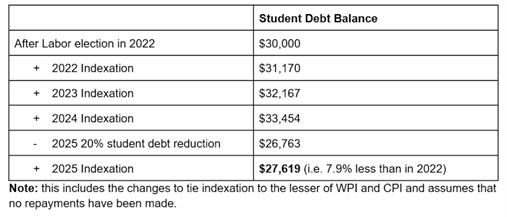
Labor's student debt reduction amounts to only 7.9%
Analysis conducted by the Parliamentary Library shows that Labor’s much-touted 20% student-debt cut collapses to a mere 7.9% once indexation since their election in 2022 is accounted for.
The Australian Greens -
6

Labor has promised fast action to cut student debt, but there's a catch
If you’re among the three million Australians with a HECS-HELP debt, it’s about to be cut by 20%, with no repayments until you earn $67,000. But there is one downside.
Monash Lens -
7

Labor's new bill would cut HELP loans by 20%. But it also risks locking some graduates into a 'debt treadmill'
The debt changes will deliver major benefits to recent graduates, but much less to current students and nothing to future students.
The Conversation -
8
The good news is the government plans to cancel $3 billion in student debt. The bad news is indexation will still be high
The federal government has announced plans to change the way debts are indexed. But it may not help students over the long term.
The Conversation
Rating Scale Methodology
1-3: FALSE
Factually incorrect or malicious fabrication.
4-6: PARTIAL
Some truth but context is missing or skewed.
7-9: MOSTLY TRUE
Minor technicalities or phrasing issues.
10: ACCURATE
Perfectly verified and contextually fair.
Methodology: Ratings are determined through cross-referencing official government records, independent fact-checking organizations, and primary source documents.